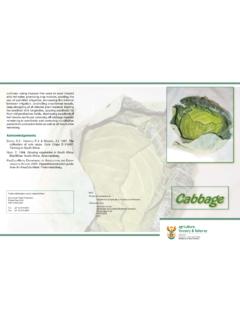
Transcription of CCabbageabbage - daff.gov.za
1 Cultivars, using disease-free seed or seed treated with hot water, practising crop rotation, avoiding the use of sprinkler irrigation, increasing the interval between irrigation, controlling cruciferous weeds, deep-ploughing of all infected plant material, treating the seedbed with fungicides, spacing seedbeds far from old production fields, destroying seedbeds if leaf lesions are found, removing all cabbage material remaining in seedbeds and removing cruciferous weeds from production fields as well as all debris after harvesting. Acknowledgements BOSCH, , HENRICO, & WAGNER, 1987. The cultivation of cole crops. Cole Crops Farming in South Africa. HEMY, C. 1984. Growing vegetables in South Africa.
2 MacMillan: South Africa, Johannesburg. KWAZULU-NATAL DEPARTMENT OF AGRICULTURE AND ENVIR- ONMENTAL AFFAIRS. 2001. Vegetable production guide- lines for KwaZulu-Natal. Pietermaritzburg. Cabbage Further information can be obtained from: 2010. Printed and published by: Directorate Plant Production Private Bag X250 Department of Agriculture, Forestry and Fisheries PRETORIA 0001 Obtainable from: Resource Centre Tel: +27 12 319 6072 Directorate Agricultural Information Services Fax: +27 12 319 6353 Private Bag X144. PRETORIA. 0001. agriculture, forestry & fisheries Department: Agriculture, Forestry and Fisheries REPUBLIC OF SOUTH AFRICA. Background row or other suitable implement to a depth of 450 to and again 3 weeks later or applied (once-off) at about 600 mm.
3 The soil should be fumigated 2 weeks before 6 weeks. A top dressing of 300 kg LAN should be ap- Origin and distribution planting time if necessary, to control nematodes. plied approximately 4 weeks after transplanting and Cabbage is believed to have evolved from a wild again 4 weeks later if required. form native to Europe, growing along the coast of Planting the North Sea, the English Channel and the northern Irrigation Mediterranean. Saxons and Romans probably culti- Cabbage may be planted by direct seeding or trans- vated and introduced it to the British Isles. Cabbage is planting of seedlings. If direct seeding is to be used, Cabbage should be irrigated immediately after sow- now grown throughout the world.
4 About 2 kg of seed per hectare may be required. ing or transplanting. Thereafter, irrigation should be applied at intervals of 10 to 12 days in heavy soils Seedlings should be transplanted as soon as they or 8 days in light soils and the schedule should be Soil and climatic requirements reach the desired size and, only well-hardened, followed until the heads are fully developed and firm. young, stocky plants should be used. Transplanting Young plants should receive enough water for vegetal Cabbage thrives in well-drained, moisture-retentive, is done in moist soil. The soil around the roots should loamy soils well supplied with organic matter. It does growth before forming heads.
5 Excess moisture when be firmed and irrigated as soon as possible after set- the heads have formed may cause them to crack. not grow well in highly acidic soil. The ideal soil pH ting the seedlings. In wet areas cabbage should be ranges from 5,5 to 6,5 and it should not be allowed to planted on raised beds or ridges to reduce waterlog- drop below 4,5. The optimum temperatures for growth ging and stem or root rot diseases. Weed control and development are from 18 to 20 C. It is fairly Plant populations of 40 000 to 45 000 per hectare are Weeds are controlled mechanically or by hand as resistant to frost and can survive temperatures as low suggested for large-headed types while for cultivars well as chemically by applying registered herbicides.
6 As 3 C without damage. Cabbage is also adapted to with medium-sized heads, populations of 55 000 Mechanical cultivation should be done during land a wide variety of weather conditions and can as such to 65 000 plants per hectare are said to be ideal. preparation until the plants are about half-grown. The be grown throughout the year in most regions. For baby cabbage, populations of 80 000 to 100 000 first cultivation should be done 2 to 3 weeks after plants per hectare are recommended. transplanting. Uses It is recommended that large-headed cultivars should Pest and disease control The plant was used for medicinal purposes to treat be planted 600 to 700 mm apart between rows and gout, stomach problems, deafness, headache and 450 mm apart within rows.
7 Smaller-headed varieties Frequent pests that affect cabbage are: Aphids hangovers in the early days. The entire plant can be are planted 600 mm between rows and 300 mm within (several kinds), diamond-back moth, Bagrada bug, consumed cooked or raw as a salad. rows. American bollworm, cabbage webworm, greater cab- bage moth, red spider mite, cutworms, Plusia looper, Cultural practices Fertilisation thrips, and nematodes. Control can be achieved by practicing crop rotation. Always try to keep the field Propagation Fertiliser programmes should be based on soil clean and free of weeds as weeds could serve as a Cabbage is propagated from seeds. analyses and should be developed for each field.
8 Host for many pests. Cabbage requires 200 to 250 kg nitrogen per hectare. Nitrogen is supplied in split applications, where half to Frequent diseases include: damping off, Sclerotonia Soil preparation two-thirds are broadcast and ploughed in just before rot or white mould, clubroot, Fusarium wilt or cab- planting. The first application is made together with bage yellows, black leg, downy mildew, black rot The land should be clean and it should be cultivated 8. phosphorus and potassium. The remainder is applied and bacterial and leafspot. Control can be achieved weeks before planting. The ground must be ploughed as a side dressing 2 to 3 weeks after transplanting through chemical means, planting tolerant or resistant deeply, immediately before planting, with a disk har.