Transcription of Cell Lysis Buffer (10X)
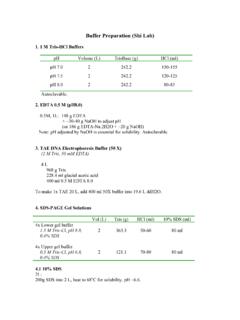
1 #9803 Store at 20 CCell Lysis Buffer (10X)Supplied as a 10X stock 15 mlDescription: Cell Lysis Buffer is used to lyse cells under nondenaturing Cell Lysis Buffer : 20 mM Tris-HCl (pH ) 150 mM NaCl 1 mM Na2 EDTA 1 mM EGTA 1% Triton mM sodium pyrophosphate 1 mM b-glycerophosphate 1 mM Na3VO4 1 g/ml leupeptinDirections for use:1. If Buffer will be continually used, it is recommended that the 10x Buffer be kept at 4 C for 1-2 weeks. For longer periods of time, Buffer should be stored at 20 C. Aliquoting of 10x Buffer is recommended if many small experiments are to be Thaw 10x Buffer at 24-30 C, mixing Dilute 10X Cell Lysis Buffer to a 1X solution using ddH2O. This product supplies enough 10X material to make 150 mls of whole cell extract. 4. Chill 1x Buffer on ice and add PMSF just prior to : CST recommends adding 1 mM PMSF immediately before : This product is stable for 24 months when stored at -20 C.
2 Cell Lysis Buffer can be stored at 4 C for a short period of time (1-2 weeks).Please visit for a complete listing of recommended companion Lysis of adherent cells, we recommend the following: (all reagents and lysates must be kept cold)1. Treat cells as Wash plate with PBS to remove residual Add 400 L of 1x Lysis Buffer / 10 cm Incubate plate on ice for 5 Scrape Sonicate Spin extract 10 minutes at 14,000 x g in a cold Remove supernant for notes:1. For non-adherent cells, add 400 l of Buffer per 107 cells once they have been washed in 1X PBS and 2X #9803 Cell Lysis Buffer can be used for Lysis of tissue samples, although a homogenization step is recommended after adding Lysis Buffer . Extract the tissue at a ratio of 100 mg of tissue to 1 ml of Buffer . Sonication of the tissue lysate is also Additional protease inhibitors can be added to the 1x Lysis Buffer without any Aggregation may be present in this Buffer upon arrival due to the high concentrations of reagents included at the supplied 10X formulation.
3 At times, the aggrega-tion persists despite warming to room temperature. We recommend warming the Buffer to 37 C for 15 minutes and mixing to help eliminate the precipitate. Alternatively, diluting the 10X Buffer with ddH2O to at least 5X, warming to 37 C and mixing for 15 minutes will yield a precipitate-free solution. Once diluted, it can be aliquoted and stored at -20 C for future use. Note: If dilution is necessary, we recommend rinsing the 10X Buffer bottle several times to ensure all of the precipitates have been captured. Species Cross-Reactivity Key:H humanM mouseR ratHm hamsterMk monkeyMi minkC chickenDm D. melanogasterX XenopusZ zebrafishB bovineDg dogPg pigSc S. cerevisiaeCe C. elegansHr horseAll all species expectedSpecies enclosed in parentheses are predicted to react based on 100% Key:W WesternIP ImmunoprecipitationIHC ImmunohistochemistryChIP Chromatin ImmunoprecipitationIF ImmunofluorescenceF Flow cytometryE-P ELISA-Peptide 2011 Cell Signaling Technology, Signaling Technology is a trademark of Cell Signaling Technology, 04/24/20 For Research Use Only.
4 Not For Use In Diagnostic Procedures.