Example: bachelor of science
Chapter 8 Gases Practice Problems Section 8.1 Properties ...
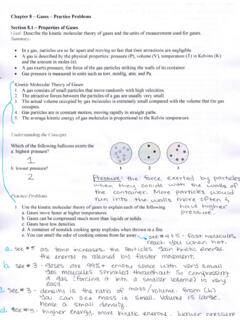
Chapter 8 – Gases – Practice Problems Section 8.1 – Properties of Gases Goal: Describe the kinetic molecular theory of gases and the units of measurement used for gases. Summary: • In a gas, particles are so far apart and moving so fast that their attractions are negligible. • A gas is described by the physical properties: pressure (P), volume (V), temperature (T) in Kelvins (K)
Tags:
Information
Domain:
Source:
Link to this page:
Documents from same domain
Chromosome 16: PV92 PCR - Utah State University
ion.chem.usu.eduChromosome 16: PV92 PCR A Bio-Rad Biotechnology Explorer™ Experiment Introduction to PCR—The Polymerase Chain Reaction You are about to perform a procedure known as PCR1—the amplification of a
Chapter 3 Protecting Groups - chem.usu.edu
ion.chem.usu.eduChapter 3: Protecting Groups ... relatively strong acid (TFA) to remove * Stable in basic conditions * The reagent, MOMCl, is considered carcinogenic Reagent/Condition Reference MOMCl, NaH in THF or ... Protecting Groups of Amino Groups (i) Masking NH2 (amino) as N3 (azido)

The Central Science 9th Edition - Chemistry Department
ion.chem.usu.edu• count the total number of electron pairs around the central atom, • arrange the electron pairs in one of the above geometries to minimize e − -e − repulsion, and count multiple bonds as one
Introduction to Organic Chemistry: Hydrocarbons
ion.chem.usu.eduOrganic Compounds Organic chemistry is the study of carbon compounds. An organic compound • Always contains carbon and hydrogen atoms • May also contain other nonmetals such as oxygen, nitrogen, phosphorus, or a halogen. • Organic compounds are found in: •Gasoline, medicines, shampoos, plastics, and perfumes •Carbohydrates, fats, and proteins
Chapter 12 Introduction to Organic Chemistry: Hydrocarbons
ion.chem.usu.eduChapter 12 – Introduction to Organic Chemistry: Hydrocarbons Section 12.1 – Alkanes Goal: Identify properties characteristic of organic or inorganic compounds. Summary: Organic compounds: always contain carbon and hydrogen (thought sometimes other nonmetals as well.) Inorganic compounds: all other compounds.Often ionic (metal + nonmetal) Organic …
Chapter 11 Acids and Bases Practice Problems Section 11.1 ...
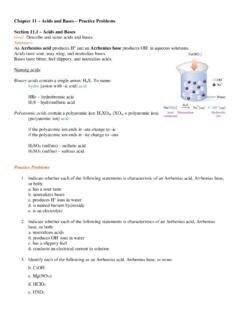
ion.chem.usu.eduSection 11.1 – Acids and Bases Goal: Describe and name acids and bases. Summary: An Arrhenius acid produces H+ and an Arrhenius base produces OH-in aqueous solutions. Acids taste sour, may sting, and neutralize bases. Bases taste bitter, feel slippery, and neutralize acids. Naming acids: Binary acids contain a single anion: H n X. To name:
Utah State University Chemistry and Biochemistry | USU
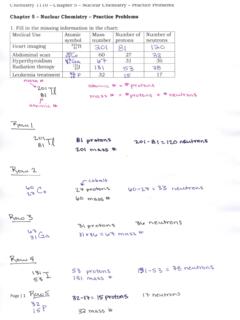
ion.chem.usu.educnermstry 1 1 IU — unapter — Nuclear cnermstry — practice yrot)lerns 32. When a gamma ray is emitted from the nucleus of an atom, the nuclear mass A) increases by two units. B) decreases by one unit. C) increases by one unit. D decreases by two units. emains the same. 33. Radium-226 decays by alpha decay to A) barium-131. B) cobalt-60. C ...
Nuclear Chemistry Practice Problems
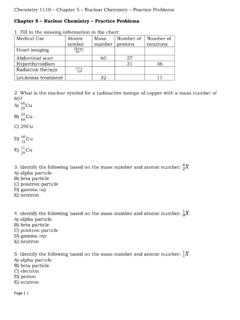
ion.chem.usu.eduChemistry 1110 – Chapter 5 – Nuclear Chemistry – Practice Problems Page | 10 47. The half-life of a radioisotope is A) one-half of the time it takes for the radioisotope to completely decay to a nonradioactive isotope. B) the time it takes for the radioisotope to become an isotope with one-half of the atomic
Utah State University Chemistry and Biochemistry | USU
ion.chem.usu.eduExample: A sample of helium gas (He) has a volume 6.8 L and a pressure of 2.5 atm. What is the final volume, ... The volume is compressed to 2.0 L. b. The volume expands to 12 L. 9. A gas at a pressure of 2.0 atm is in a closed container. Indicate the changes (increases, decreases, or does
Utah State University Chemistry and Biochemistry | USU
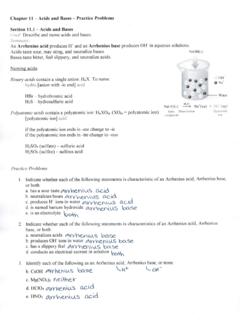
ion.chem.usu.eduth1S IS a basic solution. !nderstanding the Concepts: Why are the concentrations ofH30 and OH- equal in pure water? One is + What is the meaning and value of Kw at 250C? In an acidic solution how does the concentration of 1-130 compare to the concentration of …
Related documents

Compressed Gas Cylinder Storage Guidelines
www.aps.anl.govCompressed Gas Cylinder Storage Guidelines . ... distance between toxic gas cylinders and fuel gases must be 20 feet or a mounted non combustible partition extending the full height and width of the cylinders it separates. Ventilation rates must be maintained per ESH Manual Chapter 13.2.
Gas Laws Worksheet
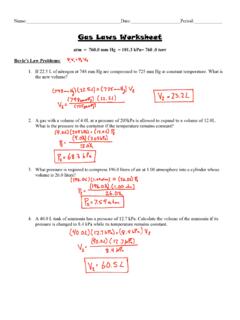
www.npsd.k12.nj.usThe gases in a hair spray can are at a temperature of 27 oC and a pressure of 30 lbs/in2. If the gases in the can reach a pressure of 90 lbs/in2, the can will explode. To what temperature must the gases be raised in order for ... by moving a large piston within a cylinder. If the original pressure was 1.00 atm, what would the final pressure be ...

DESIGN +SAFETY HANDBOOK - Air Liquide USA | Gases ...
industry.airliquide.usOct 08, 2015 · other readily combustible materials to come in contact with a cylinder or equipment used for oxidant services. Use only equipment that is intended for this type of service. Use only a regulator that is designated and labeled “cleaned for O2 service.” Pyrophoric Gases Gases such as silane, phosphine, diborane and arsine are commonly used in ...

Specific Heats: Cv and Cp for Monatomic and Diatomic Gases
www.concepts-of-physics.comeach cylinder. If the rise in temperature of the gas in A is 30 K, then the rise in temperature of the gas in B is (A) 30 K (B) 18 K (C) 50 K (D) 42 K Solution: The piston in the cylinder A is free to move. Hence pressure of the gas is constant and the heat is given to it at constant pressure i.e., QA = nCpDTA. The piston of the cylinder B is ...
States of Matter Activities - Collaborative Learning
www.collaborativelearning.orgSolids Liquids and Gases Connect Four the gas in an aerosol can petrol fumes steam from a kettle oxygen from a cylinder camping gas exhaust fumes from a car water washing-up liquid mercury syrup paint glass sugar a rock a gold bar an ice cube wood from a tree plastic pen These should be printed on card in two colours and cut up.
GASES UNDER PRESSURE HAZARDS & RISK MINIMIZATION
ehs.unl.eduthe common primary hazard of all GHS groups being high pressure contained in the cylinder. Gases in high-pressure cylinders contain an extraordinary amount of stored energy. If a cylinder valve is breached (i.e., breaks off when the cylinder falls and strikes a hard surface, etc.), the stored energy in the cylinder is released as thrust.

Cylinder Valve Outlets and Connections - Air Liquide
airliquide-expertisecenter.comCylinder Valve Outlets and Connections Scott supplies gases in cylinders with valves having BS, CGA, DIN and NEN standard outlet connections. In some cases, alternate connections may be used, and upon customer’s request, will be supplied instead of the standards shown below.
Guilford County Schools / Homepage
www.gcsnc.comgases escaped, t uld be the volume of the weather balloon after it rises to an altitude ere the .000C? 40.1.) temperature i - 3. A fixed ofgas a pressure volume o occupy if the temperature is Increased t 1450C hile the pressure is Calculate the volume the gas held constant. (14.51,) t 0.988 atman 28.00C. At what temperature, in 4.