Example: barber
Counting Rules for Membrane Filtration Methods for ...
the colony count for the 10 mL dilution is the most nearly acceptable to the range of 20 – 60, it must be used to calculate the result: (19 ÷ 10) x 100 = 190 CFU/100 mL. This would be an estimated result. Even though a 100 mL portion was filtered, the colony count for the 10 mL
Tags:
Information
Domain:
Source:
Link to this page:
Documents from same domain
Regulation 61-56 - SCDHEC
scdhec.govJun 07, 1978 · DOMESTIC WASTEWATER OR SEWAGE- The untreated liquid and solid human body waste and the liquids generated by water-using fixtures and appliances, including those associated with food service operations. For the purposes of this regulation, domestic wastewater shall not include industrial process wastewater.
Natural Resources - SCDHEC
scdhec.govNatural Resources Natural resources are materials from the Earth that are used to support life and meet people’s needs. Any natural substance that humans use can be considered a natural resource. Oil, coal, natural gas, metals, stone and sand are natural resources. Other natural resources are air, sunlight, soil and water. Animals, birds ...

Regulation 61-16 Minimum Standards for Licensing Hospitals ...
scdhec.govMinimum Standards for Licensing Hospitals and Institutional General Infirmaries Disclaimer DHEC provides this copy of the regulation for the convenience of the public and makes every effort to ensure its accuracy. However, this is an unofficial version of the regulation. The regulation's most
ONLY APPROVED FOR USE BY THE FOLLOWING FACILITY TYPES
scdhec.gov• Medical evaluation, symptom assessment & chest x-ray if TST positive or if symptomatic. • Either a TST, BAMT or symptom review risk assessment will be performed for each staff and resident on an annual basis. • Perform annual symptom assessment if positive TST or prior active TB disease.
Regulation 61-84 Standards for Licensing Community ...
scdhec.govStandards for Licensing Community Residential Care Facilities Disclaimer DHEC provides this copy of the regulation for the convenience of the public and makes every effort to ensure its accuracy. However, this is an unofficial version of the regulation. The regulation's most recent final publication in the South Carolina State Register presents

SEDIMENT CONTROL STANDARD DETAILS - SCDHEC
scdhec.govStandard Details No. Description SC-01 Dry Sediment Basin (3 Pages) SC-01A Wet Sediment Basin (3 Pages) SC-02 Sediment Trap (2 Pages) SC-03 Silt Fence (2 Pages) ... Wire Mesh and Stone Inlet Protection (2 Pages) SC-09 Type C – Block and Gravel Drop Inlet Protection (2 …
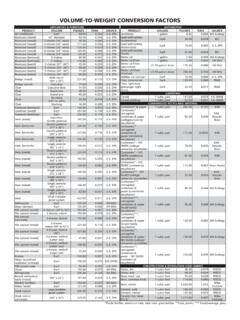
Volume-to-Weight Conversion Charts
scdhec.govStone or gravel 1 cubic foot 98.00 0.049 FEECO Stone, crushed 1 cubic foot 100.00 0.050 FEECO Stone, crushed, size reduced 1 cubic yard 2,700.00 1.350 Tellus Institute Stone, large 1 cubic foot 100.00 0.050 FEECO Wax 1 cubic foot 61.00 0.031 FEECO Wood ashes 1 cubic foot 48.00 0.024 FEECO AGGREGATE C&D bulk 1 cubic yard 484.00 0.242 FL DEP

Individuals eligible for a third dose include people with ...
scdhec.govAug 13, 2021 · • Use of testing to assess immune response and guide clinical care prior to third dose administration is not recommended. • A doctor’s note or prescription for a third dose is not required; self-attestation is all that is necessary to verify eligibility. Dosage:
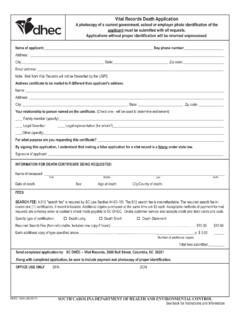
Vital Records Death Application - SCDHEC
scdhec.govVital Records Death Application A photocopy of a current government, school or employer photo identification of the applicant must be submitted with all requests. Applications without proper identification will be returned unprocessed. Send completed application to: SC DHEC – Vital Records, 2600 Bull Street, Columbia, SC 29201

Regulation 61-25 Retail Food Establishments
scdhec.govMay 27, 1983 · Regulation 61-25 . Retail Food Establishments . Disclaimer DHEC provides this copy of the regulation for the convenience of the public and makes every effort to ensure its accuracy. However, this is an unofficial version of the regulation. The regulation's most recent final publication in the South Carolina State Register presents
Related documents
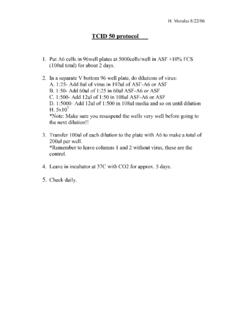
TCID 50 protocol - University of Rochester
www.urmc.rochester.edu2. Calculate 50 % end point. Log lower dilution= dilution in which position is next above 50% Example above: Log lower= 10-6 or -6 3. Add PD and Log lower dilution Example above: -6 + .375 =-6.375 Log TCID50= 10 – 6.375 or 1/ 2.37 x10 6 4. Calculate TCID 50/ml. Divide by the ml of viral innoculum added to row A
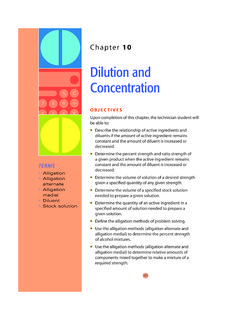
Dilution and Concentration - Lippincott Williams & Wilkins
downloads.lww.comCalculate the Active Ingredient: 50 mL of a 1:20 solution contains 2.5 g of aluminum acetate. 25 1 1000 400.g g mL mL mL Ratio strength = = = X X 11 400:,answer 1000 50 5 1000 120 50 025 mL mL mL mL == = % %.% XX X ==== 1 400 1 400 1 400:, :,answer X answer CHAPTER 10 • Dilution and Concentration 211 Critical Thinking 10.1 Dilution of a solid ...

Drug Calculations - Flinders University
students.flinders.edu.auExample 6: Dilution How much normal saline would need to be added to • ampoules (3x10mg = 30mg) to get the required 30mg morphine. • 3 This example illustrates how to dilute a drug to the required concentration. Prepare a morphine infusion 30mg to be made up to a final volume of 30mLs. Stock ampoules of morphine contain 10mg/ mL.

Spectrophotometry Page 1 10 Lab #4 SPECTROPHOTOMETRY
gervind.faculty.mjc.edudilution. Calculation of Concentration Using C1V1 = C2V2 To make a fixed amount of a dilute solution from a stock solution, you can use the formula: C1V1 = C2V2 where: • V1 = Volume of stock solution needed to make the new solution • C1 = Concentration of stock solution • V2 = Final volume of new solution
Chloride and Salinity - Lamont–Doherty Earth Observatory
www.ldeo.columbia.eduexceed 13 ppt, dilution of samples, as described in the procedure, will be necessary. This method uses the assumption that most of the ions in the solution are non-carbonate salt ions (e.g., Na+, K+, or Cl–), and converts the conductivity reading to a salinity value. Method 1: CHLORIDE CONCENTRATION AND SALINITY (ISE) Materials Checklist