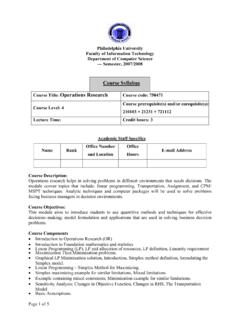
Transcription of Course Syllabus Course Title: Operations Research
1 Page 1 of 5 philadelphia University Faculty of Information Technology Department of Computer Science --- Semester, 2007/2008 Course Syllabus Course code: 750471 Course Title: Operations Research Course prerequisite(s) and/or corequisite(s):210103 + 21231 + 721112 Course Level: 4 Credit hours: 3 Lecture Time: Academic Staff Specifics E-mail Address Office Hours Office Number and Location Rank Name Course Description: Operations Research helps in solving peoblems in diffenert environments that needs dicisions. The module conver topics that include: linear programming, Transportation, Assignment, and CPM/ MSPT techniques.
2 Analytic techniques and computer packages will be used to solve problems facing business managers in decision environments. Course Objectives: This module aims to introduce students to use quantitive methods and techniques for effective decisions making; model formulation and applications that are used in solving business decision problems. Course Components Introduction to Operations Research (OR) Introduction to Foundation mathematics and statistics Linear Programming (LP), LP and allocation of resources, LP definition, Linearity requirement Maximization Then Minimization problems.
3 Graphical LP Minimization solution, Introduction, Simplex method definition, formulating the Simplex model. Linear Programming Simplex Method for Maximizing. Simplex maximizing example for similar limitations, Mixed limitations Example containing mixed constraints, Minimization example for similar limitations. Sensitivity Analysis: Changes in Objective Function, Changes in RHS, The Transportation Model Basic Assumptions. Page 2 of 5 Solution Methods: Feasible Solution: The Northwest Method, The Lowest Cost Method; Optimal Solution: The Stepping Stone Method, Modified; Distribution (MODI) Method.
4 The Assignment Model:- Basic Assumptions Solution Methods:-Different Combinations Method, Short-Cut Method (Hungarian Method) MSPT:- The Dijkestra algorithm, and Floyd s Algorithm {Shortest Route Algorithm} Text book: Title: Operations Research : Applications and Algorithms Author: Wayne L Winston Publisher: Indian University, 4th edition, 2004 In addition to the above, the students will be provided with handouts by the lecturer. Teaching Methods: Duration: 16 weeks, 48 hours in total Lectures: 31 hours, 1-2 hours per week (including two 1-hour midterm exams) Tutorial: 7 hours, 1 per two weeks Laboratories: 10 hours, 1-2 hours per week.
5 Learning Outcomes: Knowledge and understanding - Be able to understand the characteristics of different types of decision-making environments and the appropriate decision making approaches and tools to be used in each type. Cognitive skills (thinking and analysis) - Be able to build and solve Transportation Models and Assignment Models. Communication skills (personal and academic). - Be able to design new simple models, like: CPM, MSPT to improve decision making and develop critical thinking and objective analysis of decision problems. Practical and subject specific skills (Transferable Skills).
6 - Be able to implement practical cases, by using TORA, WinQSB Assessment Instruments Allocation of Marks Mark Assessment Instruments 15% First examination 15% Second examination 40 % 10% Final Exam (written unseen exam) Final Project (defended) 20% Reports, Assignments, Quizzes, Home works 100% Total * Make-up exams will be offered for valid reasons only with consent of the Dean. Make-up exams may be different from regular exams in content and format. Page 3 of 5 Practical Submissions The assignments that have work to be assessed will be given to the students in separate documents including the due date and appropriate reading material.
7 Documentation and Academic Honesty Submit your home work covered with a sheet containing your name, number, Course title and number, and type and number of the home work ( tutorial, assignment, and project). Any completed homework must be handed in to my office (room IT ---) by 15:00 on the due date. After the deadline zero will be awarded. You must keep a duplicate copy of your work because it may be needed while the original is being marked. You should hand in with your assignments: 1- A printed listing of your test programs (if any). 2- A brief report to explain your findings. 3- Your solution of questions.
8 For the Research report, you are required to write a report similar to a Research paper. It should include: - Abstract: It describes the main synopsis of your paper. - Introduction: It provides background information necessary to understand the Research and getting readers interested in your subject. The introduction is where you put your problem in context and is likely where the bulk of your sources will appear. - Methods (Algorithms and Implementation): Describe your methods here. Summarize the algorithms generally, highlight features relevant to your project, and refer readers to your references for further details.
9 - Results and Discussion (Benchmarking and Analysis): This section is the most important part of your paper. It is here that you demonstrate the work you have accomplished on this project and explain its significance. The quality of your analysis will impact your final grade more than any other component on the paper. You should therefore plan to spend the bulk of your project time not just gathering data, but determining what it ultimately means and deciding how best to showcase these findings. - Conclusion: The conclusion should give your reader the points to take home from your paper.
10 It should state clearly what your results demonstrate about the problem you were tackling in the paper. It should also generalize your findings, putting them into a useful context that can be built upon. All generalizations should be supported by your data, however; the discussion should prove these points, so that when the reader gets to the conclusion, the statements are logical and seem self-evident. - Bibliography: Refer to any reference that you used in your assignment. Citations in the body of the paper should refer to a bibliography at the end of the paper. Protection by Copyright 1.