Transcription of Chapter 2 Ultraviolet and visible spectroscopy Molecular ...
1 Chapter 2 ultraviolet and visible spectroscopy Molecular Spectrophotometry Properties of light Electromagnetic radiation and electromagnetic spectrum Absorption of light Beer s law Limitation of Beer s law Absorption of light by molecules Instrumentation: Spectrophotometer Applications: Individual species and mixtures Spectrophotometric titration (up to in the notes) Spectrophotometry It refers to the use of light (electromagnetic radiation) to measure chemical concentrations. Mainly, the fundamental principles of absorption and emission of radiation by molecules or atoms and how these processes are used in quantitative analysis will be discussed . Electromagnetic radiation Electromagnetic radiation or light, is a form of energy whose behavior is described by the properties of both waves and particles. The optical properties of electromagnetic radiation, such as diffraction and dispersion , are explained best by describing light as a wave.
2 Many of the interactions between electromagnetic radiation and matter, such as absorption and emission are better described by treating light as a particle, or photon. Plane polarized electromagnetic radiation showing the electric field, the magnetic field and the direction of propagation Wave Properties of EMR consists of oscillating electric and magnetic fields that propagate through space along a linear path and with a constant velocity Oscillations in the electric and magnetic fields are perpendicular to each other, and to the direction of the wave's propagation In a vacuum, EMR travels at the speed of light, c, which is x 108 m/s. EMR moves through a medium other than a vacuum with a velocity, v, less than that of the speed of light in a vacuum. The difference between v and c is small enough (< ) that the speed of light to three significant figures, x 108 m/s, is sufficiently accurate for most purposes.
3 Characteristics electromagnetic wave The interaction of EMR with matter can be explained using either the electric field or the magnetic field. Only the electric field component will be used to discuss this matter An electromagnetic wave is characterized by several fundamental properties, including its velocity, amplitude, frequency, phase angle, polarization, and direction of propagation. The interaction of EMR with matter can be explained using either the electric field or the magnetic field. Only the electric field component will be used to discuss this matter Ae is the electric field maximum amplitude Is the distance between successive maxima or successive minima Frequency, , is the number of oscillations in the electric field per unit time. One oscillation/sec = one hertz (HZ) The wavelength of an electromagnetic wave, , is defined as the distance between successive maxima, or successive minima For Ultraviolet and visible electromagnetic radiation the wavelength is usually expressed in nanometers (nm, 10-9 m) The wavelength for infrared radiation is given in microns ( m, 10-6 m).
4 Wavelength depends on the electromagnetic wave's velocity, where = c/ = v/ (in vacuum) : = 1/ Wave number Power and Intensity of light Power, P, and Intensity, I, of light give the flux of energy from a source of EMR P is the flux of energy per unit time I is the flux of energy per unit time per area Particle Properties of Electromagnetic Radiation When a sample absorbs electromagnetic radiation it undergoes a change in energy. The interaction between the sample and the electromagnetic radiation is easiest to understand if we assume that: electromagnetic radiation consists of a beam of energetic particles (packets of energy) called photons. When a photon is absorbed by a sample, it is "destroyed," and its energy is acquired by the sample Particle Properties of Electromagnetic Radiation The energy of a photon, in joules, is related to its frequency, wavelength, or wavenumber by the following equations: E = h = = hc hch is Planck's constant, which has a value of x 10-34 J s.
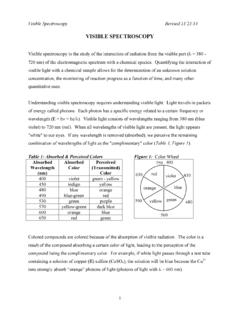
5 Electromagnetic Spectrum The spectrum is the written records of the EMR EMR is divided into different regions based on the type of atomic or Molecular transition that gives rise to the absorption or emission of photons The boundaries describing the electromagnetic spectrum are not rigid, and an overlap between spectral regions is possible. Colors of the visible light of maximum Color Color absorption (nm) absorbed observed 380-420 Violet Green-yellow 420-440 Violet-blue Yellow 440-470 Blue Orange 470-500 Blue-green Red 500-520 Green Purple 520-550 Yellow-green Violet 550-580 Yellow Violet-blue 580-620 Orange Blue 620-680 Red Blue-green 680-780 Purple Green Measuring Photons as a Signal spectroscopy is divided into two broad classes: is transferred between a photon of electromagnetic radiation and the analyte (Absorption or Emission of radiation in electromagnetic radiation wave characteristics (changes in amplitude, phase angle, polarization, or direction of propagation.))
6 Class 1: Absorption of radiation In absorption spectroscopy the energy carried by a photon is absorbed by the analyte, promoting the analyte from a lower-energy state (Ground state) to a higher-energy, (or excited) state Absorbing a photon of visible light causes a valence electron in the analyte to move to a higher-energy level. When an analyte absorbs infrared radiation one of its chemical bonds experiences a change in vibrational energy. Energy level diagram showing absorption of a photon The intensity of photons passing through a sample containing the analyte is attenuated because of absorption. The measurement of this attenuation, which we call absorbance, The energy levels have well-defined values ( , they are quantized). Absorption only occurs when the photon's energy matches the difference in energy, E, between two energy levels.
7 A plot of absorbance as a function of the photon's energy (wavelength, , is called an absorbance spectrum Ultraviolet / visible absorption spectrum for bromothymol blue Wavelenth at which Absorbance is maximum max Class 1 Emission of Radiation Emission of a photon occurs when an analyte in a higher-energy state returns to a lower-energy state The higher-energy state can be achieved in several ways: including thermal energy, radiant energy from a photon, or by a chemical reaction. Emission following the absorption of a photon is also called photoluminescence, and that following a chemical reaction is called chemiluminescence. Emission (luminescence) Spectrum Typical Emission Spectrum Various spectroscopic techniques of class 1 Class 2 Changes in the EMR wave characteristics In this class of spectroscopy : the electromagnetic radiation undergoes a change in amplitude, phase angle, polarization, or direction of propagation as a result of its refraction, reflection, scattering, diffraction, or dispersion by the sample.)
8 Several representative spectroscopic techniques are listed in the following table Various spectroscopic techniques of class 2 Sources of Energy All forms of spectroscopy require a source of energy. In absorption and scattering spectroscopy this energy is supplied by photons (EMR or light). Emission and luminescence spectroscopy use thermal, radiant (photon), or chemical energy to promote the analyte to a less stable, higher energy state. Sources of Electromagnetic Radiation A source of electromagnetic radiation must provide an output that is both intense and stable in the desired region of the electromagnetic spectrum. Sources of electromagnetic radiation are classified as either continuum or line sources. A continuum source emits radiation over a wide range of wavelengths, with a relatively smooth variation in intensity as a function of wavelengths.
9 Line sources emit radiation at a few selected, narrow wavelength ranges Common sources of EMR Emission spectrum from a continuum emission source Emission spectrum fro ma typical line source Absorbance of Electromagnetic Radiation In absorption spectroscopy a beam of electromagnetic radiation passes through a sample. Much of the radiation is transmitted without a loss in intensity. At selected wavelengths the radiation's intensity is attenuated. The process of attenuation is called absorption. Two general requirements must be met if an analyte is to absorb electromagnetic radiation. The first requirement is that there must be a mechanism by which the radiation's electric field or magnetic field interacts with the analyte. For Ultraviolet and visible radiation, this interaction involves the electronic energy of valence electrons.
10 A chemical bond's vibrational energy is altered by the absorbance of infrared radiation. The second requirement is that the energy of the electromagnetic radiation must exactly equal the difference in energy, AE, between two of the analytes quantized energy states. Molecular Orbital (MO)Theory Review MO Theory: Electrons in atoms exist in atomic orbitals while electrons in molecules exist in Molecular orbitals. Bonding MO: A MO where electrons have a lower energy than they would in isolated atomic orbitals Anitbonding MO: A MO in which electrons have a higher energy than they would in isolated atomic orbitals. Ground State: Refers to the state of lowest energy. Electrons can be promoted from a ground state to a higher excited state by input of energy. Excited State: Any electronic state other than the ground state.