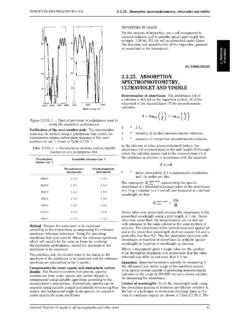
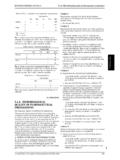
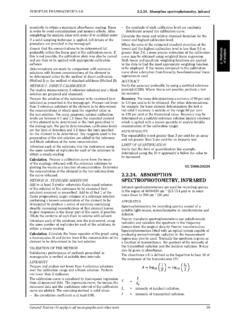
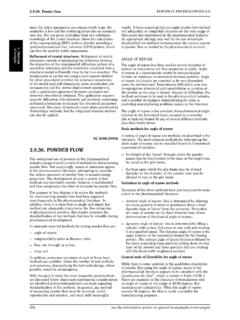
Transcription of 2.2.25. ABSORPTION SPECTROPHOTOMETRY, ULTRAVIOLET …
1 EUROPEAN PHARMACOPOEIA ABSORPTION spectrophotometry , ULTRAVIOLET and visible07/2005 ABSORPTIONSPECTROPHOTOMETRY, ULTRAVIOLET AND VISIBLED etermination of (A)ofa solution is defined as the logarithm to base 10 of thereciprocal of the transmittance (T) for monochromaticradiation:T=I/I0,I0=intensi ty of incident monochromatic radiation,I=intensity of transmitted monochromatic the absence of other physico-chemical factors, theabsorbance (A) is proportional to the path length (b)throughwhich the radiation passes and to the concentration (c)ofthe substance in solution in accordance with the equation: =molar absorptivity, ifbis expressed in centimetresandcin moles per expressionrepresenting the specificabsorbance of a dissolved substance refers to the absorbanceof a 10 g/l solution in a 1 cm cell and measured at a definedwavelength so that:Unless otherwise prescribed, measure the absorbance at theprescribed wavelength using a path length of 1 cm and at20 1 ,themeasurementsare carried out with reference to the same solvent or thesame mixture of solvents.
2 The absorbance of the solventmeasured against air and at the prescribed wavelengthshall not exceed and is preferably less than Plotthe ABSORPTION spectrum with absorbance or function ofabsorbance as ordinate against wavelength or function ofwavelength as a monograph gives a single value for the positionof an ABSORPTION maximum, it is understood that the valueobtained may differ by not more than 2 Spectrophotometers suitable for measuring inthe ULTRAVIOLET and visible range of the spectrum consistof an optical system capable of producing monochromaticradiation in the range of 200 nm to 800 nm and a devicesuitable for measuring the of wavelengths. Verify the wavelength scale usingthe ABSORPTION maxima ofholmium perchlorate solution R,the line of a hydrogen or deuterium discharge lamp or thelines of a mercury vapour shown in Table Thepermitted tolerance is 1 nm for the ULTRAVIOLET range and 3 nm for the visible range.
3 Suitable certified referencematerials may also be ABSORPTION maxima for control ofwavelength nm (Ho) nm (Hg) (Hg) (Hg) nm (Ho) nm (D ) nm (Hg) nm (H ) nm (Hg) nm (Ho) nm (Hg) nm (Hg) (Ho) (Hg) nm (Hg) nm (Hg)Control of absorbance. Check the absorbance usingsuitable filters or a solution ofpotassium dichromate Ratthe wavelengths indicated in Table which gives foreach wavelength the exact values and the permitted limits ofthe specific absorbance. The tolerance for the absorbanceis the control of absorbance, use solutions ofpotassiumdichromate Rwhich has been previously dried to constantmass at 130 C. For the control of absorbance at 235 nm,257 nm, 313 nm and 350 nm, dissolve mg ofpotassium dichromate M sulphuric acidanddilute to ml with the same acid.
4 For the control ofabsorbance at 430 nm, dissolve mg ofpotassiumdichromate M sulphuric acidand dilute ml with the same acid. Suitable certified referencematerials may also be (nm)Specific to to to to to Stray light may be detected at a givenwavelength with suitable filters or solutions: for example theabsorbance of a 12 g/l solution ofpotassium chloride Rin a1 cm cell increases steeply between 220 nm and 200 nm andis greater than at 198 nm when compared with water ascompensation liquid. Suitable certified reference materialsmay also be (for qualitative analysis). When prescribed ina monograph, measure the resolution of the apparatusas follows: record the spectrum of a per centV/Vsolution oftoluene Rinhexane absorbance at the maximum at 269 nm to that at theminimum at 266 nm is stated in the monograph.
5 Suitablecertified reference materials may also be slit-width(for quantitative analysis). To avoiderrors due to spectral slit-width, when using an instrumenton which the slit-width is variable at the selected wavelength,the slit-width must be small compared with the half-width ofthe ABSORPTION band but it must be as large as possible toobtain a high value ofI0. Therefore, a slit-width is chosensuch that further reduction does not result in a change inabsorbance (1) Thin-layer chromatographyEUROPEAN PHARMACOPOEIA The tolerance on the path length of the cells used is cm. When filled with the same solvent, the cellsintended to contain the solution to be examined and thecompensation liquid must have the same this is not the case, an appropriate correction must cells must be cleaned and handled with SPECTROPHOTOMETRYD erivative spectrophotometry involves the transformationof ABSORPTION spectra (zero-order) into first-, second- orhigher-order-derivative order-derivative spectrumis a plot of the gradient oftheabsorptioncurve(rateofchangeoftheab sorbancewithwavelength, dA/d ) order-derivative spectrumis a plot of the curvatureof the ABSORPTION spectrum against wavelength (d2A/d 2).
6 The second derivative at any wavelength is related toconcentration by the following equation:c =concentration of the absorbing solute, in gramsper Use a spectrophotometer complying withthe requirements prescribed above and equipped with ananalogue resistance-capacitance differentiation module or adigital differentiator or othermeans of producing derivativespectra. Some methods of producing second order-derivativespectra produce a wavelength shift relative to the power. When prescribed in a monograph,record the second order-derivative spectrum of a percentV/Vsolution oftoluene Rinmethanol R,usingmethanol Ras the compensation liquid. The spectrumshows a small negative extremum located between 2 largenegative extrema at 261 nm and 268 nm, respectively, asshown in Figure Unless otherwise prescribed inthe monograph, the ratioA/B(see Figure ) is notless than Prepare the solution of the substance to beexamined, adjust the various instrument settings accordingto the manufacturer s instructions and calculate the amountof the substance to be determined as prescribed in THIN-LAYERCHROMATOGRAPHYThin-layer chromatography is a separation technique inwhich a stationary phase consisting of an appropriatematerial is spread in a uniform thin layer on a support (plate)of glass, metal or plastic.
7 Solutions of analytes are depositedon the plate prior to development. The separation is basedon adsorption, partition, ion-exchange or on combinationsof these mechanisms and is carried out by migration(development) of solutes (solutions of analytes) in a solventor a suitable mixture of solvents (mobile phase) through thethin-layer (stationary phase).APPARATUSP lates. The chromatography is carried out using pre-coatedplates as described underReagents( ).Pre-treatment of the plates. It may be necessary to wash theplates prior to separation. This can be done by migration ofan appropriate solvent. The plates may also be impregnatedby procedures such as development, immersion or ,theplatesmaybeactivated,ifnecessary,byh eatinginanovenat120 tankwith a flat bottom or twin trough, ofinert, transparent material, of a size suitable for the platesused and provided with a tightly fitting lid.
8 For horizontaldevelopment the tank is provided with a trough for themobile phase and it additionally contains a device fordirecting the mobile phase to the stationary , microsyringes, calibrated disposablecapillariesor other application devices suitable for theproper application of the detection deviceto measure directfluorescence or the inhibition of devices and for derivatisation to transfer to the plate reagents byspraying, immersion or exposure to vapour and, whereapplicable, to facilitate heatingfor visualisation of A device may be used to providedocumentation of the visualised chromatogram, for at a suitable distance from the lower edge andfrom the sides of the plate and on a line parallel to thelower edge; allow an interval of at least 10 mm (5 mm onhigh-performance plates) between the centres of circularspotsand5mm(2mmonhigh-performanc eplates)betweenthe edges of bands.
9 Apply the solutions in sufficiently small3090 See the information section on general monographs (cover pages)