Transcription of Differential and Common Mode Gain lecture - ITTC
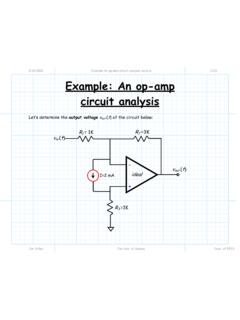
1 2/18/2011 Differential and Common Mode Gain lecture 1/8 Jim Stiles The Univ. of Kansas Dept. of EECS Differential and Common -Mode Gain Recall that in a previous handout, we analyzed this circuit: R2 R1 + - vout ideal v1 v2 R3 R4 2/18/2011 Differential and Common Mode Gain lecture 2/8 Jim Stiles The Univ. of Kansas Dept. of EECS Common mode and Differential mode We found that the output is related to the inputs as: 4222113411outRRRvvvRRRR =+ + This circuit is a weighted difference amplifier, and typically, it is expressed in terms of its Differential gain Ad and Common -mode gain Acm. To understand what these gains mean, we must first define the difference signal ()dvt and Common -mode signal ()cmvt of two inputs 1()vt and 2()vt.
2 2/18/2011 Differential and Common Mode Gain lecture 3/8 Jim Stiles The Univ. of Kansas Dept. of EECS Definitions The difference, as we might expect, is defined as: 21()() ()dvtvtvt whereas the Common -mode signal is simply the average of the two inputs: 21() ()()2cmvt vtvt+ Using these definitions, we can express the two input signals as: 21()()()2()()()2dcmdcmvtvtvtvtvtvt=+= 2/18/2011 Differential and Common Mode Gain lecture 4/8 Jim Stiles The Univ. of Kansas Dept. of EECS A new way to express the output Thus, the Differential signal ()dvt and the Common -mode signal ()cmvt provide another way to completely specify input signals 12() and ()vtvt if you know ()dvt and ()cmvt, you know 1() vtand 2()vt.
3 Moreover, we can express the behavior of our Differential amplifier in terms of ()dvt and ()cmvt. Inserting these functions into the expression of the amplifier output ()ovt, we find: 422211341422134142213414221341()()1()()2 211()21outddcmcmdRRRvvvRRRR vtvtRRRvtvtRRRRRRRvtRRR RRRRRRR R =+ + =++ + =++ + ++ + ()()1142324142313 413 4()2()()2cmcmdvtRR RRRRRR RRvtv tRR RRR R ++ =+++ 2/18/2011 Differential and Common Mode Gain lecture 5/8 Jim Stiles The Univ. of Kansas Dept. of EECS A more Common form Thus, we now have an expression for the open-circuit output in the form: ()()()outcm cmddvtAvtAvt=+ where: Differential gain Common -mode gaindcmAA 2/18/2011 Differential and Common Mode Gain lecture 6/8 Jim Stiles The Univ.
4 Of Kansas Dept. of EECS Difference amplifiers should have no Common -mode gain Note that each of these gains are open-circuit voltage gains. * An ideal Differential amplifier has zero Common -mode gain ( , Acm =0)! * In other words, the output of an ideal Differential amplifier is independent of the Common -mode ( , average) of the two input signals. * We refer to this characteristic as Common -mode suppression. Typically, real Differential amplifiers exhibit small, but non-zero Common mode gain. 2/18/2011 Differential and Common Mode Gain lecture 7/8 Jim Stiles The Univ. of Kansas Dept. of EECS Common -Mode Rejection ratio The Common -Mode Rejection Ratio (CMRR) is therefore used to indicate the quality of a Differential amplifier: 2102 CMRR 10 log()dcmAdBA= Note the CMRR of a good Differential amplifier is very large ( , > 40 dB).
5 For our example circuit, we find that the Differential and Common -mode gain are: ()()123244134123413422dcmRR RRRRARR RRRR RARR R++=+ =+ 2/18/2011 Differential and Common Mode Gain lecture 8/8 Jim Stiles The Univ. of Kansas Dept. of EECS Common -mode gain depends on design The ratio of these two gains is thus: ()()11232 123444131344123244123422212dcmARR RRRRRR RRARRRRRRRR RRRRRRR R ++ = ++ ++= and therefore CMRR is: 212324410123421 CMRR 10 log()2RR RRRRdBRRR R++= It is evident that for this example, the Common -mode gain Acm is minimized, and thus the CMRR is maximized, when: 1234 RRR R= so that 12340 RRR R =.