Transcription of Digital Image Integrity - adobe.com
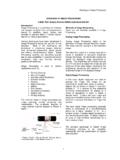
1 WHITEPAPERTABLE OF CONTENTS1 Viability of Digital images2 Best practices2 Archive image3 Audit trail4 Repeatability of Image adjustments5 History of tools to address issues of archive imagesDigital Image IntegrityThe Integrity of a Digital Image is paramount in fields such as forensics, medical imag-ing, and military and industrial photography. Courts make decisions affecting an individual s liberty based, in part, on images presented as evidence. Physicians and researchers make diagnoses based on imaging holding people s lives in the balance. Military photographs may determine target locations based on their content and inter-pretation.
2 Industrial photographs depict defects in materials that could lead to faulty and dangerous consumer making corrections and adjustments to images is frequently necessary whether to separate one type of cell from another or to enhance a fingerprint it is important to maintain the Integrity of all images from capture through final usage. To address this issue, the creator of an Image can follow best practices that maintain an archive Image , restrict access to the archive Image , require others to work only on copies of the archive Image , and provide an audit trail of any adjustments made to the Image on the left shows a fingerprint on a check.
3 The Image on the right shows a fingerprint that has been bleached/altered for of Digital imagesAre Digital images intrinsically viable in these fields? Comparing Digital imaging to silver-based photography often brings up surprises and puts many issues into photographic images have been manipulated, altered, and faked for over 150 years. And, it is probably easier to get away with falsifying an Image that was origi-nally recorded on film. Are Digital images intrinsically viable in these fields? With film, someone can scan a roll of negatives, manipulate the images, output them to a film recorder, and create a new set of negatives.
4 Unlike a Digital photograph, there is no metadata stored with an analog Image . If a Digital photograph is altered, the associated metadata will reveal the alteration; any break or inconsistency in the metadata will be a clue to the manipula-tion. Another advantage of a Digital Image is that the tools to analyze a Digital Image enable the viewer to look at very fine edge detail and find resolution mismatches, differ-ences in noise signatures, and other clues. Regarding the history of Image manipulation, Dino Brugioni s Photo Fakery (published by Brassey s Inc., 1999) shows images from the 1850s that used multiple negatives to create scenes that never existed.
5 And, throughout history silver-based images have been manipulated often for political reasons. Digital imaging doesn t create the possibility of Image manipulation; Digital imaging merely provides an additional technology for it, and for the detection of imaging is as viable as any other imaging technology and is perhaps even bet-ter than analog photography. However, in forensic, scientific, military, and industrial applications, people who create and work with images should utilize best practices with all imaging Image Integrity2 Best practicesBest practices are policies or rules that provide guidelines for procedures and workflow.
6 Best practices should incorporate any industry-wide standards or requirements, and may go beyond them. Best practices help maintain the Integrity of a Digital imaging typical best-practices policy incorporates the items discussed imageMaintaining an unaltered archive Image is essential to the workflow in most technical and medi-cal fields, forensics, and military applications. A viewer can compare the archive Image and the final Image to determine if the Image content or quality has been altered. Maintaining an archive Image also ensures that any user can verify that the procedures used to make adjustments to it are reproducible and Federal Bureau of Investigation (FBI) formed the Scientific Working Group on Imaging Technologies (SWGIT) in the mid 1990s to address some of the issues surrounding the use of Digital imaging in forensics, among other issues.
7 The SWGIT guidelines ( images/SWGIT% ) provide recommendations for photography and Digital imaging in forensics. SWGIT recommends maintaining an archive Image , and defines the archive Image as Either the primary or original Image stored on media suitable for long-term storage. The primary Image is defined as ..the first instance in which an Image is recorded onto any media that is a separate, identifiable object or objects. Examples include a Digital Image recorded on a flash card or a Digital Image downloaded from the Internet. In other words, an archive Image is an exact copy of what the camera recorded onto its original the original Image was captured in the JPEG or TIFF format, the archive Image will be that file (or an exact copy of it) in that same format.
8 TIFF and JPEG captures have distinct limitations they are processed within the camera and are limited to 8 bits per channel during their camera processing. In addition, recovering highlights is impossible, and adjustments to color balance, contrast, brightness, and so on can quickly deteriorate the Image the original was captured in a raw format, it is important to also retain the information on any Image adjustments that are made when the raw Image is opened or converted. Raw files are, by definition, unalterable (read-only) file formats. These files contain the unprocessed data from the Digital camera and must be processed upon opening.
9 Raw files opened with the adobe Camera Raw plug-in may contain a hidden sidecar file, or this information may be placed in a database on the host computer depending on the user preferences. In either case, it is important, but not intuitive, to keep this information with the file when the file is moved or archived. With raw file formats, the archive Image is the raw file plus the sidecar raw formats can provide images that have greater bit depth (10, 12, or more, depending on the camera). When these images are opened using the Camera Raw plug-in, they provide many advantages in addition to their higher bit depth, such as color balance, brightness, and contrast adjustments that are nearly Image Integrity3 Audit trailIn some fields, making adjustments to images is often required.
10 An Image presented in court or analyzed for medical evaluation may have gone through several adjustments after it was captured. A question may arise as to whether the adjustments made were valid for the applica-tion, or if the adjustments resulted in a forensics, an Image that was taken under fluorescent lighting may need color correction to eliminate the green cast for courtroom use, or a fingerprint Image may benefit from a contrast boost and Image sharpening. In medical imaging, restricting the tonal range may help isolate, identify, and quantify a specific type of bacteria.