Transcription of ELECTRICAL FUNDAMENTALS General Electricity is …
1 GeneralElectricity is a form of energy called ELECTRICAL energy. It is sometimes called an "unseen" force because the energy itself cannot be seen, heard, touched, or , the effects of Electricity can be seen .. a lamp gives off light; a motor turns; a cigarette lighter gets red hot; a buzzer makes effects of Electricity can also be heard, felt, and smelled. A loud crack of lightning is easily heard, while a fuse "blowing" may sound like a soft "pop" or "snap." With Electricity flowing through them, some insulated wires may feel "warm" and bare wires may produce a "tingling" or, worse, quite a "shock." And, of course, the odor of burned wire insulation is easily FUNDAMENTALS Page 1 Toyota Motor Sales, , Inc. All Rights Reserved. Electron TheoryElectron theory helps to explain Electricity .
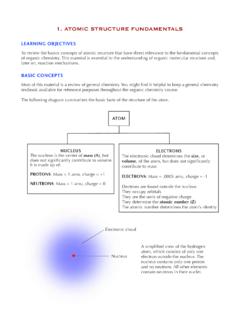
2 The basic building block for matter, anything that has mass and occupies space, is the atom. All matter - solid, liquid, or gas - is made up of molecules, or atoms joined together. These atoms are the smallest particles into which an element or substance can be divided without losing its properties. There are only about 100 different atoms that make up everything in our world. The features that make one atom different from another also determine its ELECTRICAL STRUCTUREAn atom is like a tiny solar system. The center is called the nucleus, made up of tiny particles called protons and neutrons. The nucleus is surrounded by clouds of other tiny particles called electrons. The electrons rotate about the nucleus in fixed paths called shells or has the simplest atom with one proton in the nucleus and one electron rotating around it. Copper is more complex with 29 electrons in four different rings rotating around a nucleus that has 29 protons and 29 neutrons.
3 Other elements have different atomic FUNDAMENTALS Page 2 Toyota Motor Sales, , Inc. All Rights Reserved. ATOMS AND ELECTRICAL CHARGESEach atomic particle has an ELECTRICAL charge. Electrons have a negative (-) charge. Protons have a positive charge. Neutrons have no charge; they are a balanced atom, the number of electrons equals the number of protons. The balance of the opposing negative and positive charges holds the atom together. Like charges repel, unlike charges attract. The positive protons hold the electrons in orbit. Centrifugal force prevents the electrons from moving inward. And, the neutrons cancel the repelling force between protons to hold the atom's core AND NEGATIVE IONSIf an atom gains electrons, it becomes a negative ion.
4 If an atom loses electrons, it becomes a positive ion. Positive ions attract electrons from neighboring atoms to become balanced. This causes electron FLOWThe number of electrons in the outer orbit (valence shell or ring) determines the atom's ability to conduct Electricity . Electrons in the inner rings are closer to the core, strongly attracted to the protons, and are called bound electrons. Electrons in the outer ring are further away from the core, less strongly attracted to the protons, and are called free can be freed by forces such as friction, heat, light, pressure, chemical action, or magnetic action. These freed electrons move away from the electromotive force, or EMF ("electron moving force"), from one atom to the next. A stream of free electrons forms an ELECTRICAL FUNDAMENTALS Page 3 Toyota Motor Sales, , Inc.
5 All Rights Reserved. CONDUCTORS, INSULATORS, SEMICONDUCTORSThe ELECTRICAL properties of various materials are determined by the number of electrons in the outer ring of their atoms. CONDUCTORS - Materials with 1 to 3 electrons in the atom's outer ring make good conductors. The electrons are held loosely, there's room for more, and a low EMF will cause a flow of free electrons. INSULATORS - Materials with 5 to 8 electrons in the atom's outer ring are insulators. The electrons are held tightly, the ring's fairly full, and a very high EMF is needed to cause any electron flow at all. Such materials include glass, rubber, and certain plastics. SEMICONDUCTORS - Materials with exactly 4 electrons in the atom's outer ring are called semiconductors. They are neither good conductors, nor good insulators. Such materials include carbon, germanium, and FLOW THEORIESTwo theories describe current flow.
6 The conventional theory, commonly used for automotive systems, says current flows from (+) to (-) .. excess electrons flow from an area of high potential to one of low potential (-). The electron theory, commonly used for electronics, says current flows from (-) to (+) .. excess electrons cause an area of negative potential (-) and flow toward an area lacking electrons, an area of positive potential (+), to balance the the direction of current flow makes a difference in the operation of some devices, such as diodes, the direction makes no difference to the three measurable units of Electricity : voltage, current, and FUNDAMENTALS Page 4 Toyota Motor Sales, , Inc. All Rights Reserved. Terms Of ElectricityElectricity cannot be weighed on a scale or measured into a container.
7 But, certain ELECTRICAL "actions" can be actions or "terms" are used to describe Electricity ; voltage, current, resistance, and is ELECTRICAL pressure, a potential force or difference in ELECTRICAL charge between two points. It can push ELECTRICAL current through a wire, but not through its is pressureCurrent is opposes is the amount of work performed. It depends on the amount of pressure and the volume of flow. Voltage is measured in volts. One volt can push a certain amount of current, two volts twice as much, and so on. A voltmeter measures the difference in ELECTRICAL pressure between two points in volts. A voltmeter is used in FUNDAMENTALS Page 5 Toyota Motor Sales, , Inc. All Rights Reserved. CURRENTC urrent is ELECTRICAL flow moving through a wire.
8 Current flows in a wire pushed by is measured in amperes, or amps, for short. An ammeter measures current flow in amps. It is inserted into the path of current flow, or in series, in a FUNDAMENTALS Page 6 Toyota Motor Sales, , Inc. All Rights Reserved. RESISTANCER esistance opposes current flow. It is like ELECTRICAL "friction." This resistance slows the flow of current. Every ELECTRICAL component or circuit has resistance. And, this resistance changes ELECTRICAL energy into another form of energy - heat, light, is measured in ohms. A special meter, called an ohmmeter, can measure the resistance of a device in ohms when no current is FUNDAMENTALS Page 7 Toyota Motor Sales, , Inc.
9 All Rights Reserved. Factors Affecting ResistanceFive factors determine the resistance of conductors. These factors are length of the conductor, diameter, temperature, physical condition and conductor material. The filament of a lamp, the windings of a motor or coil, and the bimetal elements in sensors are conductors. So, these factors apply to circuit wiring as well as working devices or in motion are constantly colliding as voltage pushes them through a conductor. If two wires are the same material and diameter, the longer wire will have more resistance than the shorter wire. Wire resistance is often listed in ohms per foot ( , spark plug cables at 5 per foot). Length must be considered when replacing conductors allow more current flow with less voltage. If two wires are the same material and length, the thinner wire will have more resistance than the thicker wire.
10 Wire resistance tables list ohms per foot for wires of various thicknesses ( , size or gauge .. 1, 2, 3 are thicker with less resistance and more current capacity; 18, 20, 22 are thinner with more resistance and less current capacity). Replacement wires and splices must be the proper size for the circuit In most conductors, resistance increases as the wire temperature increases. Electrons move faster, but not necessarily in the right direction. Most insulators have less resistance at higher temperatures. Semiconductor devices called thermistors have negative temperature coefficients (NTC) resistance decreases as temperature increases. Toyota's EFI coolant temperature sensor has an NTC thermistor. Other devices use PTC CONDITIONP artially cut or nicked wire will act like smaller wire with high resistance in the damaged area. A kink in the wire, poor splices, and loose or corroded connections also increase resistance.