Transcription of Cambridge TECHNICALS LEVEL 3 APPLIED SCIENCE
1 SuiteCambridge TECHNICALS LEVEL 3 LABORATORY SKILLSUnit 1 SCIENCE fundamentalsD/507/6148 Guided learning hours: 90 Version 3 - r evised exemplification- March 2017 OCR 2017 1 Unit 1: SCIENCE fundamentals LEVEL 3 UNIT 1: SCIENCE fundamentals D/507/6148 Guided learning hours: 90 Essential resources required for this unit: A range of chemicals, cell and tissues, microscopes, scales, voltmeters, ohmmeters, ammeters, resistors, circuitry and general SCIENCE laboratory equipment. This unit is externally assessed by an OCR set and marked examination. UNIT AIM A thorough understanding of scientific principles and practices are essential for SCIENCE technicians.
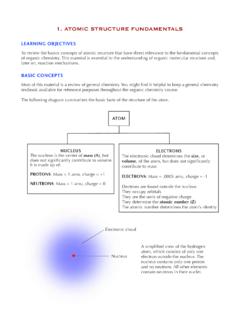
2 Knowledge learnt in this unit will create a solid foundation in the fundamentals of SCIENCE that you will be able to build on in your further study through your choice of additional optional units which will provide you with greater depth of knowledge and practice in your chosen specialisms. OCR 2017 2 Unit 1: SCIENCE fundamentals TEACHING CONTENT The teaching content in every unit states what has to be taught to ensure that learners are able to access the highest grades. Anything which follows an details what must be taught as part of that area of content. Anything which follows an is illustrative. For externally assessed units, where the content contains and under specific areas of content, the following rules will be adhered to when we set questions for an exam: a direct question may be asked about unit content which follows an where unit content is shown as an a direct question will not be asked about that outcomes Teaching content Exemplification The Learner will: Learners must be taught: the chemicalstructures of elements The atom is the basic structure , it is made up of subatomic particles.
3 Nucleus contains protons and neutronssurrounded by electrons relative masses and charges nuclear and atomic diameters nucleon number, proton number and isotopes proton number defines the type of atom nuclear notation attractive and repulsive forces within Use of nuclear notation 612 Know about the four fundamental forces and their relative magnitude. Learners should be able to explain how such forces maintain or are involved in the decay of the basic structure of the atom. Elements are based on atomic structure and can be classified by the Periodic Table : organisation of elements within the table groups periods atomic number atomic mass atomic Understand how the location of the elements within the periodic table provides information on the structure of the atom.
4 Identify groups, atomic numbers atomic symbols, atomic masses and atomic radii for a range of elements. Use atomic symbols to represent chemical formulae. OCR 2017 3 Unit 1: SCIENCE fundamentals Learning outcomes Teaching content Exemplification The Learner will: Learners must be taught: Elements react together to form compounds by : ionic bonding covalent bonding Learners need to understand that when chemical bonds are formed electrons are transferred or shared. In covalent molecules, unequal sharing of electrons can lead to polarity. 2. Understand reactions in chemical and biological systems Chemicals interact and react with each other : For mixtures, learners should know differences between solutions, colloidal mixtures and suspensions.
5 Learners should know that colloids include aerosols, emulsions, foams, gels and sols and the combinations of the states of matter in each. Colloids have particles ranging from 1 nm to 100 nm. The particle size in suspensions is >1 m. For alloys, learners should know that these are mixtures of metals and other elements. Know about the characteristics and features of alloys. This should lead to an understanding of the different types of mixtures and the special significance of colloids in nature and medicine, and include the uses of common alloys amalgam, solder, bronze, titanium alloy. Interactions mixtures and alloys OCR 2017 4 Unit 1: SCIENCE fundamentals Learning outcomes Teaching content Exemplification The Learner will: Learners must be taught: Reactions oxidation and reduction addition substitution polymerisation radical reactions displacement Know the different types of reactions leading to an understanding of how they are used to create different substances.
6 Learners should be able to define these chemical reactions and recognise examples of each. They do not need to know mechanisms of addition and substitution reactions. Rate of reaction can be affected by factors, : physical state temperature pressure solvents catalysts and enzymes surface area light intensity electromagnetic radiation Know that the rate of reaction can be affected by a range of physical and chemical influences leading to the ability to understand, for a given scenario how one or more of these will influence the rate of reaction. 3. Understand cell organisation and structures Types of cells : prokaryotic cells eukaryotic cells Compare the structure of prokaryotic and eukaryotic cells similarities such as both cell types have a cell surface/plasma membrane, cytoplasm and DNA and differences such as an eukaryotic cell has nuclear DNA and organelles and membrane systems involved in respiration and photosynthesis and ribosomes that are structurally different Identify and compare prokaryotic and eukaryotic cells from micrographs or diagrams.
7 OCR 2017 5 Unit 1: SCIENCE fundamentals Learning outcomes Teaching content Exemplification The Learner will: Learners must be taught: Components of the cell and their role in the cell : cell wall plasma membrane cytoplasm mitochondria chloroplasts Golgi apparatus lysosome endoplasmic reticulum (rough and smooth) ribosomes nucleus o nuclear membrane o chromatin material, chromosomes o DNA and RNA Identify cell components and explain their roles. Compare the structure of DNA and RNA length, structure , deoxyribose and ribose sugars, uracil and thymine, base pairings G-C, A-T, A-U Identify different types of organelles from light and electron micrographs and describe their structure .
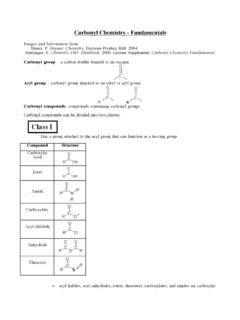
8 Summarise the different roles of the organelles within cells. Understand how tissues types are related to their function : epithelial connective muscle bone nerve ovary and testis Identify different tissue types from micrographs and diagrams and describe their structure and function. Explain how the components of different tissues work as an integrated whole. 4. Understand the principles of carbon chemistry Carbon forms a vast number of different types of compounds with other elements due to the nature of the carbon atom : alkanes, alkenes, alkynes aldehydes and ketones alcohols carboxylic acids esters Organic chemistry is the SCIENCE of the structure , properties and reactions of compounds which contain one or more carbon atoms.
9 The structure of the carbon atom eg four bonding electrons in the valence shell, forms strong bonds with elements C, O, H and N and some metals leading to the formation of a large number of compounds. Neighbouring carbon atoms can form single, double or triple bonds and learners should be able to depict these pictorially. Learners should be able to recognise members of the functional groups of the homologous series listed. OCR 2017 6 Unit 1: SCIENCE fundamentals Learning outcomes Teaching content Exemplification The Learner will: Learners must be taught: Carbon compounds can be represented using empirical and structural formulae.
10 : polymers o polyethene, polypropene, polylactate, polystyrene, polyvinylchloride Carbon compounds form different types of isomer : structural isomers geometric isomers optical isomers Carbon compounds can form large complex molecules complex carbohydrates (starch, glycogen, cellulose) Proteins and peptides from amino acids Lipids from fatty acids, glycerol and phosphorus compounds protein synthesis (transcription, translation) RNA, messenger, ribosomal and transfer Learners will be able to identify and draw structural, geometric and optical (the numbers of asymmetric carbon atoms) isomers. Carbohydrates as monomers, dimers or polymers (monosaccharides, disaccharides, polysaccharides).