Example: tourism industry
Electron affinity, Electronegativity, Ionization energy
Electron affinity, Electronegativity, Ionization energy 1. Electron affinity Definition: The energy released when an electron is added to a gaseous atom which is in its ground state to form a gaseous negative ion is defined as the first electron affinity. The …
Tags:
Information
Domain:
Source:
Link to this page:
Documents from same domain

Structures and Properties of Solids - Uni Siegen
www.chemie-biologie.uni-siegen.de2.1 Basics of Structures Trends of the atomic / ionic radii • Increase on going down a group (additional electrons in different shells) • Decrease across a period (additional electrons in the same shell) • Ionic radii increase with increasing CN (the higher its CN, the bigger the ions seems to be, due to increasing d!!!) • Ionic radius of a given atom decreases with increasing charge

Schwefel –Vorkommen,Verwendung, Gewinnung
www.chemie-biologie.uni-siegen.deSchwefel –Vorkommen,Verwendung, Gewinnung. Vorkommen: Schwefel kommt in Form von S8-Ringen in der Natur als sogenannte Schwefelblüte sowie in Verbindungen wie Sulfiden (Pyrit FeS2; Kupferkies CuFeS2; Bleiglanz PbS und Zinkblende ZnS) und Sulfaten (Gips CaSO4 × 2 H2O; Bittersalz MgSO4 und Schwerspat BaSO4) vor. Elementarer Schwefel kommt aus Sizilien, den USA, der Sowjetunion, …
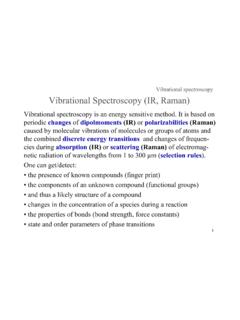
Vibrational spectroscopy Vibrational Spectroscopy (IR, Raman)
www.chemie-biologie.uni-siegen.defor the atomic . the . vibrational modes. are usually . not known: Assignment of the vibrational modes via symmetry properties of the ... 3500 3000 2500 1300 1150 1000 850 700 ν/cm-1 400 Sr(HPO OH) 22 RT 1226 1235 1225 1241 1164 1155 1170 1168 758 779 694 685 686 2881 2439 2433 2899 2440 2434 3032 3019 2400 2432 2300 2303 3176 3175
Advanced Inorganic Chemistry (Part 1) Basic Solid State ...
www.chemie-biologie.uni-siegen.de2.1 Basics of Structures Trends of the ionic radii • ionic radii increase on going down a group • radii of equal charge ions decrease across a period • ionic radii increase with increasing coordination number (the higher its CN the bigger the ions seems to be !!) • the ionic radius of a given atom decreases with increasing charge (r(Fe2 ...

pH-Wert, Berechnung von pH-Werten, pks-Wert
www.chemie-biologie.uni-siegen.depH-Wert, Berechnung von pH-Werten, pks-Wert . 1.) Der pH-Wert gibt an, wie sauer oder basisch eine wässrige Lösung wirkt. ... Pufferlösungen sind Stoffgemische, die bei Zugabe von Säure oder Lauge den pH-Wert . nahezu konstant halten. Sie bestehen immer aus einer schwachen Säure und ihrer .
Related documents

1.6 Term Symbols A brief general review of atomic ...
www.chemistry.uoguelph.caenergy due to the different electron-electron repulsion energies in these microstates. → This leads to electronic fine structure of the atom. E.g., the d2 configuration: • Two electrons can occupy any of the five d-orbitals depending on their quantum numbers m l and m s. One possible microstate would be: … Obviously there are many more ...

Density Functional Theory - University of Minnesota
pollux.chem.umn.eduUse only the electron density to determine the molecular energy: consider the system as classical: easy to determine the components of the potential energy. Nuclear-electron attraction Self-repulsion of a classical charge distribution r 1, r 2 dummy integration variables running over all space. € V ne [ρ(r)]= Z

Chapter 2 The Atomic Nucleus
www2.lbl.govthese isotopes have one electron to balance the charge of the one proton. Since chemistry depends on the interactions of protons with electrons, the chemical properties of the ... Why does the electrical repulsion among all those positive charges not cause the nucleus to break up? There must be an attractive force strong enough to be capable of

The Structure of the Sun - Space Weather Prediction Center
www.swpc.noaa.govelectron positron Gamma ray Figure 2–2.— The proton-proton fusion reaction which occurs in the core of the sun at a temperature of about 15,000,000 K. In this reaction 0.7% of the total mass disappears and is released as energy. 1. Two hydrogen nuclei (protons) collide and fuse. One proton turns into a neutron by the
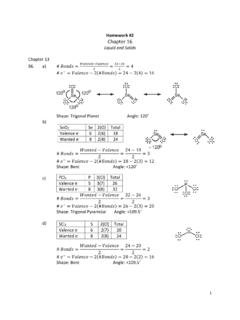
Homework #2 Chapter 16 - UC Santa Barbara
people.chem.ucsb.eduelectron on hydrogen to spend most of the time around the O, N, or F. This generates a partial positive charge on the hydrogen atom and a partial negative charge on the O, N, or F atom. The partial positive charge on the H atom is attracted to a partial negative charge on the O, N, or F atom in an adjacent molecule.