Transcription of Enterococcus Differential Agar Base (TITG Agar Base)
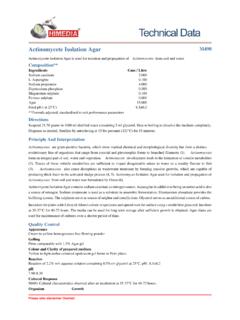
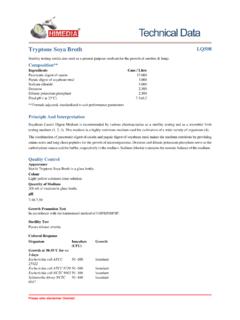
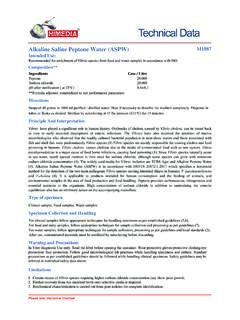
1 Please refer disclaimer Differential agar base ( titg agar Base) M1896 For selective isolation and differentiation of Enterococcus faecalis and Enterococcus faecium Composition**IngredientsGms / LitreProteose pH ( at 25 C) **Formula adjusted, standardized to suit performance parametersDirectionsSuspend 43 grams in 1000 ml distilled water. Heat to boiling to dissolve the medium completely. Sterilize by autoclaving at15lbs pressure (121 C) for 15 minutes. Cool to 45-50 C. Aseptically add rehydrated contents of one vial of TTC solution 1% (FD057). Mix well and pour into sterile Petri And InterpretationEnterococci were formerly classified as faecal steptococci. Enterococci serves as an indicator organism in monitoring foodsamples as it is cause of faecal contamination. Of the various species of Enterococci, and arefrequently found in humans.
2 The presence of Enterococci in food samples has been studied. (2,4).A variety of selective media have been recommended for the isolation of Enterococcus species (3). Enterococcus DifferentialAgar base was designed for the selective isolation and differentiation between Enterococcus faecalis and Enterococcusfaecium . The differentiation is based depending upon the reduction of tetrazolium. Enterococcus faecalis produces colonieswith a deep red centre and a narrow white periphery, whereas Enterococcus faecium produces white or pale pink peptone and beef extract serves as a source of nitrogen and vitamins. Glucose serves as a source of carbohydrate. Themedium incorporates thallium acetate as a selective inhibitory agent(1).Quality ControlAppearanceCream to yellow homogeneous free flowing powderGellingFirm, comparable with agar gelColour and Clarity of prepared mediumLight yellow coloured clear to slightly opalescent gel forms in Petri platesReactionReaction of w/v aqueous solution at 25 C.
3 PH : ResponseCultural characteristics observed with added TTC Solution 1% (FD057) after an incubation at 35-37 C for 18-24 ResponseOrganismInoculum(CFU)GrowthRecov eryColour ofcolonyCultural ResponseHiMedia LaboratoriesTechnical DataDisclaimer :User must ensure suitability of the product(s) in their application prior to use. Products conform solely to the information contained inthis and other related HiMedia publications. The information contained in this publication is based on our research and developmentwork and is to the best of our knowledge true and accurate. HiMedia Laboratories Pvt Ltd reserves the right to make changes tospecifications and information related to the products at any time. Products are not intended for human or animal or therapeutic use butfor laboratory,diagnostic, research or further manufacturing use only, unless otherwise specified.
4 Statements contained herein should notbe considered as a warranty of any kind, expressed or implied, and no liability is accepted for infringement of any Laboratories Pvt. Ltd. A-516,Swastik Disha Business Park,Via Vadhani Ind. Est., LBS Marg, Mumbai-400086, India. Customer care No.: 022-61471919 Email: Website: faecalis ATCC2921250-100good-luxuriant>=50%red or maroonEscherichia coli ATCC25922>=10 inhibited0% Enterococcus faecium ATCC1943450-100good-luxuriant>=50%Colour lessLactococcus lactis ATCC19435>=10 inhibited0%Storage and Shelf LifeStore below 30 C and the prepared medium at 2 - 8 C. Use before expiry date on , (1956)Methods for the isolation of faecal streptococci(Lancefield group D)from , , , Pot, B., Van Damme, L., Kersters, K and Haesebrouk, F. (1995) Identification of Enterococcus speciesisolated from food of animal origin.
5 Int. J. Food Microbiol. 26, , , Mayer, and Kneifel, W (2003a) Methods used for isolation, enumeration, characterization andidentification of Enterococcus Media fro isolation and enumeration. , and Hartman, (1993) Enterococci in pork processing. Prot. 56, : 0 / 2013