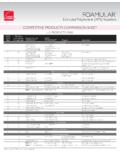
Transcription of FOAMULAR Extruded Polystrene Insulation …
1 FOAMULAR Extruded Polystrene Insulation Resisting Water Absorption, the Key for High Performance Foam Plastic Rigid Insulation Technical Bulletin FOAMULAR Extruded hydrophilic (attracts water), and, Figure 1. Polystyrene Insulation 2) the cell structure must be truly Extruded Polystyrene Cell Structure Owens Corning manufactures a closed. complete line of FOAMULAR . Extruded polystyrene Closed Cell: What it Means Insulation (XPS) products Foam plastics insulate by trapping for use in residential and an insulating gas inside millions commercial construction. The of tiny plastic bubbles, or, cells.
2 Primary difference between Insulation that absorbs water Cell Wall Cell FOAMULAR XPS products is into the cells loses R- value. A. foam plastic Insulation that has Figure 2. compressive strength ranging Polyisocyanurate Cell Structure from 15 psi to 100 psi. The a closed cell structure absorbs a variety provides common minimum amount of water thus strength products for use in retaining R-value. Often all foam walls where there is almost no plastic insulations are referred to compressive load; or, intermediate as closed cell . It is important to strength product for use with know what closed cell means modest loads such as around and then relate it to specific foundations, or in low slope Insulation types.
3 Cell Wall Cell roofs; or, high strength product FOAMULAR XPS viewed under Figure 3. Expanded Polystyrene Cell Structure suitable for use under high load a microscope (Figure 1) shows floors or plaza decks. The general a homogeneous cross section FOAMULAR XPS product line of very well defined, uniform has an R-value of 5 per inch of cells with continuous walls. thickness, while faced sheathing The cell walls are comprised of products are available with an R-3 hydrophobic (does not bond with for 1/2 or R-4 for 3/4 thick. water) polystyrene polymer. That Resisting Water Absorption, combination of characteristics, Cell Edge of Bead Air Space the Key for High closed cell/hydrophobic, results in a very low rate of water Expanded polystyrene (EPS).
4 Performance Insulation absorption compared to other Insulation (Figure 3) is comprised The greatest attribute of types of foam plastic Insulation . of polystyrene beads fused FOAMULAR XPS is its ability to together under heat and pressure. retain R-value and compressive Polyisocyanurate Insulation (Figure Although the beads themselves strength even when exposed to 2), by its nature, has a less well are closed cell and hydrophobic, water. Insulation products that defined cell structure, meaning the air spaces between the absorb water lose R-value, and cells tend to be irregular in shape beads allow water and air to structural integrity.
5 Water is a and size and sometimes blended penetrate the board structure. good conductor of energy, so if together. Irregular cells, combined The air spaces between the Insulation is water soaked, R-value with a hydrophilic chemical beads lower the R-value of the is lost. There are two keys for tendency (seeks to bond with board because air has a higher resistance to water absorption: water) results in higher water thermal conductivity than the 1) the plastic itself must be absorption compared to XPS. insulating gas in the cells. The air hydrophobic (repels water), not spaces also provide a path for FOAMULAR Extruded Polystrene Insulation Resisting Water Absorption, the Key for High Performance Foam Plastic Rigid Insulation Technical Bulletin water penetration, raising water Figure 4.
6 Absorption for the complete Water Absorption, XPS vs. Polyiso board. Comparing Properties: What Do They Mean? Published properties for different types of Insulation are not % Volume always directly comparable because different test methods may be used to measure the same properties. If different methods are used to measure performance, identify the differences. They may be significant. XPS Method, ASTM C 272, Polyiso Method, ASTM C 209, Water Absorption 24 Hour Immersed, No Drain 2 Hour Immersed, 10 min. Drain For example, the material standard that defines XPS, Type VI,VII,V. XPS, Type X, IV.
7 Polyiso, Glass Faced Polyiso, Foil Faced properties for all XPS and EPS. is ASTM It requires Figure 5. that polystyrene Insulation be Water Absorption, XPS vs. EPS. tested for water absorption in accordance with ASTM C272 requires the polystyrene sample to be immersed in water for 24 hours, and weighed immediately upon removal from % Volume immersion to determine the amount of absorbed water. The material standard for polyisocyanurate is ASTM It requires that polyiso be tested for water absorption in accordance with ASTM C209 requires the polyiso sample 2 hour 24 hour 7 day 14 day to be immersed in water 2 hours, and drained for 10 minutes before weighing for water absorption.
8 FOAMULAR 250 EPS w/facer EPS, facer removed Figure 4 shows the significant differences in XPS and polyiso water absorption that result FOAMULAR Extruded Polystrene Insulation Resisting Water Absorption, the Key for High Performance Foam Plastic Rigid Insulation Technical Bulletin Figure 6 R-Value & Water Compressive Strength after Water Immersion Absorption 45 Insulation products that absorb 40 water lose R-value. Water is a good conductor of energy, so if 35 Insulation is water soaked, R-value lbs. per sq. in. (psi). 30 is lost. See Figure 7. 25 R-Value & Reflective Foil Facers 20. Some rigid foam plastic Insulation 15 products have foil facers on them that some manufacturers claim 10 add R-value to the wall.
9 The 5 presence of a foil surface can add R-value to a wall if two conditions 0 are FOAMULAR 250 EPS Polyiso Woodfiber 1. The foil must be adjacent to a As Received After 24 Hour Immersion sealed air space; and, 2. The air space must be of from using different measuring Facers also make a difference in uniform thickness, bounded techniques. Note that the water EPS water absorption. Figure 5. by plane, smooth and parallel absorption level for polyiso shows the significant changes in surfaces. increases greatly when tested by the water absorption levels of the same method used for XPS. EPS when facers are removed, If these conditions are not Glass faced polyiso goes from and when immersion time is met, the foil does not provide absorbing 14x more water than increased.
10 Over time, water any increase in R-value. Most XPS, to absorbing 30x more creeps into the spaces between foil faced sheathing is installed water than XPS, when measured EPS beads, lowering R-value and under beveled vinyl or other using the same method. Foil faced raising the risk of beads breaking type of beveled siding, and/or, polyiso goes from absorbing apart with the expansion forces not adjacent to an air space. In more water than XPS, to of freezing and thawing. such situations, the foil does not absorbing over 7x more water provide any increase in R-value. than XPS. Because the presence Compressive Strength &.