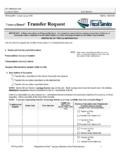
Transcription of FS Form 5511 - TreasuryDirect
1 RESET. For official use only: Customer Name Case Number FS Form 5511 (revised January 2018) omb no . 1535-0138. TreasuryDirect Transfer Request IMPORTANT: Follow instructions in filling out this form. You should be aware that the making of any false, fictitious, or fraudulent claim or statement to the United States is a crime that is punishable by fine and/or imprisonment. PRINT IN INK OR TYPE ALL INFORMATION. Use this form to request the transfer of securities in a TreasuryDirect account. 1. TreasuryDirect Account Information NOTE: If transferring securities from either a custom, minor, or conversion linked account, show only TreasuryDirect Account Number: the number for the linked account.
2 TreasuryDirect Account Name: Taxpayer Identification Number (SSN or EIN): 2. Description of Securities Transfer ALL securities for the above TreasuryDirect account. Transfer the securities described on the attached list. Transfer the securities described below. NOTE: Series EE and Series I savings bonds may not be split. Each savings bond must be transferred in its entirety. Marketable securities may be transferred in full or in increments of $100. If this is a marketable security transaction, I understand that all scheduled reinvestments related to this security, or these securities, will be canceled at the time of the transfer.
3 NOTE: If you are requesting transfer of savings bonds to a trust, carefully read and complete Page 2. CUSIP No. Portion of Security to be Transferred Confirmation (Bills, Notes, Issue Date Face Amount (If neither square is selected, Number Bonds, FRNs, TIPS. transfer in FULL will be assumed.). only). Transfer in FULL. OR. Transfer to the Extent of $. Transfer in FULL. OR. Transfer to the Extent of $. Transfer in FULL. OR. Transfer to the Extent of $. Transfer in FULL. OR. Transfer to the Extent of $.
4 FS Form 5511 Department of the Treasury | Bureau of the Fiscal Service 1. TAX LIABILITY NOTICE (Carefully read before completing the Tax Liability Statement below.). Upon the transfer of savings bonds to a trust, you must include in your gross income any accumulated interest on the bonds, if you have not already reported it, unless, under the grantor trust provisions of the Internal Revenue Code, you are treated as the owner of the portion of the trust represented by any tax-deferred accumulated interest on the transferred bonds.
5 If you are treated as the owner of that portion, the accumulated interest continues to be your income rather than that of the trust, and therefore, you may continue to defer reporting the interest earned each year. You must include the total accumulated interest in your gross income when the bonds are disposed of or finally mature, whichever is earlier. These rules apply when bonds being transferred are Series I or EE bonds, if you are the owner of the portion of the trust represented by the tax-deferred accumulated interest.
6 Generally, you will be treated as the owner of a trust that you have created to the extent that you retain certain powers over or interests in the trust. For example, you will be treated as the owner of the portion of the trust represented by any tax-deferred accumulated interest on the transferred bonds under the following circumstances: (1) You will be treated as the owner of a trust to the extent that you have an unconditional power to revest in yourself title to the trust assets. Thus, if you can, at your discretion, revoke all or part of the trust so that the bonds will be returned to you, you will be treated as the owner of the portion of the trust represented by any accumulated interest on the bonds.
7 (2) If the trust instrument provides that the transferred bonds or the proceeds from the redemption or disposition of those bonds must be distributed to you or your spouse, or held or accumulated for future distribution to you or your spouse, you will be treated as the owner of the portion of the trust represented by any accumulated interest on the bonds. You will be treated as the owner in this circumstance irrespective of the terms of the trust. (3) You will be treated as the owner of a trust to the extent that you retain a power to control the beneficial enjoyment of property transferred to a trust.
8 Thus, if you retain, under the terms of the trust instrument, an immediately exercisable power to determine, in your sole discretion, who will receive the bonds or the proceeds from the redemption or disposition of the bonds, then you will be treated as the owner of the portion of the trust represented by any accumulated interest. The examples outlined above are illustrative only and they are not intended to cover all possible situations in which you could be treated as the owner of a trust or a portion of a trust.
9 Furthermore, events can occur, such as the renunciation of a retained power or interest, which would cause you to cease being treated as the owner of a trust. If you are not sure whether you will be treated as the owner of a trust, you may request a letter ruling from the Internal Revenue Service. A request for a letter ruling should be sent to: Internal Revenue Service, ATTN: CC: DOM: CORP: T, PO. Box 7604, Ben Franklin Station, Washington, DC 20044. For more information, visit TAX LIABILITY STATEMENT (This section must be completed if you are transferring savings bonds to a trust.)
10 You must mark box "a" or "b" to indicate if you are the owner of the portion of the trust represented. (See TAX LIABILITY NOTICE above.). Interest includes interest earned on EE or I bonds from the issue date until the date of transfer. This statement will also apply to all future transactions requested by the same owner(s) or person(s) entitled to the same trust. For federal income tax purposes: a. I certify that I will be treated as owner of the portion of the trust represented by the tax-deferred accumulated interest on the bonds being transferred.