Example: marketing
Generative Adversarial Text to Image Synthesis
Generative adversarial networks (Goodfellow et al.,2014) have also benefited from convolutional decoder networks, for the generator network module.Denton et al.(2015) used a Laplacian pyramid of adversarial generator and dis-criminators to synthesize images at multiple resolutions. This work generated compelling high-resolution images
Tags:
Information
Domain:
Source:
Link to this page:
Documents from same domain

On the di culty of training recurrent neural networks
proceedings.mlr.pressOn the di culty of training recurrent neural networks @Et+1 @xt+1 Et Et+1 Et 1 xt 1 xt +1 ut +11 u tu @Et @xt @Et1 @xt1 @ xt +2 @xt +1 @x +1 x @xt1 @xt1 @xt2 Figure 2. Unrolling recurrent neural networks in time by creating a copy of the model for each time step.
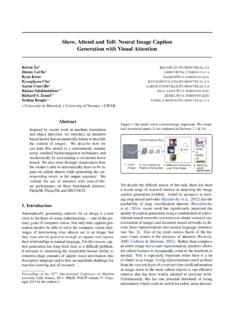
Show, Attend and Tell: Neural Image CaptionGeneration …
proceedings.mlr.pressShow, Attend and Tell: Neural Image Caption Generation with Visual Attention Kelvin Xu? KELVIN.XU@UMONTREAL.CA Jimmy Lei Bay JIMMY@PSI.UTORONTO.CA Ryan Kirosy RKIROS@CS.TORONTO.EDU Kyunghyun Cho?
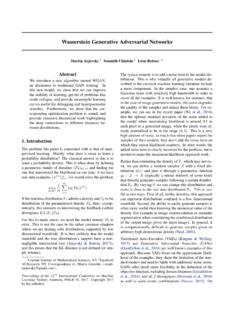
Wasserstein Generative Adversarial Networks
proceedings.mlr.pressWasserstein Generative Adversarial Networks Figure 1: These plots show ˆ(P ;P 0) as a function of when ˆis the EM distance (left plot) or the JS divergence (right plot).The EM plot is continuous and provides a usable gradient everywhere.
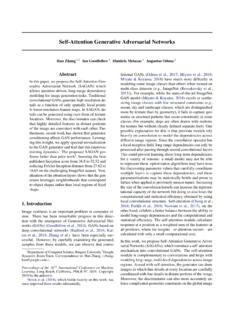
Self-Attention Generative Adversarial Networks
proceedings.mlr.pressSelf-Attention Generative Adversarial Networks Figure 1. The proposed SAGAN generates images by leveraging complementary features in distant portions of the image rather than local regions of fixed shape to generate consistent objects/scenarios. In each row, the first image shows five representative query locations with color coded dots.
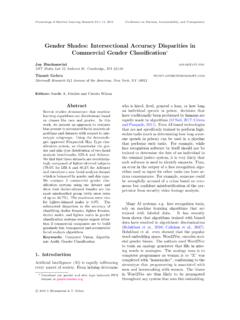
Gender Shades: Intersectional Accuracy Disparities in ...
proceedings.mlr.press117 million Americans are included in law en-forcement face recognition networks. A year-long research investigation across 100 police de-partments revealed that African-American indi-viduals are more likely to be stopped by law enforcement and be subjected to face recogni-tion searches than individuals of other ethnici-ties (Garvie et al.,2016).

TPOT: A Tree-based Pipeline Optimization Tool for ...
proceedings.mlr.pressJMLR: Workshop and Conference Proceedings 64:66{74, 2016 ICML 2016 AutoML Workshop TPOT: A Tree-based Pipeline Optimization Tool for Automating Machine …
Ensembles for Time Series Forecasting
proceedings.mlr.pressEnsembles for Time Series Forecasting set of real world time series. Our results clearly indicate that this is a promising research direction. In Section2we provide a brief description of the tasks being tackled in this paper.

Deep Gaussian Processes
proceedings.mlr.pressrepresentational power of a Gaussian process in the same role is significantly greater than that of an RBM. For the GP the corresponding likelihood is over a continuous vari-able, but it is a nonlinear function of the inputs, p(yjx) = N yjf(x);˙2; where N j ;˙2 is a Gaussian density with mean and variance ˙2. In this case the likelihood is ...
Noise-contrastive estimation: A new estimation principle ...
proceedings.mlr.pressated noise y. The estimation principle thus relies on noise with which the data is contrasted, so that we will refer to the new method as “noise-contrastive estima-tion”. In Section 2, we formally define noise-contrastive es-timation, establish fundamental statistical properties, and make the connection to supervised learning ex-plicit.

Variational Inference with Normalizing Flows
proceedings.mlr.pressprovement in performance (Mnih & Gregor,2014). There is also a large body of evidence that describes the detri-mental effect of limited posterior approximations.Turner & Sahani(2011) provide an exposition of two commonly experienced problems. The first is the widely-observed problem of under-estimation of the variance of the poste-
Related documents
Deep Learning Based Text Classification: A Comprehensive ...
arxiv.orgincluding recurrent neural networks (RNNs), convolutional neural networks (CNNs), attention, Transformers, Capsule Nets, and so on. The contributions of this paper can be summarized as follows: ... the task of measuring the semantic similarity of a sentence pair indicating how likely one sentence is a paraphrase of the other. 1.2 Paper Structure
MSR-VTT: A Large Video Description Dataset for Bridging ...
www.microsoft.comthe input to the long-term recurrent convolutional networks to output sentences [7]. In [35], Venugopalan et al. design an encoder-decoder neural network to generate description-s. By mean pooling, the features over all frames can be represented by one single vector, which is the input of the RNN. Compared to mean-pooling, Li et al. propose to u-

Learning Convolutional Neural Networks for Graphs
proceedings.mlr.pressLearning Convolutional Neural Networks for Graphs 3. Background We provide a brief introduction to the required background in convolutional networks and graph theory. 3.1. Convolutional Neural Networks CNNs were inspired by earlier work that showed that the visual cortex in animals contains complex arrangements
Show, Attend and Tell: Neural Image CaptionGeneration …
proceedings.mlr.pressanalogous to “translating” an image to a sentence. The first approach to using neural networks for caption gen-eration was proposed byKiros et al.(2014a) who used a multimodal log-bilinear model that was biased by features from the image. This work was later followed byKiros et al.(2014b) whose method was designed to explicitly al-