Transcription of Hose End Regulator
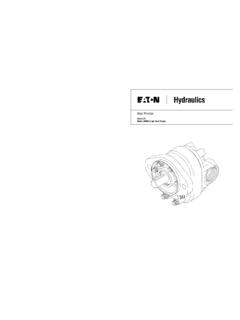
1 SM60129-1 April 2011 Applicable additional manuals: Aerospace Group Conveyance Systems Division Carter Brand Ground Fueling Equipment SM60427 Nozzle SM40679 Quick Disconnect SM427 MISC Misc. Adapters SM61154 Dry Break Disconnect SM64348 Nozzle SM64200 Nozzle Maintenance Manual Hose End Regulator To Mate Model 60427 Nozzle Model 60129-1 SM60129-1 April 2011 2 TABLE OF CONTENTS Page Introduction .. 3 Equipment 3 Table Of 3 Safety Instructions .. 4 Special 4 4 5 Reassembly.
2 6 Test .. 6 Illustrated Parts Catalog .. 7 Figure 1 - Options for 9 Figure 2 - Parts Breakdown .. 10 Figure 3 - 61656 blockout device .. 11 Figure 4 - Typical Lapping 11 SM60129-1 April 2011 3 Maintenance, Overhaul & Test Instructions Eaton Carter Brand Model 60129-1 Hose End Regulator INTRODUCTION This manual furnishes detailed instructions covering the maintenance and overhaul of Eaton s Carter brand Model 60129-1 hose end Regulator and its various options. The 60129-1 and earlier Model 40680 are interchangeable.
3 Model 60129-1 is designed to provide a relatively fixed pressure at its outlet. Three pressure settings (35, 45, and 55 psi) are available and are procured by specifying the pressure setting as the dash number to the basic model number, 60129-14 is a Regulator with a 45 psi spring (3 for 35 and 5 for 55 psi units). When the Regulator is obtained as an integral part or option to a nozzle it is specified as noted in paragraph EQUIPMENT DESCRIPTION Eaton s Carter brand Model 60129-1 hose end Regulator is designed to be used as a part of Eaton s Carter brand nozzle models 60427, 64200 or 64348 or as a stand alone unit, to provide a relatively maximum pressure at its outlet ("nozzle pressure") to control the flow of fuel into the aircraft.
4 In addition the unit responds to increases in pressure within the aircraft fuel manifold caused by closure of the aircraft's tank level control valves to either maintain the desired maximum pressure or to close to prevent an excessive "surge" pressure from being allowed within the aircraft. The unit is a direct acting, spring loaded Regulator which will control pressure at its outlet in accordance with the spring force provided therein. A double ended piston of different areas is balanced against the spring and atmospheric pressure to provide the control. The smaller end of the piston is vented to the atmosphere through a screened breather to provide an atmospheric pressure reference point. TABLE OF OPTIONS See Model 60129-1 brochure for additional information.
5 Part 1 - Model number 60129-1 Part 4 - Letter describing the inlet thread type & size Part 3 - Number describing the male adapter required to mate the desired inlet configuration. Part 2 - Options A-F, N, R, T, W & 3-5 describing various changes to the basic configuration. Part 2 Option Description Option Description *A 40 mesh screen N Adds 2 " NPT male straight outlet (40779) *B 60 mesh screen R Adds inlet adapter to mate flight refueling disconnect (41600) *C 100 mesh screen T Adds adapter flange to outlet to mate military nozzle (60797) D Adds 2 " BSPP male straight outlet (40913) W Inlet and outlet flanges to mate Whittaker F116/ F117 nozzles.
6 Can only be used with options 3-5. E Adds 2 " NPT female straight inlet (41914) **3 Specifies 35 psi spring setting F Adds outlet adapter to mate Thiem F116/F117 nozzle (60435) **4 Specifies 45 psi spring setting **5 Specifies 55 psi spring setting * Options B & C only available when a male half from part 3 or option R is specified. Option A available with option 7 from part 3 only. ** The spring setting number must be included at the end of part 2. SM60129-1 April 2011 4 Part 3 One of the numbers below must be included as Part 3, as indicated above, to specify the type of inlet configuration desired, except when option R is ordered.
7 The hose end Regulator may be ordered with the inlet terminating in an adapter half only, if desired. In this case leave Part 4 blank. If a female half, either quick disconnect or dry break of some configuration is desired, Part 4 must be completed. Option Description 6 Adds male adapter half (43046) to mate standard female QD 43108 & old style dry break QD 60672-1 7 Adds male adapter half to mate 61154 dry break (44185) Part 4 One of the following letters must be included as Part 4 as indicated above to specify the inlet thread and size: Option Description Option Description H Inlet thread - 2 " NPT M Inlet thread - 3" BSPP K Inlet thread - 2 " BSPP P Inlet thread - 2" NPT L Inlet thread - 3" NPT Examples: 60129-14 45 psi Hose End Regulator with inlet and outlet to mate 60427 Nozzle.
8 (Formerly ordered as 40680-45 or 60129-1-45). 60129-1EN3 35 psi hose end Regulator with 2 " NPT female inlet fitting and 2 " NPT male outlet fitting. 60129-1C56K 55 psi hose end Regulator with 100 mesh screen, outlet to mate 60427 nozzle and inlet with 2 " BSPP QD If the unit is to be ordered as a part of the nozzle, refer to the appropriate service manual for ordering information. All current production units utilize the same Housing (23) and there is no external way of distinguishing between them. The 55 psi unit previously utilized Housing (23A) which had either a yellow painted or alodined (gold or yellow color) stripe around the housing or the housing was completely yellow. (It was the consensus of the industry that this was no longer desired).
9 The individual springs are color coded as explained in a later section of this manual. (Older units may have the entire body alodined or be black with no identification as to spring setting). SAFETY INSTRUCTIONS NOTE: The subject Regulator incorporates a highly loaded spring that moves the piston against the pressure during operation. It is worth noting that one should take care in disassembly so as not to be injured by the spring loaded piston. The smaller end of the piston is vented to the atmosphere through a breather. Due to the fact that the piston is sealed with a sliding Teflon seal there is always a minute amount of leakage from the pressure side of the piston to the chamber behind the piston. As the amount of fuel increases in this cavity, it will be forced out of the breather with each stroke of the piston.
10 This small leakage is normal, however as wear on the seal and piston become more with use the leakage will become more significant and the parts should be replaced. Care should be exercised such that the breather is not pointed toward the operator during operation to prevent fuel from coming into contact with sensitive areas of the body. The breather port should not be plugged at any time. This will make the unit inoperable. SPECIAL TOOLS The following special tools are recommended for proper repair and or overhaul of the hose end control valve: 61607 Ball Assembly Tool. 61656 Blockout device. No part number - Seal run-in tool - See Figure 4. WL4680 Torque Wrench or Standard torque wrench is required for some disassembly and re-assembly.