Transcription of Installation Operation Maintenance Manual - …
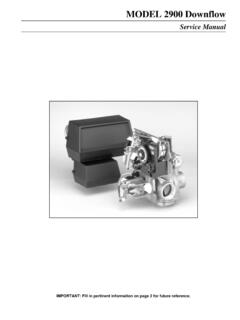
1 9000/9100/9500 Duplex Series Installation Operation Maintenance Manual Duplex Softener With 9000/9100/9500 Series Downflow Brining Valve 20-350 litres Resin Inc. Measuring Tank Option Models: Mechanical Meter/Timer SXT Electronic Meter/Timer 9xDXIOMM\page 1. 9000/9100/9500 Duplex Watersoftener Installation Operation Maintenance Manual CONTENTS. NOS. PAGE. GENERAL NOTES 5. THE SOFTENING PROCESS 6. In Service 6. Regeneration 6. The Regeneration Process 7. Meter Control of Regeneration Initiation 7. Duplex Operation 8. UNPACKING AND PARTS IDENTIFICATION 9. Basic Packages 9. Unpacking Notes 9. Missing or Damaged Goods 9. TEMPORARY STORAGE 9. DESCRIPTION OF PLANT COMPONENTS 10. Softener Vessel and Internals 10.
2 Control Valve 10. Regeneration Controller and Transformer 10. Brine System 11. PRE- Installation CHECKS 12. Mechanical 12. Foundations/Drainage 12. Operating Space 12. Incoming Water 12. Pipework 13. Water Supply Company Requirements 13. Electrical 13. 9xDXIOMM\page 2. 9000/9100/9500 Duplex Watersoftener Installation Operation Maintenance Manual NOS. PAGE. ASSEMBLY/ Installation 14. Mechanical 14. Assembling Vessel, Riser Tube and Internals 14. Charging the Resin 14. Assembling the Control Valve 15. Attatching the Control Valve and Slave Adapter 15. Brine System 15. Pipework 15. Storage tank ball valve 16. Drains and Overflow Connections 16. Electrical 17. Mains Supply 17. Transformer 17. COMMISSIONING 18.
3 Introduction 18. Controller Setting 18. Setting the Time of Day 18. Site Program Setting the Capacity 18. Brine System 19. Brine Tank Filling 19. Pre Service Flush and Regeneration (MI) 20. Pre Service Flush and Regeneration (SXT) 22. 9xDXIOMM\page 3. 9000/9100/9500 Duplex Watersoftener Installation Operation Maintenance Manual NOS. PAGE. Operation 23. Normal Operation 23. Refilling with Salt 23. Manual Regeneration 23. By-passing the Softener 23. Temporary Shut-down 24. Changes in Incoming Water 24. Routine Monitoring 25. FAULT FINDING AND RECTIFICATION 26. No Flow to Service 26. Poor Treated Water Quality 26. No Regeneration 27. Unsatisfactory Capacity between Regeneration's 27. WARRANTY AND SERVICE 28.
4 After Sale Warranty 28. TECHNICAL DATA 29. Process and Operating 29. Engineering Data 34. FACTORY PROGRAMMING. Regeneration Settings 39. Softener Outputs 40. Master Programming Setup Summary 9000/9100 41. Master Programming Setup Summary 9500 43. DRAWINGS. Dimensions 45. General Installation 46. CE CERTIFICATE 48. APPENDIX I. Resin MSDS. APPENDIX II. Valve manufacturer's Manual including parts lists and exploded diagrams 9xDXIOMM\page 4. 9000/9100/9500 Duplex Watersoftener Installation Operation Maintenance Manual GENERAL NOTES. These instructions cover the 9000/9100/9500 Range of Duplex Water Softeners, which includes models ranging in size from 20-120 litres resin volume fitter with Mechanical Meter/Timer or SXT Electronic Meter/Timer.
5 It is recommended that these instructions are read throughout before commencing any work on the unit, particularly if you have no previous experience of installing and using a water softener. The Installation of a softener is very straightforwards, and the only adjustments to be made to the controller program are setting the water hardness as detailed in Section 8. However we have tried to make these instructions as comprehensive as possible to answer any queries you may have about the functioning of your softener. This softener will require salt for regeneration. We recommend the used of proprietary 'pellet' or 'tablet' salt. Drinking softened water has not been shown to be harmful to normal healthy children and adults, but softened water contains a higher level of Sodium than a hard town mains supply.
6 This is of concern to individuals on low Sodium diets or for babies fed with powder formula milk that already contains Sodium. It is therefore recommended that a separate un-softened drinking water supply is left in place or installed on a drinking water faucet. If a cartridge type water filter is installed on the drinking water line, this must be fed with un-softened water. We have also supplied with the system the original valve manufacturer's handbook. This is written principally for American customers and has a number of small differences in the setting up instructions from those used in Europe. In the event of confusion, refer to the data in this Manual rather than in the valve manufacturer's handbook!
7 9xDXIOMM\page 5. 9000/9100/9500 Duplex Watersoftener Installation Operation Maintenance Manual THE SOFTENING PROCESS. Hardness in water is caused by the presence of dissolved salts of Calcium and Magnesium. In order to overcome the problems associated with the use of hard water, these salts must be removed. This process is called 'Softening'. One means of removing the salts is to exchange them for soluble Sodium salts. This technique is known as 'Ion Exchange Softening'. IN SERVICE. In order to soften the water, it is passed through a bed of Ion Exchange resin beads which are contained inside a vertical cylindrical vessel. these beads are made of a synthetic material, and are usually amber or dark brown in colour and between and mm in diameter.
8 As the water flows down through the resin, the Calcium and Magnesium in the hard water are progressively exchanged for Sodium, with the result that the water which flows out of the unit contains only Sodium salts, which are not scale-forming. The Calcium and Magnesium remain, attached to the resin. The Ion Exchange resin does not have an unlimited capacity for exchanging Calcium and Magnesium, so to keep the exit water soft it is necessary to periodically 'Regenerate' the resin to restore its capacity to soften the water. REGENERATION. The softening process can be reversed if a strong solution of Sodium Chloride ( Common salt dissolved in water -'brine') is passed through the resin. The high concentration of Sodium allows it to exchange for the Calcium and Magnesium held on the resin, and these are then carried away to drain.
9 The resin is left full of Sodium to enable it to soften water again. 9xDXIOMM\page 6. 9000/9100/9500 Duplex Watersoftener Installation Operation Maintenance Manual THE REGENERATION PROCESS. The regeneration process consists of four stages:- Backwash - Water flows upwards through the resin bed, and out to a drain. As it does so, it loosens the ion exchange beads, removes any resin 'fines'. ( small pieces of broken beads etc.) and cleans off any particles of dirt or pipework corrosion products which may have accumulated during the service cycle. Brine injection/Displacement Rinse - During the first part of this stage, the concentrated salt -solution is drawn from the salt storage tank, blended with water to reduce the concentration to the correct level, and passed down through the resin.
10 When the required quantity of brine has been drawn in, the water flows alone to push the remaining brine through the resin at the correct rate, and ensure that all the resin sees the right amount of regenerant. Fast Rinse - This follows the brine injection and displacement rinse stage, and entails rinsing away the residual brine and Calcium and Magnesium salts from the resin and re-packing the resin bed down. This is done down with water flowing through the resin in the direction of service. Salt Tank Refill - Following the fast rinse, a quantity of water sufficient to dissolve the correct amount of salt for the next regeneration is returned to the salt tank. When this has finished, the unit automatically returns to service.