Example: marketing
Intermolecular and Ionic Forces
record its mass in your lab notebook. 3. In the hood, carefully add only 10 drops of the ethanol liquid into the beaker. Reweigh the beaker, and record its mass in your lab notebook. 4. Take the beaker back to the hood, and set a timer for 3 minutes. 5. When the timer goes off for each liquid, weigh the sample again, and record its mass in your lab
Tags:
Information
Domain:
Source:
Link to this page:
Documents from same domain

Chapter 14. CHEMICAL EQUILIBRIUM
web.gccaz.eduChapter 14. CHEMICAL EQUILIBRIUM 14.1 THE CONCEPT OF EQUILIBRIUM AND THE EQUILIBRIUM CONSTANT Many chemical reactions do not go to completion but instead attain a ...
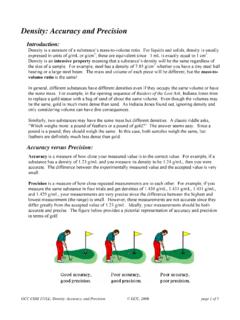
Density: Accuracy and Precision
web.gccaz.eduGCC CHM 151LL: Density: Accuracy, and Precision © GCC, 2008 page 4 of 5 glassware. ... 1. Obtain a set of 4 brass slugs and 1 aluminum slug. 2.
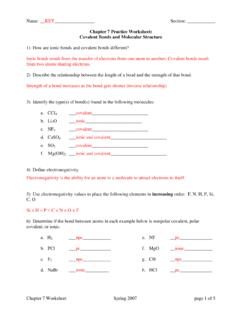
Chapter 7 Practice Worksheet: Covalent Bonds and Molecular ...
web.gccaz.eduChapter 7 Worksheet Spring 2007 page 1 of 5 Chapter 7 Practice Worksheet: Covalent Bonds and Molecular Structure 1) How are ionic bonds and covalent bonds different? ... f. Mg(OH) 2 ___ ionic and covalent _____ 4) Define electronegativity. Electronegativity is the ability for an atom in a molecule to attract electrons to itself. ...

Balancing Equations Worksheet KEY
web.gccaz.eduBalancing Equations Worksheet KEY 1. Zn (s) + 2 AgNO 3 (aq) ⇒ Zn(NO 3) 2 (aq) + 2 Ag (s) 2. N 2 (g) + 3 H 2 (g) ⇒ 2 NH 3 (g) 3. NaCl (aq) + AgC 2H 3O 2 (aq) ⇒ NaC 2H 3O 2 (aq) + AgCl (s) 4. 3 Mg(OH) 2 (aq) + 2 H 3PO 4 (aq) ⇒ 6 H 2O (l) + Mg 3(PO 4 ) 2 (aq) 5. 2 HNO 3 (aq) + Ni (s) ⇒ Ni(NO 3) 2 (aq) + H 2 (g) 6. Ba(HCO 3) 2 (s) ⇒ BaCO 3 (s) + H 2O (g) + CO
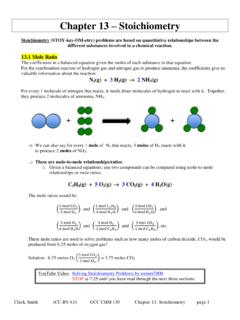
Chapter 13 Stoichiometry - Glendale Community College
web.gccaz.eduChapter 13 – Stoichiometry Stoichiometry (STOY-key-OM-etry) problems are based on quantitative relationships between the different substances involved in a chemical reaction.

Intermolecular and Ionic Forces - web.gccaz.edu
web.gccaz.eduIntermolecular and Ionic Forces ... general, intermolecular forces are much weaker than the ionic and covalent bonds that hold together the atoms and ions in a compound. ... compared in this lab. The alkane used in this activity is pentane, CH 3 CH 2 CH 2 CH 2 CH 3. Alcohols are

Marine Biology: Study Guide - web.gccaz.edu
web.gccaz.eduBIO145: Marine Biology 3 Study Guide Chapter 10 An Introduction to Ecology Ecology is the scientific study of the interactions between organisms and their environment that determine the distribution and abundance of organisms.

CHM 130LL: Electrolytes - Welcome to web.gccaz.edu
web.gccaz.edumainly in body fluids outside the cells. Human body fluids have almost the ... CHM 130LL: Electrolytes Lab . GCC CHM 130LL Spring 2016 page 2 of 7 Understanding ... This makes it possible to identify which substance is in which well (ex: A3 or C2). In your data table (on the next page), ...
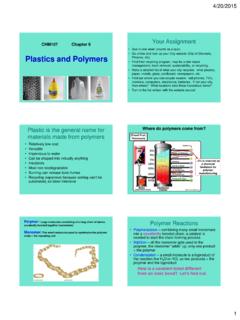
Polymers and Plastics - web.gccaz.edu
web.gccaz.edua chemical feedstock for polymer manufacturing Polymer: ... • Now back to polymers and plastics Given these monomers predict the structure of the polymer Ethylene Vinyl chloride ... recycle numbers are these plastics? • Plastic comes from oil – so less recycling means

CHM 130 Predicting Products Worksheet
web.gccaz.eduCHM 130 Predicting Products Worksheet Circle the appropriate reaction type for each, complete the reaction with products (remember to check charges for ionic compounds), include states, and finally balance each reaction.
Related documents

Experiment 8 The thermodynamics of the solubility of borax
www.chemistrylabmanual.comPre-Lab Assignment Before coming to lab: • Read the lab thoroughly. • Answer the pre-lab questions that appear at the end of this lab exercise. The questions should be answered on a separate (new) page of your lab notebook. Be sure to show all work, round answers, and include units on all answers. Background information can be

Qualitative Analysis of Anions - Lab Manuals for Ventura ...
www.chemistrylabmanual.comthe lab manual to complete in your lab notebook the following sections of the report for this lab exercise: Title, Lab Purpose, Procedure and Data Tables. Purpose The purpose of this experiment is to determine what anions are present in an unknown sample.

ECE 2110 Electrical Engineering Laboratory I
www.clemson.eduAug 17, 2020 · experiments. The LTA is expected to grade the lab notebooks and reports in a fair and timely manner. The reports should be returned to the students in the next lab period following submission. The LTA should report any errors in the lab manual to the faculty coordinator. 1.3Faculty Coordinator Responsibilities
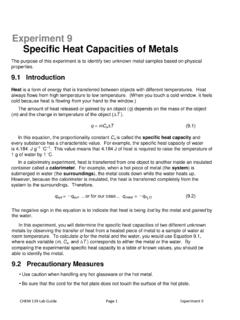
Experiment 9 Specific Heat Capacities of Metals
www2.chem21labs.comCHEM 139 Lab Guide Page 2 Experiment 9 9.3 Experimental Set up your notebook as usual, recording the title, objective and procedure. 1. Using a hot plate, heat about 400 mL of water to a rolling boil in a 600 mL or 800 mL beaker. Keep an eye on the level of the water bath, and add more water if the level gets too low. 2.
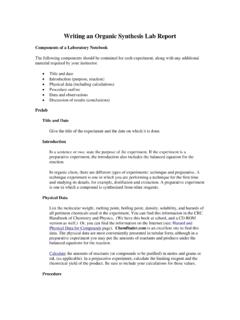
Writing an Organic Chemistry Lab Report
chemistry.miamioh.eduWriting an Organic Synthesis Lab Report . Components of a Laboratory Notebook. The following components should be contained for each experiment, along with any additional material required by your instructor. • Title and date • Introduction (purpose, reaction) • Physical data (including calculations) • Procedure outline
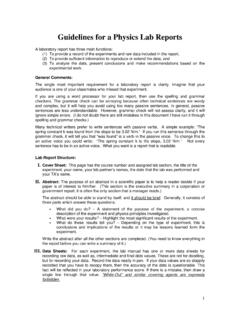
Guidelines for a Physics Lab Reports - Baylor University
www.baylor.eduOct 21, 2005 · Your lab instructor’s initials. If you happen to forget your lab manual, then you will take your data on notebook paper. Your lab instructor will initial that as your data sheet and you will turn that in with your lab report as well as your own data sheet from the lab manual. You may not use your lab

Writing a Formal Lab Report - Germanna Community …
www.germanna.eduWriting a Formal Lab Report Note: This handout provides guidelines for writing a formal, typed laboratory report for a Biology, Chemistry, Natural Science, or Physics class. Routine lab “write-ups” such as those used in a laboratory notebook may follow a similar format and style, but they are usually written in pen during

Laboratory Training Manual
static.training.nij.govpdi_lab_userguide.pdf President's DNA Initiative - DNA Analyst Training Page 4 of 13. Structure of the Laboratory Training Manual ... • Evaluation of the trainee’s notebook for each exercise • Documentation of problem areas, as applicable, and their solutions or proposed solutions

Case Studies - APS Home
www.aps.orgMay 09, 2007 · an inherent desire to be safe, but the extent to which safety procedures are practiced in the lab depends on a range of factors, including prior experience, an understanding of appropriate procedures, and an understanding of what harm may come from failing to follow these procedures. Formal safety training is often useful to fill in