Example: bachelor of science
Intermolecular and Ionic Forces
GCC CHM 151LL: Intermolecular and Ionic Forces ©GCC, 2013 page 4 of 12 Intermolecular and Ionic Forces Comparing IMF U sing Percent Evaporation: This lab will explore changing masses during evaporation of organic liquids. The decrease in mass is related to the strength of the intermolecular forces of attraction. Consider the strength of the forces
Tags:
Information
Domain:
Source:
Link to this page:
Documents from same domain
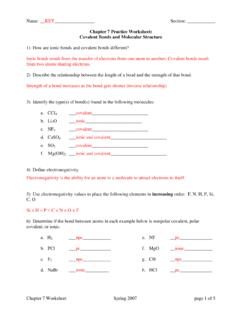
Chapter 7 Practice Worksheet: Covalent Bonds and Molecular ...
web.gccaz.eduChapter 7 Worksheet Spring 2007 page 1 of 5 Chapter 7 Practice Worksheet: Covalent Bonds and Molecular Structure 1) How are ionic bonds and covalent bonds different? ... f. Mg(OH) 2 ___ ionic and covalent _____ 4) Define electronegativity. Electronegativity is the ability for an atom in a molecule to attract electrons to itself. ...

Intermolecular and Ionic Forces - web.gccaz.edu
web.gccaz.eduIntermolecular and Ionic Forces ... general, intermolecular forces are much weaker than the ionic and covalent bonds that hold together the atoms and ions in a compound. ... compared in this lab. The alkane used in this activity is pentane, CH 3 CH 2 CH 2 CH 2 CH 3. Alcohols are

CHM 130 Predicting Products Worksheet
web.gccaz.eduCHM 130 Predicting Products Worksheet Circle the appropriate reaction type for each, complete the reaction with products (remember to check charges for ionic compounds), include states, and finally balance each reaction.

Chapter 14. CHEMICAL EQUILIBRIUM
web.gccaz.eduChapter 14. CHEMICAL EQUILIBRIUM 14.1 THE CONCEPT OF EQUILIBRIUM AND THE EQUILIBRIUM CONSTANT Many chemical reactions do not go to completion but instead attain a ...
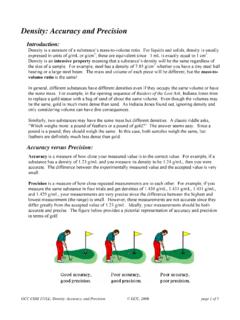
Density: Accuracy and Precision
web.gccaz.eduGCC CHM 151LL: Density: Accuracy, and Precision © GCC, 2008 page 4 of 5 glassware. ... 1. Obtain a set of 4 brass slugs and 1 aluminum slug. 2.

Balancing Equations Worksheet KEY
web.gccaz.eduBalancing Equations Worksheet KEY 1. Zn (s) + 2 AgNO 3 (aq) ⇒ Zn(NO 3) 2 (aq) + 2 Ag (s) 2. N 2 (g) + 3 H 2 (g) ⇒ 2 NH 3 (g) 3. NaCl (aq) + AgC 2H 3O 2 (aq) ⇒ NaC 2H 3O 2 (aq) + AgCl (s) 4. 3 Mg(OH) 2 (aq) + 2 H 3PO 4 (aq) ⇒ 6 H 2O (l) + Mg 3(PO 4 ) 2 (aq) 5. 2 HNO 3 (aq) + Ni (s) ⇒ Ni(NO 3) 2 (aq) + H 2 (g) 6. Ba(HCO 3) 2 (s) ⇒ BaCO 3 (s) + H 2O (g) + CO
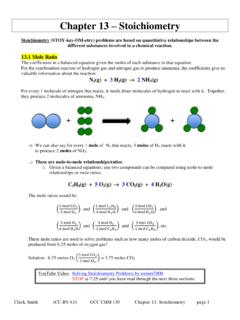
Chapter 13 Stoichiometry - Glendale Community College
web.gccaz.eduChapter 13 – Stoichiometry Stoichiometry (STOY-key-OM-etry) problems are based on quantitative relationships between the different substances involved in a chemical reaction.

Marine Biology: Study Guide - web.gccaz.edu
web.gccaz.eduBIO145: Marine Biology 3 Study Guide Chapter 10 An Introduction to Ecology Ecology is the scientific study of the interactions between organisms and their environment that determine the distribution and abundance of organisms.

CHM 130LL: Electrolytes - Welcome to web.gccaz.edu
web.gccaz.edumainly in body fluids outside the cells. Human body fluids have almost the ... CHM 130LL: Electrolytes Lab . GCC CHM 130LL Spring 2016 page 2 of 7 Understanding ... This makes it possible to identify which substance is in which well (ex: A3 or C2). In your data table (on the next page), ...
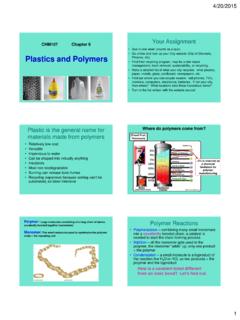
Polymers and Plastics - web.gccaz.edu
web.gccaz.edua chemical feedstock for polymer manufacturing Polymer: ... • Now back to polymers and plastics Given these monomers predict the structure of the polymer Ethylene Vinyl chloride ... recycle numbers are these plastics? • Plastic comes from oil – so less recycling means
Related documents
B.Sc.((Honors)(Chemistry( - UGC
ugc.ac.inCovalent character in ionic compounds, polarizing power and polarizability. Fajan’s rules and consequences of polarization. Ionic character in covalent compounds: Bond moment and dipole moment. Percentage ionic character from dipole moment and electronegativity difference. (iii) Metallic Bond: Qualitative idea of valence bond and band ...

Sugar or Salt? Ionic and Covalent Bonds
uu.eduLab 11 Sugar or Salt? Ionic and Covalent Bonds TN Standard 2.1: The student will investigate chemical bonding. Have you ever accidentally used salt instead of sugar? rinking tea that has been sweetened with salt or eating vegetables that have been salted with sugar tastes awful! Salt and sugar may look the same, but they obviously taste very ...
ELECTRICAL CONDUCTIVITY
www.cerritos.eduAll soluble ionic compounds are electrolytes. Water molecules are able to pull the positively and the negatively charged ions away from each other in the solid state, and carry them along to be distributed throughout the solution. NaCl (s) !"# Na+(aq) + Cl …
COVALENT
chemunlimited.comLab- Covalent Solubility Purpose- The purpose of this lab is to develop a series of solubility guidelines for covalent compounds. Safety: Goggles and Aprons must be worn Procedure- 1. Fill 7 test tubes ¾ full with tap water. 2. Using the small bottles provided, add 10 drops of each chemical to a test tube. 3.