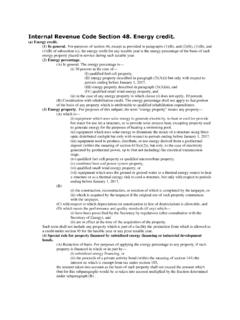
Transcription of Internal Revenue Code section 1042 - Long Point …
1 Ab What is an Internal Revenue code section 1042 ESOP Rollover? 2 What requirements must be met in order to elect the code section 1042 ESOP Rollover? 2 What is qualified replacement property? 2 What if the taxpayer, individually, is not selling at least 30% to the ESOP? 3 What documents are required for an ESOP transaction? 3 What are the tax consequences of the code section 1042 ESOP Rollover? 4 How is the taxpayer s basis allocated to QRP? 4 Does the code section 1042 Rollover allow for a partial election? 4 What happens if a taxpayer invests in QRPs but does not file a Statement of Purchase as to some portion of the QRPs?
2 5 Does the code section 1042 Rollover allow for short-term deferral? 5 Summary 6 Keith A. Mericka Managing Director Wealth A. LauerSenior Vice President Wealth Hirshman, CFAS enior Wealth Strategy T. Glasgow, CFP Senior Wealth Strategy 404-479-6027 Curt RubinasSenior Wealth Strategy 404-479-59633280 Peachtree Road NE21 st FloorAtlanta, GA 30305 Current as of 1/27/2015 Internal Revenue code section 1042 ESOP briefESOP brief 2 What is an Internal Revenue code section 1042 ESOP Rollover? Internal Revenue code of 1986, as amended ( code ), section 1042, allows an owner of a closely-held C corporation to defer, or potentially eliminate, capital gains taxation on qualified securities he or she sells to an employee stock ownership plan (ESOP) if the taxpayer reinvests the sale proceeds into qualified replacement property (QRP).
3 QRP includes certain stocks, bonds and/or other securities of operating companies incorporated in the United States and meeting other tests. If the QRP is held until the death of the taxpayer, the QRP transfers to the taxpayer s heirs with a stepped-up cost basis, and thus the gain on the stock sale to the ESOP has favorable tax treatment for federal capital gains taxation purposes and for many state capital gains taxation purposes. code section 1042 provisions are similar to the tax provisions that exist under other like-kind exchanges, most notably code section 1031 used for real estate transactions and code section 1035 for annuity exchanges.
4 What requirements must be met in order to elect the code section 1042 ESOP Rollover?In order for a taxpayer to elect code section 1042 ESOP Rollover treatment, there are several criteria that must be met. 1. The ESOP can only acquire qualified securities, which generally means common stock issued by the employer/plan sponsor of the ESOP, subject to certain requirements. 2. The qualified securities sold by the taxpayer cannot be publicly traded, nor can any member of the employer/plan sponsor s controlled group be publicly traded.
5 There are notable exemptions for over-the-counter or pink sheets traded securities. 3. The taxpayer must have held the qualified securities for at least 3 years prior to the sale. 4. The qualified securities may not have been acquired by the taxpayer as a result of a distribution from a retirement plan or as a result of an exercise of an employer-granted option or issuance of restricted stock. 5. The ESOP must own at least 30% of the employer/plan sponsor of the ESOP after the completion of the transaction. 6. The taxpayer must reinvest his or her proceeds in QRP no earlier than 3 months prior to the ESOP transaction or no later than 12 months after the ESOP transaction (this period is called the replacement period ).
6 What is qualified replacement property?In order for a security to qualify as QRP, it must be a security of a domestic operating corporation. It can be common stocks, preferred stocks, convertible bonds, corporate fixed rate bonds or corporate floating rate notes (FRNs). The QRP must be securities of a corporation that (i) is incorporated in the , and (ii) uses more than 50% of its assets in the active conduct of a trade or business. Furthermore, the corporation cannot have passive income that exceeds 25% of its gross receipts for the year preceding the purchase.
7 Investments that do not qualify as QRP include municipal bonds, government bonds, mutual funds, foreign securities, real estate investment trusts and bank CDs. Similarly, stock of the employer/plan sponsor which issued the qualified securities sold to the ESOP or any member of its controlled group is also an ineligible investment. Special care must be taken when assembling a portfolio composed of QRP to ensure all requirements are met, and the taxpayer is successfully able to defer capital gains on the proceeds received in the ESOP primary objective is the deferral, if not possible elimination of capital gains if the taxpayer, individually, is not selling at least 30% to the ESOP?
8 The code recognizes the integrated transaction doctrine in the code section 1042 Rollover context. The integrated transaction provides for the sale of qualified securities by two or more taxpayers to be treated as a single sale if they are made as part of a single, integrated transaction under a prearranged agreement between the taxpayers, subject to certain conditions. This allows two (or more) taxpayers, neither of which is selling 30% individually to the ESOP, to combine their sales to the ESOP to satisfy the 30% requirement set forth above.
9 In such a case, the Statement of Election (discussed below) submitted to the IRS must contain the names and taxpayer identification numbers of each other seller involved in the integrated transaction. However, the integrated transaction doctrine does not require that both sellers make an election under code section 1042. It should also be noted that if the ESOP already owns 30% or more of the employer/plan sponsor of the ESOP, the sale of additional qualified securities to the ESOP will always meet the 30% ownership requirement. What documents are required for an ESOP transaction?
10 There are several important documents that you will need to work with your tax advisor to complete during the course of an ESOP transaction in which code section 1042 ESOP Rollover treatment is sought. The Statement of Election is completed upon the sale of stock to the ESOP. It is signed by the selling shareholder and confirms his or her intention to elect non-recognition treatment under code section 1042 with respect to the stock sale. The Statement of Election is due with the taxpayer s tax return for the year in which the sale to the ESOP occurred, including any extensions.