Transcription of Ionic molecular compounds lab - School District 22 Vernon
1 Science 10 Comparing Properties of Ionic and molecular compounds Theory There are literally thousands of new compounds synthesized every year in a variety of different industries. Like the polymer, Kevlar, shown above. Kevlar was synthesized first in the 1970 s to be used in the manufacturing of tires. Of course now it is used in everything from sports equipment like hockey sticks, bicycles, tennis racquets and athletic footwear to musical instruments and equipment, as well as protective armour like bullet proof vests. The industries that manufacture new compounds are extensive and not limited to obscure science industries rather include, sports (equipment and clothing), fashion (cologne/perfume, skin creams), food, and of course all types of industry involving explosives, plastics, pharmaceuticals, the list goes on and on.
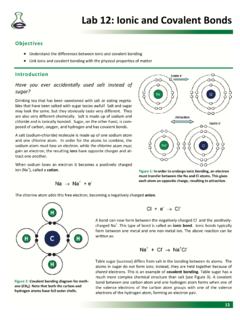
2 compounds may be grouped into many different categories many of which we will study such as; salts, acids, bases, oxides (metal or non-metal) and organic. compounds are classified as either Ionic or molecular ( covalent ) based on what elements make them up and the properties they have. Hopefully from grade 9 you remember the basic difference between the two. Ionic compounds are made mainly of positive ions and negative ions of which metals (positive ions) and non-metals (negative ions) are included. In Ionic bonding, elements come together by transferring valence electrons from their outer energy level, in doing so form a positive/negative attraction that holds the two newly formed ions together.
3 molecular compounds , what you know as covalent , are made of two or more non-metal elements formed by sharing electrons. They do not form ions or charged particles rather share electrons to fill their outer energy levels. Each atoms electrons are attracted to the other atoms nucleus (and positive protons). Objective: In this activity you will examine the properties of a variety of chemical compounds . You will classify each compound based on information you learn about its properties and the names of the compounds and the elements that make them up. Materials: Hot plate Aluminum Foil test tube Sink and Water test tube rack magnifying glass Conductivity apparatus (used by your teacher)
4 Table salt table sugar candle wax Potassium chloride Epsom salts mothball flakes Procedure 1. In your observations section of your lab report, construct a table as shown, give your table a title and use a ruler. compound Smell Hardness Solubility(yes/no) Conductive (yes/no) Melting pt (high/ low) Other Observations (state, color, crystalline etc.)
5 2. You will perform each of the steps at 6 different stations, one station for each compound . a. Place a small amount of the test material (about the size of a pea, or less) onto a small sheet of aluminum foil. Examine the material with the hand lens and record as many observations as you can. Particularly if it is crystalline or not. b. Carefully smell the sample, remember always smell a substance in the lab by wafting. Record observations. c. Using a spatula or scoopula attempt to crush your sample, explain how it crushes and describe its level of hardness/softness/brittleness.
6 D. Take a very small sample of what you have and, filling your test tube with water determine if your compound dissolves or not. We tend to refer to this property as solubility, whether or not a material can dissolve in water. e. Your teacher will demo whether or not the solution you created in the previous step is conductive. f. Finally, place a small portion of your sample, with the Aluminum foil, on your hotplate and determine the time it takes to melt, if it melts at all. Record observations in your table. 3. After you have completed all six stations your group is responsible for cleaning up the station, follow your teachers instructions for clean up.
7 Questions 1. Based on what you know about the name of a compound and the elements that make it up, make a list of your 6 compounds under the heading of Ionic or molecular . 2. Which of your compounds are conductive and which are not. 3. Identify which of your compounds are soluble and which are not. 4. Identify which compounds have an odor and which do not. 5. Identify which of your compounds are crystalline by nature and which are not. 6. Identify which of your compounds are hard/brittle and which seem softer. 7. Based on question number 1 and the properties you ve observed for each compound identify any properties that clearly distinguish a substance as Ionic or molecular .
8 8. Which substances conduct electricity, why is this? Conclusion Below are the formulas to each substance, match the name of the substance, with its formula and based on what you ve learned classify each substance as Ionic or molecular and give a minimum of three reasons to support your classification, you can do this in the form of a table if you wish. Bonus, can you explain why Ionic substances have higher melting points then covalent compounds . Hint, candle wax mainly C18H38, is made of covalent bonds, which are extremely strong, yet it is soft and has a low melting point, think of the KMT, why is this the case?
9 Formulas NaCl, C12H22O11 KCl C10H8 C18H38 MgSO4