Example: confidence
Laboratory Procedure Manual
adenine dinucleotide (NAD), G-6-P is oxidized by the enzyme glucose-6-phosphate dehydrogenase (G-6-PD) to 6-phosphogluconate and reduced nicotinamide adenine dinucleotide (NADH). The increase in NADH concentration is directly proportional to the glucose concentration and can be measured spectrophotometrically at 340 nm. (1–3).
Tags:
Information
Domain:
Source:
Link to this page:
Documents from same domain

School Chemistry Laboratory Safety Guide
www.cdc.govSchool Chemistry Laboratory Safety Guide. October 2006. U.S. Consumer Safety Product Commission DEPARTMENT OF HEALTH AND HUMAN SERVICES. Centers for Disease Control and Prevention

Biosafety in Microbiological and Biomedical …
www.cdc.goviii. Foreword. Biosafety in Microbiological and Biomedical Laboratories (BMBL) quickly became the cornerstone of biosafety practice and policy in the United States upon first
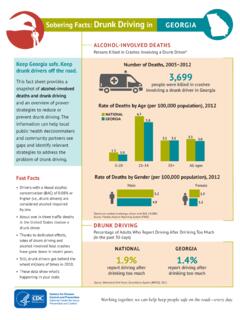
Sobering Facts: Drunk Driving in Georgia
www.cdc.govSobering Facts: Drunk Driving in GEORGIA Keep Georgia safe. Keep drunk drivers off the road. This fact sheet provides a snapshot of alcohol-involved deaths and drunk driving
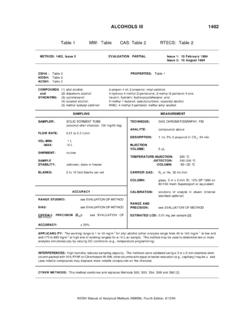
ALCOHOLS III 1402
www.cdc.govALCOHOLS III: METHOD 1402, Issue 2, dated 15 August 1994 - Page 3 of 4 a. Remove and discard back sorbent section of a media blank sampler. b. Inject a known amount of analyte or DE stock solution directly onto front sorbent section
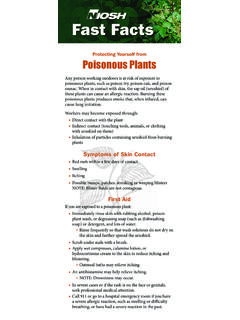
Fast Facts
www.cdc.govAny person working outdoors is at risk of exposure to poisonous plants, such as poison ivy, poison oak, and poison sumac. When in contact with skin, the sap oil (urushiol) of
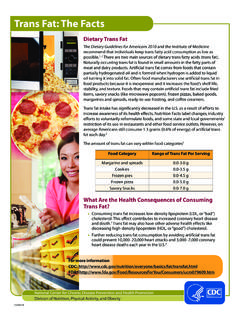
Trans Fat: The Facts
www.cdc.gov• Read the Nutrition Facts label and ingredient list to compare foods. » Choose products with 0 grams trans fat. » Check the Ingredient List to see if there is any partially hydrogenated oil in the product.

ANTIBIOTIC RESISTANCE THREATS
www.cdc.govApr 23, 2013 · 6. ANTIBIOTIC RESISTANCE THREATS IN THE UNITED STATES, 2013. Executive Summary. Antibiotic Resistance Threats in the United States, 2013. is a snapshot of the complex problem
Chlorine Residual Testing
www.cdc.govChlorine Residual Testing Fact Sheet, CDC SWS Project 4 Methods to Test Free Chlorine in the Field in Developing Countries There are three main methods to test free chlorine residual in drinking water in the field
2018 Combined Recommended Immunization …
www.cdc.govRecommended Immunization Schedule for Children and Adolescents Aged 18 Years or Younger, UNITED STATES, 2018 Approved by the Advisory Committee on …

Traveling? Make Sure You Protect Yourself from …
www.cdc.govCS26201 Malaria transmission occurs throughout Malaria transmission occurs in some parts Malaria transmission is not known to occur Center for Global Health
Related documents
Table of Genetic Disorders - Loyola University Chicago
www.meddean.luc.eduGlucose 6-phosphate dehydrogenase deficiency Glucose 6-phosphate dehydrogenase X-linked recessive (prominent among individuals of Mediterranean and African descent) Anemia (due to increased hemolysis) induced by oxidizing drugs, sulfonamide antibiotics, sulfones (e.g. dapsone), and certain foods (e.g. fava beans) Hemochromatosis Unknown gene on ...
Gluconeogenesis, Glycogen Metabolism, and the Pentose ...
academic.mu.edu3. the release of glucose-6-phosphate and glucose from glycogen for entry into metabolism need to be explored. ... NADH is required in the cytoplasm for the Glyceraldehyde-3-phosphate Dehydrogenase step. In the cytoplasm the ratio of [NADH] / [NAD] is normally very low, about 8 × 10⁻⁴. These different

Glycolysis The Glycolytic Pathway The Reactions of ...
biochem.siu.eduPhosphoglucose isomerase (glucose-6-phosphate isomerase) isomerization (aldose to ketose) reaction pH dependent, pK = 6.7 (Glu) and pK = 9.3 (Lys) absolute stereospecificity. Reactions of Glycolysis Phosphofructokinase ... phosphate dehydrogenase Excess fructose depletes liver Pi ...
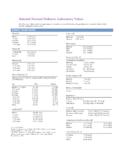
Selected Normal Pediatric Laboratory Values
wps.prenhall.comGlucose 6-Phosphate Dehydrogenase (RBC)2 150–215 units/dL Glucose Tolerance Test Results in Serum a2 GLUCOSE INSULIN TIME mg/dL mmol/L U/mL pmol/L Fasting 59–96 3.11–5.33 5–40 36–287 30 min 91–185 5.05–10.27 36–110 258–789 60 min 66–164 3.66–9.10 22–124 158–890
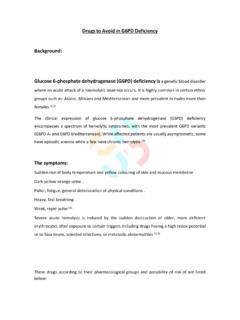
Drugs to Avoid in G6PD Deficiency Background: Glucose 6 ...
kucpn.netGlucose 6-phosphate dehydrogenase (G6PD) deficiency is a genetic blood disorder where an acute attack of a haemolytic anaemia occurs. It is highly common in certain ethnic groups such as: Asians, Africans and Mediterranean and more prevalent in males more than females (1,2).

The Structure Adenine and Hydrolysis of ATP
www.nslc.wustl.eduGlucose (C 6H 12O 6) Fructose (C 6H 12O 6) Figure 8.13 Course of reaction without enzyme E A without enzyme E A with enzyme is lower Course of ... phosphate dehydrogenase Phospho- glycerokinase 6 7 . Figure 9.9d Glycolysis: Energy Payoff Phase 2 ATP 2 ADP 2 2 2 2 2 H 2O Phosphoenol- Pyruvate

Updating the WHO G6PD classification of variants and the ...
www.who.intGlucose-6-phosphate dehydrogenase (G6PD) deficiency is an X-linked recessive disorder. It is the most common genetic abnormality affecting an estimated 400 million people worldwide. Although mostly asymptomatic, G6PD deficiency can lead to three clinical manifestations: (i) neonatal jaundice; (ii)
Glycolysis
www.csun.edu• Regulated only by excess glucose-6-phosphate. If G6P accumulates in the cell, there is feedback inhibition of hexokinase till the G6P is consumed. • Glucose-6-phosphate is required for other pathways including the pentose phosphate shunt and glycogen synthesis. So hexokinase step is not inhibited unless G-6-P accumulates.

Sugar Metabolism in Yeasts: an Overview of Aerobic and ...
repositorium.sdum.uminho.ptmetabolites, and further phosphorilates fructose 6-phosphate to fructose 1,6-bisphosphate. These steps are the first part of glycolysis that requires energy in the form of ATP. The subsequently acting enzymes are aldolase, triosephosphate isomerase, glyc-eraldehyde 3-phosphate dehydrogenase, phosphoglycerate kinase, phosphoglycerate mutase ...
REGULATION OF GLYCOLYSIS
aqu2018.weebly.compermits initiation of glycolysis even when blood glucose levels are relatively low. However, its Vmax is relatively low. • Hexokinase is inhibited by the product of its reaction, glucose-6-phosphate. This is a very important regulatory step, since it prevents the consumption of too much cellular ATP to form G6P when glucose is not limiting.