Transcription of Lesson 10: The Divided Kingdom - Truthnet
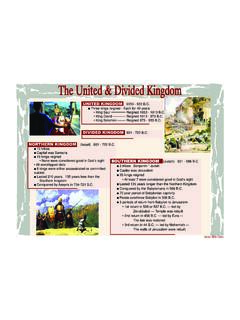
1 Lesson 10: The Divided Kingdom God predicted the division of Israel to Jeroboam through Ahijah the prophet. - Rehoboam's unwillingness to reduce Solomon's heavy tax burden and conscription resulted in the secession of the 10 northern tribes. They made Jeroboam the first king, as Ahijah had predicted. - The Unified Kingdom of Israel was now split, with the 10 tribes in the north, referred to as Israel, and the tribes of Judah and Benjamin in the south, referred to as Judah. ISRAEL (The Northern Kingdom ). JEROBOAM (931-910) 1 Kings 12:25 14:20. Jeroboam took over as first ruler of the new 10-tribe nation of Israel. - The initial capital was established at Shechem (1 Kings 12:25). - Jeroboam eventually established his permanent capital at Tirzah (1 Kings 14:17; 15:21), thought to be modern Tell el-Farah, about six miles northeast of Shechem. Jeroboam sinned in the sight of God by establishing cult worship for the people (1 Kings 12:26-33).
2 He established worship centers at Dan in the north and Bethel in the south. He erected gold calves at each center. - God sent a messenger to rebuke Jeroboam. Called a man of God, the messenger came north from Judah, spoke against the Bethel altar, and predicted that a prince of the House of David, Josiah, would one day burn the bones of Jeroboam's priests upon that very altar. (1 Kings 13:1-3; 2 Kings 23: 15-16). Jeroboam was not able to maintain all of the land that he had received when he became king. - The region around Damascus was lost. This is known from the fact that, when Rezon (Damascus king) died, he left Damascus as capital of an independent Aramean state. Rezon was likely the Hezion of 1. Kings 15:18, who is listed on the votive stele of Benhadad I. o The votive basalt stele of Benhadad I was found in Bredsh, a village north of Aleppo. - Another area lost was in the southwest where the Philistines reclaimed territory around Gibbethon.
3 - In the east Moab was lost. The Moabite Stone records her reconquest by Omri, Israel's sixth king. - Jeroboam also suffered invasion into Israel by Shishak (fig. 1), king of Egypt, who had earlier given asylum to Jeroboam when he fled from Solomon. o The name of the Egyptian king to whom Jeroboam fled, Pharaoh Shishak, has also been found on an inscription, which lists the cities Fig. 1 Shishak _____. 1 of 22. he conquered during his invasion of Israel. This confirms the bible in 1 Kings 14:25-26: 1KI 14:25. Now it happened in the fifth year of King Rehoboam, that Shishak the king of Egypt came up against Jerusalem. 1KI 14:26. He took away the treasures of the house of the LORD and the treasures of the king's house, and he took everything, even taking all the shields of gold which Solomon had made. 1 Kings 14:25-26 (NASB). In 1903 during excavations at Megiddo a jasper seal (fig.)
4 2) was found with the following inscription: - Shema servant of Jeroboam . - The seal belonged to a servant of either Jeroboam I (first king of Israel), or Jeroboam II who ruled from 782-753. BC at the time of Jonah the prophet. NADAB (910-909) 1 Kings 15:25-31. Nadab succeeded his father, reigning at Tirzah for two years. The only biblical record we have is his siege of Gibbethon, in Philistine territory, which his father lost. - During this siege Nadab was Fig. 2 Jeroboam Seal assassinated by Baasha (1 Kings 15:27- 28), probably one of his generals, who then ruled. BAASHA (909-886) 1 Kings 15:32 16:7; 2 Chronicles 16:1-6. Baasha ruled for 24 years. Little is recorded of his reign except that he continued in conflict with Judah. - Baasha attempted to fortify Ramah, four miles north of Jerusalem. - Asa, king of Judah, retaliated by persuading Benhadad I (c.
5 896-874), king of the Aramean city of Damascus, to attack Baasha's northern cities. Benhadad attacked and Baasha had to cease his efforts at Ramah to protect his own land. ELAH & ZIMRI (886-885) 1 Kings 16:8-22. Elah succeeded his father Baasha and ruled two years. - Elah also wanted the Philistine city of Gibbethon and sent his general, Omri, to lay siege to it. While Omri was there, Zimri, another general, assassinated Elah and proclaimed himself king. - When Omri, still at Gibbethon, learned of the assassination he had himself declared king by his army and returned to Tirzah where he successfully put down Zimri's rebellion. OMRI (885-874) 1 Kings 16:23-28. Omri began a dynasty that would last three generations, but pressures from enemies were ever present. - The Aramean state to the north was rising in power. The Aramean king, Benhadad I, left a stele near Aleppo which shows that he was able to extend his power as far north as Syria by 850 BC.
6 - In addition to the threat of Aramean, a greater danger was rising in the east. Assyria was becoming a world power under Ashur-nasir-pal II (883-859). With him the period of Assyrian empire is said to _____. 2 of 22. have begun. He marched his army across the Euphrates and occupied land as far west as Byblos, Sidon, and Tyre on the Mediterranean. Omri was a strong ruler. Testimony of this is provided by Assyrian rulers, living a century later, who still referred to Israel as the Land of Omri.. - Adad-nirari III (810-782), Tiglath-pileser III (745-727), and Sargon II (721-705) all make references to Omri in various inscriptions and relief's. Omri built a new capital for Israel, the city of Samaria, which would continue as capital until Israel's fall to the Assyrians in 722 BC. - Samaria proved to be an almost impregnable stronghold. Excavation has revealed excellent workmanship with walls some 24 feet thick.
7 - Omri must have secured a Phoenician alliance as implied by the marriage of his son Ahab to the Phoenician princess, Jezebel. It is likely that he made a treaty with her father, King Ethbaal. The Moabite (Mesha) Stone (fig. 3). This monument was found by a German missionary in 1898, lying on the ground near the Arnon River in the Biblical city of Dibon. Recorded on the stone are victories over the Israelites by Mesha, king of Moab - Written by Mesha, king of Moab (2 Kings 3:4), it states that Omri, king of Israel had conquered Moab in the days of Mesha's father. Mesha goes on to say that under the direction of his god Chemosh he was able to throw off the tribute that Omri had imposed. - What we are able to determine from the Moabite Stone is that Omri was at some point capable of defeating Moab. The following is a translation of the text taken from the Mesha stone: Line 1 I Mesha, son of Chemosh, Mesha's king, the Line 2 Dibonite.
8 My father governed Moab for 30 years, then I reigned Line 3 after my father. I made a high place for Chemosh in Qarhoh, Line 5 As for Omri king of Israel, he oppressed Moab for many years, for Chemosh was furious with his Line 6 country. And his son followed in his footsteps, and he also said: I will cast Fig. 3 The Moabite (Mesha) Stone down Moab. In my days, he spoke, Line 8 And he lived in it during his time and in the days of his sons; 40 years; yet Chemosh Line 18 hearths of YHWH, dragging them before Chemosh. And Israel's king built Line 31 [..] sheep of the land. While the house of David inhabited Horonaim. _____. 3 of 22. Lines 1-3 mention King Mesha, a Dibonite who ruled over Moab. He worshiped a Moabite god called Chemosh, whom he attributes his victories to. - The Bible in 2 Kings 3:4 verifies Mesha was the king of Moab during their revolt against Israel.
9 2KI 3:4. Now Mesha king of Moab was a sheep breeder, and used to pay the king of Israel 100,000 lambs and the wool of 100,000 rams. 2 Kings 3:4 (NASB). - The bible also states in Numbers 21:29-30, that Dibon was a city in the land of Moab and mentions their god, Chemosh. NU 21:29. Woe to you, O Moab! You are ruined, O people of Chemosh! He has given his sons as fugitives, And his daughters into captivity, To an Amorite king, Sihon. NU 21:30. But we have cast them down, Heshbon is ruined as far as Dibon, Then we have laid waste even to Nophah, Which reaches to Medeba.. Numbers 21:29-30 (NASB). Lines 5-6 state that Omri was king of Israel and that he was succeeded by his son. - The Bible confirms this in 1 Kings 16:23 & 28: 1KI 16:23. In the thirty-first year of Asa king of Judah, Omri became king over Israel and reigned twelve years; he reigned six years at Tirzah.
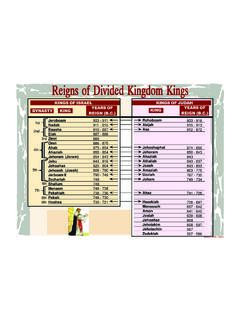
10 1KI 16:28. So Omri slept with his fathers and was buried in Samaria; and Ahab his son became king in his place. 1 Kings 16:23, 28 (NASB). Line 8 says that Omri and his sons ruled for 40 years. - The Bible says the same thing starting in 1 Kings 16:23. Omri ruled for 12 years, six of those years he co-reined with Tibni, and for six years he ruled as king of Israel from 880-874 BC, his son Ahab took over and ruled 22 years from 874-853 BC (1 Kings 16:29), then Ahab's son Ahaziah ruled two years from 853-852 BC (1 Kings 22:51), Ahab's last son Joram ruled 10 years from 852-841 BC, a total of 40 years. Joram was killed by Jehu in his eleventh year as king (2 Kings 9:14-29). Line 18 makes a reference to the altar hearths of YHWH. - YHWH is the Hebrew word for God (Yahweh), spelled just as it is used in the Bible. Line 31 says, And the House of David inhabited Horonaim.