Example: barber
MVSNet: Depth Inference for Unstructured Multi-view Stereo
Multi-view stereo (MVS) estimates the dense representation from overlapping images, which is a core problem of computer vision extensively studied for decades. Traditional methods use hand-crafted similarity metrics and engineered ... current state-of-the-art algorithms [7,36,8,32] perform very well on the accu-racy, the reconstruction ...
Tags:
Information
Domain:
Source:
Link to this page:
Documents from same domain
What Have We Learned From Deep Representations for …
openaccess.thecvf.comwhat these powerful models actually have learned. In this paper we shed light on deep spatiotemporal net-works by visualizing what excites the learned models us-ing activation maximization by backpropagating on the in-put. We are the first to visualize the hierarchical features
Finding Tiny Faces in the Wild With Generative Adversarial ...
openaccess.thecvf.comfaces, which are unfriendly for the face classifier. Toward-s this end, we design a refinement sub-network to recover some detailed information. In the discriminator network, the basic GAN [17, 12, 8] is trained to distinguish the real and fake high resolution images. To classify faces or non-
Squeeze-and-Excitation Networks - openaccess.thecvf.com
openaccess.thecvf.comSqueeze-and-Excitation Networks Jie Hu1∗ Li Shen2∗ Gang Sun1 hujie@momenta.ai lishen@robots.ox.ac.uk sungang@momenta.ai 1 Momenta 2 Department of Engineering Science, University of Oxford Abstract Convolutional neural networks are built upon the con-
RegularFace: Deep Face Recognition via Exclusive ...
openaccess.thecvf.comRegularFace: Deep Face Recognition via Exclusive Regularization Kai Zhao Jingyi Xu Ming-Ming Cheng ∗ TKLNDST, CS, Nankai University kaiz.xyz@gmail.com cmm@nankai.edu.cn
Protecting World Leaders Against Deep Fakes
openaccess.thecvf.comProtecting World Leaders Against Deep Fakes Shruti Agarwal and Hany Farid University of California, Berkeley Berkeley CA, USA {shrutiagarwal, hfarid}@berkeley.edu
Auto-DeepLab: Hierarchical Neural Architecture Search for ...
openaccess.thecvf.comAuto-DeepLab: Hierarchical Neural Architecture Search for Semantic Image Segmentation Chenxi Liu1∗, Liang-Chieh Chen 2, Florian Schroff2, Hartwig Adam2, Wei Hua2, Alan Yuille1, Li Fei-Fei3 1Johns Hopkins University 2Google 3Stanford University Abstract Recently, NeuralArchitectureSearch(NAS)hassuccess-
PointNet: Deep Learning on Point Sets ... - CVF Open Access
openaccess.thecvf.comPointNet: Deep Learning on Point Sets for 3D Classification and Segmentation Charles R. Qi* Hao Su* Kaichun Mo Leonidas J. Guibas Stanford University
Frustum PointNets for 3D Object Detection From RGB-D Data
openaccess.thecvf.comFrustum PointNets for 3D Object Detection from RGB-D Data Charles R. Qi1∗ Wei Liu2 Chenxia Wu2 Hao Su3 Leonidas J. Guibas1 1Stanford University 2Nuro, Inc. 3UC San Diego Abstract In this work, we study 3D object detection from RGB-D data in both indoor and outdoor scenes.
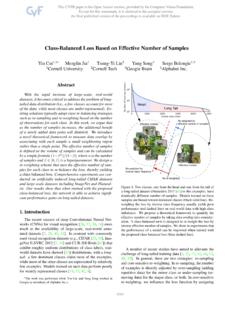
Class-Balanced Loss Based on Effective Number of Samples
openaccess.thecvf.comand large-scale datasets including ImageNet and iNatural-ist. Our results show that when trained with the proposed class-balanced loss, the network is able to achieve signifi-cant performance gains on long-tailed datasets. 1. Introduction The recent success of deep Convolutional Neural Net-works (CNNs) for visual recognition [26, 37, 38, 16] owes
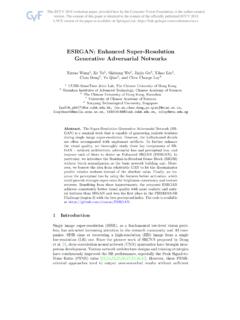
ESRGAN: Enhanced Super-Resolution Generative Adversarial ...
openaccess.thecvf.comESRGAN: EnhancedSuper-Resolution Generative Adversarial Networks Xintao Wang 1, Ke Yu , Shixiang Wu2, Jinjin Gu3, Yihao Liu4, Chao Dong 2, Yu Qiao , and Chen Change Loy5 1 CUHK-SenseTime Joint Lab, The Chinese University of Hong Kong 2 Shenzhen Institutes of Advanced Technology, Chinese Academy of Sciences 3 The Chinese University of Hong Kong, …
Related documents

A Taxonomy and Evaluation of Dense Two-Frame Stereo ...
vision.middlebury.eduMost stereo correspondence methods compute a univalued disparity function d(x,y)with respect to a reference image, which could be one of the input images, or a “cyclopian” view in between some of the images. Other approaches, in particular multi-view stereo meth-ods, use multi-valued [113], voxel-based [101, 67, 34, 33,
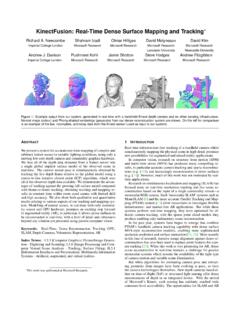
KinectFusion: Real-Time Dense Surface Mapping and …
www.microsoft.commulti-view stereo techniques while relying on sparse models for estimating the sensor motion. [19], using a monocular camera and dense variational optical flow matching between selected frames, were able to reconstruct a patchwork of depth maps to form a dense scene model live; but relied on camera pose estimates coming from PTAM.
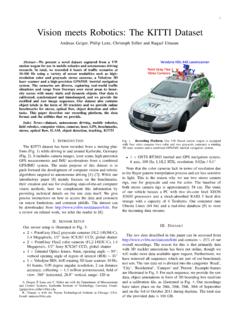
Vision meets Robotics: The KITTI Dataset
www.cvlibs.netto light. This is the reason why we use two stereo camera rigs, one for grayscale and one for color. The baseline of both stereo camera rigs is approximately 54 cm. The trunk of our vehicle houses a PC with two six-core Intel XEON storage with a capacity of 4 Terabytes. Our computer runs Ubuntu Linux (64 bit) and a real-time database [9] to ...