Transcription of Naming Rules for Organic Compounds
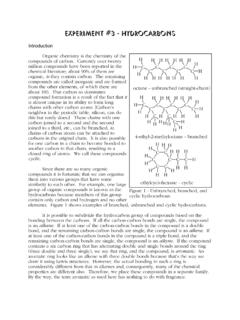
1 Naming Rules for Organic Compounds The names of Organic molecules are divided into three parts; 1. the root name, indicative of the number of carbon atoms in the longest continuous chain, which includes the highest priority functional group. 2. the suffix name, which indicates the position and identity of the highest priority functional group. 3. the prefix name, indicative of the position and identity of substituent groups. Root Names for Hydrocarbons # Carbons Root NameAlkane (add "ane") Alkyl Substituent (add "yl") 1 meth methane methyl 2 eth ethane ethyl 3 prop propane propyl 4 but butane butyl 5 pent pentane pentyl 6 hex hexane hexyl
2 7 hept heptane heptyl 8 oct octane octyl 9 non nonane nonyl 10 dec decane decyl 11 undec undecane undecyl 12 dodec dodecane dodecyl 20 eicos eicosane eicosyl Suffixes for Functional Groups alkenes (contain C=C): Add "ene" to the root name alkynes (contain C C): Add "yne" to the root name Alcohols (contain -OH): Add "anol" to the root name Aldehydes (contain terminal C=O): Add "anal" to the root name Ketones (contain C=O): Add "anone" to the root name Amides (contain -CONR): Add anamide to the root name Esters (contain -CO2R): Add anoate to the root name Carboxylic Acids (contain -CO2H).
3 Add "anoic acid" to the root name IUPAC Nomenclature for Hydrocarbons Alkanes 1) Identify the "parent" chain by counting the longest number of carbon atoms which are continuously bonded in the molecule. 2) Using this number, choose the corresponding root name and add "ane". This is the parent chain name. 3) Identify substituent groups attached to the parent chain and place them in front of the parent name in alphabetical order. Substituent (or side group) names are based on the total # of carbon atoms in the group and the position of attachment ( , n-butyl, sec-butyl, tert-butyl). The n-, sec-, tert-, are used to indicate the whether the position of attachment is normal (meaning primary, 1o), secondary (2o), or tertiary (3o).
4 The prefix "iso" is used to indicate a methyl branching at the end of a side group chain ( , isopentyl is (CH3)2CH2CH2CH2- . Note isopropyl is equivalent to sec-propyl but the latter is rarely used). When placing substituent groups in alphabetical order, the prefixes n -, sec- and tert- are ignonored. However, the prefix "iso" is included. Remember, alkyl substituent names must end in "yl". 4) Number the carbon atoms in the parent chain. Assign a number to each of the substituent groups to indicate where it is attached. Start the numbering from whichever end of the parent chain will give rise to the lowest set of numbers.
5 The lowest set is selected on the basis of the lowest number at the first point of difference. 5) If identical substituents are present, then combine them using di, tri, tetra etc. as prefixes. These prefixes are not included in the alphabetizing. A list of numbers are separated from each other by commas and the substituent name by a hyphen ( , 2,3,3-trimethylhexane). Notes: (1) Common Substituent Groups CH3CH3CH2CH3CH2CH2(CH3)2 CHCH3CH2CH2CH2(CH3)2 CHCH2CH3CH2 CHCH3(CH3)3 Cmethylethylpropylisopropylbutylsec-buty lisobutyltert-butyl (2) Cyclic Compounds are named with the prefix "cyclo" directly before parent name ( , cyclopentane).
6 Substituents on a cyclic compound may have different geometric orientations with respect to the plane of the ring. Groups on the same side of a cyclic molecule are distinguished with the prefix cis-, whereas those on opposite sides are denoted trans-. alkenes - Compounds containing carbon-carbon double bonds 1) Identify the parent structure with the longest continuous carbon chain that contains the C=C bond. Add "ene" after the appropriate root name. 2) Number the parent chain such that carbon starting the double bond has the lowest numerical value. This number is added as a prefix directly in front of the parent alkene name separated by a hyphen ( , 2-butene).
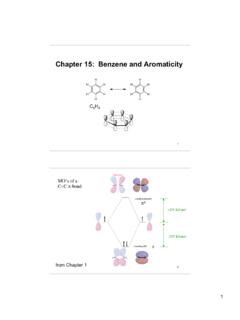
7 3) Treat substituent groups as with alkanes. 4) Use cis-/trans- or E/Z to distinguish between geometric isomers where applicable. Note: Geometric isomers exist whenever there are two different groups attached on both sides of a double bond. Consider 2-butene; the two methyl groups may be directed on the same side of the double bond (cis-or Z) or they may be directed away from one another (trans- or E). (The terms cis- and trans- are still used but this usage is being phased out). alkynes - Compounds containing carbon-carbon triple bonds 1) Are named and numbered like alkenes . Add "yne" to root name. aromatic Hydrocarbons - Compounds containing benzene-like rings 1) Benzene is the simplest aromatic compound containing cyclic structure of six carbons with a total of three double bonds.
8 BenzeneNOT1,3,5-cyclohexatrieneortho1,2- 1,3-meta1,4-para 2) Substituents are treated as before. Notes: (1) As a substituent, benzene is referred to as a phenyl group. (2) 1,2-disubstituted benzenes are also known as ortho-substituted 1,3-disubstituted benzenes are also known as meta-substituted 1,4-disubstituted benzenes are also known as para-substituted Nomenclature for Other Functional Groups Alkyl Halides (R-X) - name halogen substituents F, Cl, Br and I as "fluoro", "chloro", "bromo" and "iodo" respectively. eg. FClCH3CH32-chloro-2-fluoro-4,4-dimethylh exaneCH3II3,3-diiodo-2-methylpropene Alcohols (R-OH) - identify the longest continuous carbon chain that contains the carbon attached to the alcohol group.
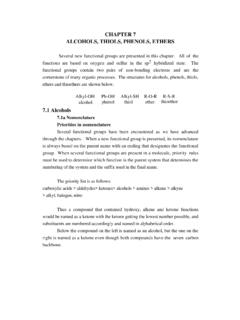
9 Add "anol" to the appropriate root name. - number the parent chain such that the carbon attached to the -OH group has the lowest possible number. Prefix the name with this number. - treat side groups as before. eg. HOClCH3 OHClClCH32-pentanol1,1,1-trichloro-3,3-d imethyl-2-hexanol Note: Coumpounds such as alcohols may be classified as being primary (1o), secondary (2o) or tertiary (3o) depending on the number of carbons bonded to the carbon attached to the -OH group. For example; CCOHCCCOHCCOHCC primary (1o)secondary (2o)tertiary (3o)CH3CH2OH(CH3)2 CHOH(CH3)3 COH Amines (RNH2, R2NH, R3N) -many common names are still in usage -for simple primary amines, name as follows eg.
10 CH3CH2CH2CH2NH2 2-butanamine -for simple 2o and 3o amines, name the substituents as N-alkyl groups eg. CH3CH2 NHCH3 N-methylethanamine -for molecules where the -NH2 group is treated as a substituent, it is referred to as an amino group Ethers (R-O-R') -identify the largest alkyl group as the parent name -treat the remaining R-O- group as an alkoxy side group. Add "oxy" to the root name. eg. O3-ethoxy-5-methylhexane Aldehydes (R-CHO) -identify the longest continuous carbon chain containing the terminal carbon-oxygen double bond. Add "anal" to the root name. -number the chain such that the aldehyde carbon is atom number one (the number "1" need not appear in the name) eg.