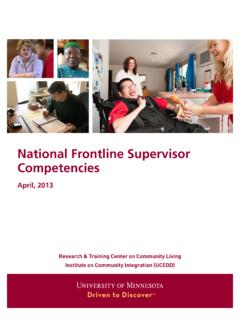
Transcription of National Frontline Supervisor Competencies Frontline ...
1 National Frontline Supervisor CompetenciesFrontline Supervisor Structured Behavioral Interview QuestionsApril, 2013 Research & Training Center on Community LivingInstitute on Community Integration (UCEDD)Published April, 2013 Authors: Lori Sedlezky, Director of Knowledge Translation Jennifer Reinke, Graduate Research Assistant Sheryl Larson, Research Director Amy Hewitt, Director Research and Training Center on Community Living Institute on Community Integration (UCEDD) University of MinnesotaThe preparation of this paper was supported by the National Institute for Disability and Rehabilitation Research, Department of Education (Grant number 2008-2013)
2 Awarded to the Research and Training Center on Community Living, Institute on Community Integration at the University of opinions of the authors expressed herein do not necessarily reflect those of the Institute, University of Minnesota, or their funding sources. The University of Minnesota is an equal opportunity educator and document is available in alternative formats upon alternate formats, contact RTC on Community Living University of Minnesota 204 Pattee Hall, 150 Pillsbury Dr SE Minneapolis, MN 55455612-624-6328 citation Sedlezky, L., Reinke, J., Larson, S., & Hewitt, A. (2013). National Frontline Supervisor Competencies : Frontline Supervisor structured behavioral interview questions. Minneapolis, MN: University of Minnesota, Research and Training Center on Community Living, Institute on Community of ContentsFrontline Supervisor structured behavioral interview questions p.
3 1 1. direct support p. 2 2. Health, wellness, and safety p. 2 3. Participant support plan development, monitoring, and assessment p. 3 4. Facilitating community inclusion across the lifespan p. 3 5. Promoting professional relations and teamwork p. 4 6. Staff recruitment, selection, and hiring p. 4 7. Staff supervision, training, and development p. 5 8. Service management and quality assurance p. 5 9. Advocacy and public relations p. 6 10. Leadership, professionalism, and self-development p. 6 11. Cultural awareness and responsiveness p. 7 Additional questions: Experience, credentials, and self-evaluation p. 71 Frontline Supervisor Structured Behavioral Interview QuestionsFrontline Supervisor structured behavioral interview questions_____ _____ Name Date completed _____ Name/title of direct Supervisor conducting this interviewBackground Structured behavioral interview questions were based on the Competencies identified in the National Frontline Supervisor Competencies (NFSC) and were adapted, in part, from Staff Recruitment, Retention and Training Strategies for Community Human Services Organizations (Larson & Hewitt, 2005).
4 The NFSC was largely informed by the National Validation Study, a recent validation of the Minnesota Frontline Supervisor Competencies and Performance Indicators (Larson, Doljanec, Nord, Salmi, Hewitt, & O Nell, 2007). For more information about the NFSC, refer to ; for more information about the National Validation study, refer to for direct Supervisor completing assessment This interview guide includes both behavioral and situational questions and is intended to be used for external Frontline Supervisor (FLS) candidates. For internal FLS candidates, refer to the Frontline Supervisor Assessment found at (provide link). As you conduct the interview, use the following likert scale to assign a score to each response 5 = Excellent; response demonstrated knowledge and experience, and included concrete examples 3 = Average; response demonstrated some knowledge or experience, and included limited examples1 = Poor.
5 Response demonstrated no knowledge or experience, and included no examplesFor the best and most efficient use of this assessment tool, we make the following recommendations Prior to the interview, identify which questions will be asked Choose only the questions that are in alignment with your organization s mission and goals Ask the same questions of all applicants Use probing and clarifying follow-up questions as necessary to gather complete information Note: having too many questions can be frustrating for the interviewer and interviewee; 8-10 questions are sufficient for a one hour Frontline Supervisor Competencies1. direct supportFrontline supervisors demonstrate excellence in providing culturally appropriate direct support services to participant using person-centered approaches and strategies that support participant to be fully en-gaged and included in each aspect of his or her daily life, have maximum choice and control, and gain independence.
6 QuestionScore1. Describe what direct support means to you ( , in terms of doing, teaching, assisting, person-centered care) 1 2 3 4 52. Describe ways in which you have communicated with a person who does not communicate 2 3 4 53. Describe a time when you assisted an individual with creating a physical environment that was accessible, comfortable and met his or her unique style and 4 3 2 12. Health, wellness, and safetyFrontline Supervisors work with participant and his or her teams to develop a support plan to promote the health, safety, and wellbeing of participant based on individual preferences and goals. Frontline Supervisors actively monitor, review, discuss with participant, and modify support plans to ensure most effective strategies are in Betty, an individual receiving supports, is sensitive to loud noises.
7 One afternoon, the maintenance crew comes to the house to do yard work and the sound of the riding mower sends her into a panic. She begins pacing rapidly while crying and covering her ears. She picks up a nearby object in an attempt to throw it through the window toward the maintenance employee. How would you handle this situation?5 4 3 2 12. Sally, who is nonverbal, has had increased instances of self-injurious behavior during the last few days. What might be your next steps?5 4 3 2 13. Describe the last time you became involved with a challenging behavior or crisis with an individual receiving supports. What was the situation? What did you do? How well did it work? What could you have done to prevent the situation from occurring?
8 5 4 3 2 14. A health care professional has diagnosed Charlie with diabetes, and identified numerous treatment options. How might you support Charlie and his support network in making informed decisions about the most appropriate treatment option, including health care choices, lifestyle choices, and informal supports? 5 4 3 2 15. Describe your experience working with a DSP who has made medication efforts. What steps did you take, or what is your support strategy to ensure best practice? 5 4 3 2 13 Frontline Supervisor Structured Behavioral Interview Questions3. Participant support plan development, monitoring, and assessmentFrontline Supervisors operationalize participant s individual goals and identified outcomes into a coordinated support plan.
9 Frontline Supervisors coordinate and facilitate support network meetings, maintain communication with other service providers, family, and allies, and monitor, document, and report progress toward What is the most effective way to communicate and maintain positive working relationships with staff from other agencies?5 4 3 2 12. Give an example of a program you developed with individual goals and outcomes. What assessment strategies did you use and how did you engage the participant in the process?5 4 3 2 13. Describe how you maintain confidentiality of individuals supported and DSPs as you partner with community organizations and others in the community. 5 4 3 2 14. Share your understanding of Positive Behavior Supports.
10 How have you built this into the services individuals receive?5 4 3 2 14. Facilitating community inclusion across the lifespanFrontline Supervisors facilitate and support the development and maintenance of participant support networks in partnership with person supported. Frontline Supervisors support participant to explore educational, employment, volunteer, and retirement opportunities, and/or collaborate with other staff and providers to coordinate supports that will assist participant in reaching goals and actively participating in activities of his or her choice across the Michelle is quiet and does not leave the house. She is not involved in any activities and does not have any close personal relationships. Michelle claims she has no areas of interest and seems unhappy with her life.