Transcription of Polymyxin Pyruvate Egg Yolk Mannitol …
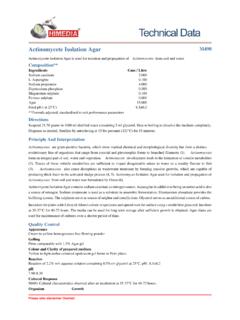
1 Polymyxin Pyruvate Egg yolk Mannitol bromothymol Blue M1484. Agar Base (PEMBA). Polymyxin Pyruvate Egg yolk Mannitol bromothymol Blue Agar Base (PEMBA) is used for the cultivation of Bacillus cereus . Composition**. Ingredients Gms / 100 ml Peptic digest of animal tissue Mannitol Sodium Pyruvate Disodium phosphate Sodium chloride Potassium dihydrogen phosphate Magnesium sulphate. heptahydrate Bromo thymol blue Agar Final pH ( at 25 C) **Formula adjusted, standardized to suit performance parameters Directions Suspend grams in 90 ml distilled water.
2 Heat to boiling to dissolve the medium completely. Sterilize by autoclaving at 15. lbs pressure (121 C) for 15 minutes. Cool to 45-50 C. Aseptically add sterile rehydrated contents of 1 vial PEMBA Supplement (FD200) and 5 ml of sterile Egg yolk Emulsion (FD045). Mix well and pour into sterile Petri plates. Principle And Interpretation Bacillus cereus is an aerobic spore-forming bacteria commonly found in soil and isolated from different vegetables, raw and processed foods. B. cereus causes food poisoning due to the consumption of contaminated raw vegetables, sprouts, meat, custards, soups, boiled or fried rice (1, 2, 3).
3 It also causes eye infections (2) and a wide range of other clinical conditions like abscess formation, meningitis, septicaemia and wound infection. B. cereus is a known cause of mastitis, especially in ewes and heifers (3). Polymyxin Pyruvate Egg yolk Mannitol bromothymol Blue Agar (PEMBA), formulated as per Holbrook and Anderson (4), is a highly specific, selective medium for the isolation and enumeration of B. cereus from foods (5, 6). Selectivity is attained with Polymyxin and a critical concentration of nutrients (9). It supports the growth of even a small number of B.
4 Cereus cells and spores from foods having large number of microbial load. The low peptone content in the medium promotes sporulation and sodium Pyruvate reduces the colony size of the organisms. Egg yolk emulsion demonstrates the strong lecithinase opacity reaction (5). bromothymol blue acts as pH indicator to detect Mannitol fermentation. Addition of Polymyxin B sulphate (7, 8) at a final concentration of 100 units per ml of medium is sufficient to make the medium selective for the isolation of B. cereus . Cycloheximide (4mg/ l) may be used to inhibit the growth of moulds (9).
5 Some strains of B. cereus have very weak egg yolk reaction. Moreover, on this medium B. cereus is indistinguishable from B. thuringiensis . B. cereus forms crenated blue colonies surrounded by a zone of opacity in the medium. Quality Control Appearance Cream to greenish yellow homogeneous free flowing powder Gelling Firm,comparable with Agar gel Colour and Clarity of prepared medium Please refer disclaimer Overleaf. HiMedia Laboratories Technical Data Basal medium :Green coloured clear to slightly opalescent gel. After addition of Egg yolk Emulsion : Forest green coloured, opaque gel forms in Petri plates Reaction Reaction of w/v aqueous solution (basal medium) at 25 C.
6 PH : pH. Cultural Response M1484: Cultural characteristics observed with added PEMBA (FD200) and Egg yolk Emulsion (FD045), after an incubation at 35-37 C for 24-48 hours. Organism Inoculum Growth Recovery Colour of Egg yolk (CFU) colony Reaction Bacillus cereus ATCC 10876 50-100 good-luxuriant >=50% blue positive,precipitation Escherichia coli ATCC >=10 inhibited 0%. 25922. Proteus vulgaris ATCC 50-100 good-luxuriant >=50% green negative 13315. Staphylococcus aureus 50-100 good-luxuriant >=50% yellow positive, ATCC 25923 clearing Storage and Shelf Life Store below 30 C in tightly closed container and prepared media at 2 8 C.
7 Use before expiry date on label. Reference 1. Mortimer P. R. and McCann G., 1974, Lancet, 104:3. 2. Bouza E., Grant S., Jordan C. et al, 1979, arch. Ophthalmol., 97:488. 3. Wohlegmuth K., Kirkbride C. A., Bicknell E. J. and Ellis R. P., 1972, Am. Vet. Med. Ass., 161:1691. 4. Hollbrook R., Anderson J. M., 1980, Canadian Journal of Microbiology 26:753-759. 5. Collee J. G., Fraser A. G., Marmion B. P., Simmons A., (Eds.), 1996, Mackie and McCartney, Practical Medical Microbiology, 14th Edition, Churchill Livingstone 6. Atlas R. M., 1996, Handbook of Microbiological Media, 2nd Edition, CRC Press, New York, pg.
8 1112. 7. Donovan K. O., 1958, J. Appl. Bacteriol., 21(1):100. 8. Mossel D. A. A., Koopman J. and Jongerius E., 1967, J. Appl. Micorbiol., 15(3):650. 9. Corry J. E. L., Curtis G. D. W. and Baird R. M., (Eds.), Culture Media for Food Microbiology. Vol. 34,1995, Elsevier, Amsterdam Revision : 2 / 2015. Disclaimer : User must ensure suitability of the product(s) in their application prior to use. Products conform solely to the information contained in this and other related HiMedia publications. The information contained in this publication is based on our research and development work and is to the best of our knowledge true and accurate.
9 HiMedia Laboratories Pvt Ltd reserves the right to make changes to specifications and information related to the products at any time. Products are not intended for human or animal or therapeutic use but for laboratory,diagnostic, research or further manufacturing use only, unless otherwise specified. Statements contained herein should not be considered as a warranty of any kind, expressed or implied, and no liability is accepted for infringement of any patents. HiMedia Laboratories Pvt. Ltd. A-516,Swastik Disha Business Park,Via Vadhani Ind.
10 Est., LBS Marg, Mumbai-400086, India. Customer care No.: 022-6147. 1919 Email.