Transcription of Population and Vital Statistics Report
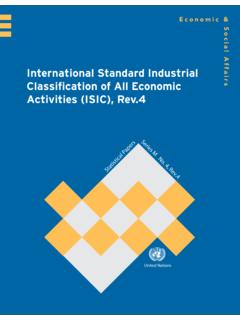
1 Population and Vital Statistics ReportStatistical Papers Series A, Vol. LXXIIIJ anuary 2021 Population and Vital Statistics Report Statistical Papers Series A Vol. LXXI II Data available as of January 2021 ST/ESA/ Department of Economic and Social Affairs Statistics Division United Nations New York, 2021 Department of Economic and Social Affairs The Department of Economic and Social Affairs of the United Nations is a Vital interface between global policies in the economic, social and environmental spheres and national action. The Department works in three main interlinked areas: (i) it compiles, generates and analyses a wide range of economic, social and environmental data and information on which United Nations Member States draw to review common problems and to take stock of policy options; (ii) it facilitates the negotiations of Member States in many intergovernmental bodies on joint courses of action to address ongoing or emerging global challenges.
2 And (iii) it advises interested Governments on the ways and means of translating policy frameworks developed in United Nations conferences and summits into programmes at the country level and, through technical assistance, helps build national capacities. Note Symbols of United Nations documents are composed of capital letters combined with figures. Mention of such a symbol indicates reference to a United Nations document. The designations employed and the presentation of material in this publication do not imply the expression of any opinion whatsoever on the part of the Secretariat of the United Nations concerning the legal status of any country, territory, city or area, or of its authorities, or concerning the delimitation of its frontiers or boundaries.
3 Where the designation "country or area" appears in the headings of tables, it covers countries, territories, or areas. Biweekly updates of the Population and Vital Statistics Reports are available at the United Nations Statistics Division website: ST/ESA/ ISBN: 978-92-1-259158-2 eISBN: 978-92-1-005261-0 Print ISSN: 0251-0030 Online ISSN: 2412-138X 1 INTRODUCTION This issue of the Population and Vital Statistics Report presents data for countries or areas1 on Population size (total, male, and female) from the latest available census, estimated total Population size for 2018 or 2019 (the later available year), and the number and rate of Vital events (live births, deaths, and infant deaths) for the latest available year within the past 15 years (2005-2019).
4 These data are presented as reported by national statistical authorities to the Demographic Yearbook of the Statistics Division of the United Nations Department of Economic and Social This issue also presents Population estimates for 2018 and 2019 of the world and its major areas and regions1. These estimates were prepared by the Population Division of the United Nations Department of Economic and Social The data described in this paragraph are presented in three tables: Table 1. Estimated mid-year Population by major area and region, 2018 and 2019 Table 2.
5 Population , latest available census and estimates for 2018 or 2019 Table 3. Live births, deaths, and infant deaths, latest available year within the past 15 years (2005-2019) TECHNICAL NOTES A. Population Population estimates for 2018 and 2019 for the world and its major areas and regions (table 1) refer to 1 July of the given year, and are produced by the United Nations Population Latest Population census figures for countries or areas (table 2) refer to the given date, and are presented as reported by national statistical authorities to the Demographic Yearbook of the United Nations Statistics Division.
6 The data are from national Population and housing censuses. These censuses use different methods of enumeration: traditional, based on administrative/ Population registers, or a combination of methods that may include a sample The censuses are conducted on either a de facto or a de jure basis, as indicated in the column Code. The de facto Population consists of all persons who are physically present in the country or area at the reference date, whether or not they are usual residents. The de jure Population consists of all usual residents, whether or not they are present at the time of the enumeration.
7 Population census data are presented for 240 countries or areas that conducted a census during the period 1960-2020. Mid-year Population estimates for 2018 or 2019 for countries or areas (table 2) refer to 1 July of the given year unless otherwise stated, and are presented as reported by national statistical authorities to the Demographic Yearbook of the United Nations Statistics Division. They are also coded as either de jure or de facto, since for some countries or areas the code is not the same as for the census figure. B. Vital Statistics Table 3 presents data for countries or areas on live births, deaths, and infant deaths (excluding foetal deaths) for the latest available year within the last 15 years (2005-2019).
8 The data usually refer to Vital events that occurred in the specified year, even if some were registered later. In some countries or areas, however, they refer to events that were registered in the specified year, and, therefore, include some events that occurred previously, and exclude some events that occurred in the specified year but that were or will be registered later. In this case, the symbol + is displayed in the column Code. Most of the Vital Statistics data presented in table 3 come from national civil registration systems. These systems differ markedly in the completeness of the data that they produce.
9 If the country or area reports to the Demographic 1 In table 1 of this Report countries or areas are grouped geographically into 21 regions (for example, Central America), which are then grouped into six major areas (for example, Latin America and the Caribbean). In tables 2 and 3 they are listed by six continents (Africa; America, North; America, South; Asia; Europe; Oceania). 2 Data on these and many other demographic Statistics are maintained and continuously updated in the Demographic Yearbook database. A small selection of demographic Statistics are published annually as the Population and Vital Statistics Report , and a much larger selection of data, including complementary technical notes, are published annually as the Demographic Yearbook.
10 The Demographic Yearbook is also available online, at: 3 United Nations, Department of Economic and Social Affairs, Population Division (2019). World Population Prospects: The 2019 Revision. 4 If the census method of enumeration is not traditional, the type of method is indicated in a footnote to the census date in the table. 2 Yearbook its own estimate of the completeness of its civil registration data, then this estimate is classified in the column Code as follows: C indicates virtually complete data (that is, representing 90 per cent or more of the events occurring in the specified year); and U indicates incomplete data (that is, less than 90 per cent of the events).