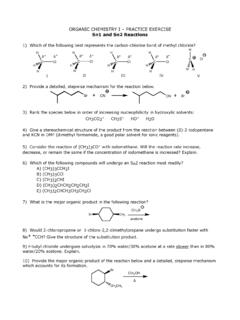
Transcription of PRACTICE EXERCISE – ORGANIC CHEMISTRY I Alkynes …
1 PRACTICE EXERCISE ORGANIC CHEMISTRY IAlkynes Synthesis and ReactionsFOR QUESTIONS 1-4, DRAW A LEWIS OR LINE-ANGLE FORMULA AND GIVE THE IUPAC ) (CH3)2C(CH2CH3)CCCH(CH3)2 2) HCCCH2CH2CH3 3) CH3CH=CHCH=CHCCCH3 4) BrCH2CH2 CCCH2CH35) Draw acetylene 6) Draw (S)-5-phenyloct-2-yne 7) Draw hepta-3,6-dien-1-yne8) The carbon-carbon triple bond of an alkyne is composed ofA) 3 s bonds B) 3 p bonds C) 2 s bonds and 1 p bond D) 1 s bond and 2 p bonds9) Why are terminal Alkynes more acidic than other hydrocarbons?10) Provide the structure of the major ORGANIC product(s) in the reaction ) NaNH22) PhCH2Br11) Which of the species below is less basic than acetylide?A) CH3 LiB) CH3 ONaC) CH3 MgBrD) both A and CE) all of the above12) Describe a chemical test for distinguishing terminal Alkynes from internal ) 2-Methylhex-3-yne can be prepared by the reaction of an alkynide with an alkyl halide.
2 Does the bettersynthesis involve alkynide attack on bromoethane or on 2-bromopropane? Explain your ) Provide the structure of the major ORGANIC product(s) in the reaction +Br15) Provide the structure of the major ORGANIC product(s) in the reaction +16) Provide the structure of the major ORGANIC product(s) in the reaction 'scatalyst17) Provide the structure of the major ORGANIC product(s) in the reaction ) Provide the structure of the major ORGANIC product(s) in the reaction (1 equivalent)19) Provide the structure of the major ORGANIC product(s) in the reaction , H2O20) Provide the structure of the major ORGANIC product(s) in the reaction sequence ) Provide the structure of the major ORGANIC product(s) in the reaction ) O32) H2O22) To a solution of propyne in diethyl ether, one molar equivalent of CH3Li was added and the resultingmixture was stirred for hour. After this time, an excess of D2O was added.
3 Describe the major organicproduct(s) of this ) CH3 CCD + CH4B) CH3 CCCH3C) CD3 CCD3D) CH3 CCCD3E) CH3 CCD + CH3D23) Provide the structure of the major ORGANIC product(s) in the reaction / BaSO4 / quinoline24) Which of the alkyne addition reactions below involve(s) an enol intermediate?A) hydroboration/oxidationB) treatment with HgSO4 in dilute H2SO4C) hydrogenationD) both A and BE) none of the above25) Draw the products which result when oct-3-yne is heated in basic potassium permanganate 26-33 INVOLVE MULTISTEP SYNTHESES. PROVIDE THE STEPS BY WHICH THEPRODUCT GIVEN CAN BE PREPARED FROM THE STARTING MATERIAL ) Prepare racemic 2,3-dibromobutane from propyne 27) Prepare meso-2,3-dibromobutane from propyne28) Prepare hept-1-yne from hept=1-ene. 29) Prepare butylbenzene from phenylacetylene30) Prepare trans-pent-2-ene from ) Prepare the compound shown below from ) Prepare the compound shown below from ) How many distinct Alkynes exist with a molecular formula of C4H6?
4 A) 0 B) 1 C) 2 D) 3 E) 434) Name the compound which results when pent-2-yne is subjected to catalytic hydrogenation using aplatinum ) Which of the following reagents should be used to convert hex-3-yne to (E)-hex-3-ene?A) H2, Pt B) Na, NH3 C) H2, Lindlar's catalyst D) H2SO4, H2O E) HgSO4, H2O36) Which of the following reagents should be used to convert hex-3-yne to (Z)-hex-3-ene?A) H2, Pt B) Na, NH3 C) H2, Lindlar's catalyst D) H2SO4, H2O E) HgSO4, H2O37) Draw the product that results when CH3 CCLi reacts with CH3CH2 COCH2CH3 followed by addition of H2O38) Name the compound which results when pent-1-yne is treated with sodium in liquid ) Explain why the synthetic route shown below would be ) Explain why the synthetic route shown below would be ) Provide the major ORGANIC product of the reaction shown +ANSWERS1)2,5,5-trimethylhept-3-yneCC123 45672)pent-1-yneHCC3)octa-2,4-dien-6-yne CCCH3123456784)1-bromohex-3-yneBr1234565 )CCHHorHCCH6)(S)-5-phenyloct-2-ynePhH123 456787)hepta-3,6-dien-1-yne12345678) D9) The carbanion which results upon deprotonation of a terminal alkyne has the lone pair of electrons in ansp hybrid orbital.
5 The greater % s character of this orbital gives this orbital a significantly lower )CH3CH2 CCHNaNH2CH3CH2 CCNa1)CH3CH2 CCPhCH2 BrSn2CH3CH2 CCCH2 PhAcid-base reaction2)11) B 12) Add a solution of Cu+ or Ag+. Terminal Alkynes form insoluble metal acetylides and precipate13) Attack on the less sterically hindered primary bromide (bromoethane) is more favorable. Reaction of analkynide with the secondary (hindered) bromide would result mostly in elimination instead of )CCNa+BrThe attack of the strong base on a hindered bromide promotes elimination (E2) over substitution+CCH15)CCHNaNH2 CCNaCCOCCOH3O+CCOH3o alcohols are produced from the reactionbetween carbon nucleophiles and first step is an acid-base reaction which producesthe alkyne conjugate base, or alkynide ion (a nucleophile)Nucleophilic attack on the ketone gives the alkoxide ion,which is the conjugate base of the 3o )H2 Lindlar'scatalyst17)CH3CH2 CCCH3 NaNH3trans isomer18)CCHBrHBr (1 equivalent)Markovnikov's product19) Markovnikov addition of water to the triple bond produces the enol, which then rearranges to the , H2 OCH2 OHenolCH3 Oketone20) Anti-Markovnikov addition of water to the triple bond produces the enol, which then rearranges to )CC1) O32)
6 H2 Ooxidative cleavage products (carboxylic acids)COOH+COHO22) This is simply a series of acid base reactions, as follows (the answer is A).CCHH3 CCH3 LiCCH3 CLiD2O+CH4(g)CCDH3C+LiODorganic products23)PhPhD2Pd / BaSO4 / quinolinesyn-addition of deuterium to the triple bondPhDDPh24) D25) CH3CH2CO2- K+ + CH3CH2CH2CH2CO2- K+. These products are the conjugate bases of thecarboxylic acids that would be produced if the pH was neutral or acidic. But because the KMnO4 reactioninvolves basic medium (OH-), the actual products are not the free carboxylic acids, but their conjugate )CH3 CCHNaNH2CH3 CCCH3 ISn2CH3 CCCH3H2 Lindlar's +enantiomer27)CH3 CCHNaNH2CH3 CCCH3 ISn2CH3 CCCH3 NaH3 CHCH3 HtransBr2NH3H3 CCH3 HHBrBrH3 CCH3 BrHHBrmeso28)Br2 BrBrNaNH2, heatelimination29)PhCCHNaNH2 PhCCCH3CH2 BrPhCCH2, PtPh30)CH3 CCHNaNH2CH3 CCCH3CH2 BrCH3 CCNa, NH331)OHCCHNaNH2 HCCCH3CH2 BrHCCNaNH2 CCOH3O+OH32)OHCH3H3 CHHCCHNaNH2 HCCCH3 BrHCCCH3 NaNH2 CCCH3CH3 BrCCH3 CCH3Na, NH3H3 CHCH3 HPhCO3 Hepoxidationtranstrans epoxide33) C (2):34) pentane35) BNa, NH3HH(E), or cis isomer36) C37)CH3 CCLiOa ketoneOCH3H2 OOHCH3a tertiary alcohol38) pent-1-ene39) The t-butyl bromide would not undergo Sn2 when treated with the intermediate alkynide because thesteric hinderance in the halide is too great.
7 Instead, the alkynide would deprotonate the tertiary bromide viaan E2 +CCH+Br40) Sodium methoxide (NaOCH3) is not a strong enough base to deprotonate the intermediate terminalalkyne (A):HCCNaCH3CH2 BrNaOCH3(A)CCHno favorable reaction41)CCHNaNH2 PhHOH3O+CCPhHOPhHOHa secondary alcohol