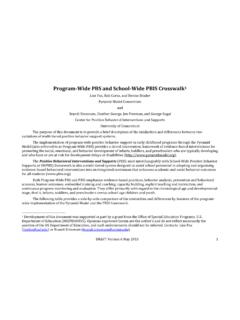
Transcription of RI School-Wide Positive Behavioral Interventions and ...
1 PBIS is a systems approach to establishing a social culture of Behavioral supports for all children that promotes both social and academic success in school . Inappropriate behaviors and negative school climates are Interventions and Supports (SW-PBIS). School-Wide Positive Behavioral linked to loss of instruction, poor academic achievement, Interventions and Supports poor standardized test performance, increased dropout RI School-Wide Positive Behavioral rates, and negative school climate. For more information: The Paul V. Sherlock Center on Disabilities has led the state in PBIS implementation within schools/districts since 2005. The Sherlock Center currently supports 60. schools, 13 Districts, and 18 Early Care and Education Programs.
2 A Train-the-Trainer Model to support district- Phone: 401-456-8072 wide implementation began in 2009. TDD: 401-456-8773 PBIS efforts in Rhode Island are having a Positive impact Fax: 401-456-8150 by increasing social and academic outcomes. Schools E-mail: implementing PBIS with fidelity have a significantly lower number of students who are referred for problem behaviors, and fewer students (2% vs. 10%) who need intensive, individualized, multi-agency support (see below). Impact of School-Wide Positive Behavioral PBIS and RTI (Response to Intervention) work hand-in-hand. Interventions and RTI is a continuum of academic supports for students Supports on: who could benefit from extra support (see above).
3 PBIS applies that same continuum to providing reading, writing, math, and Behavioral supports for students who could benefit from reduction in challenging extra support . School-Wide systems are established to behaviors. support all students. PBIS supports the development of Paul V. Sherlock Center academic and social/ Behavioral skills needed to support on Disabilities *. optimal student success (see below). Rhode Island College 600 Mt. Pleasant Avenue Providence, RI 02908. Paul V. Sherlock Center on Disabilities Rhode Island College Providence, RI. *Determination of fidelity of implementation of Universal Systems 2010 is defined by SET scores of 80% or greater on Expectations Taught,' and 80% or greater on the average Total' (80/80).
4 PBIS in Early Care and Education THE IMPORTANCE OF FIDELITY. Centers PBIS is just as relevant in early care and education A comparison of schools implementing PBIS with fidelity and schools not implementing with fidelity as measured by the SET ( School-Wide Evaluation Tool): centers/programs as it is for school -aged children (Kindergarten forward). Key social and emotional skills children need as they enter elementary school Schools Implementing with Fidelity Schools Not Implementing with Fidelity are: Confidence Attendance Showed an increase in average annual attendance of No increase during same period Capacity to develop good relationships with peers and adults AYP (Annual Yearly Progress) Twice as likely to meet AYP and 86% met AYP 2008 2009 44% met AYP during same period Concentration and persistence on challenging tasks Ability to effectively communicate emotions Ability to listen to instructions and be attentive Reading and Math Scores 50% of schools implementing with fidelity had increased 19% of schools implementing PBIS, but not with both reading and math scores fidelity.
5 Had increased both reading and math Ability to solve social problems scores EC PBIS outcomes include building the capacity of Suspension Days 29% of PBIS schools had a decrease in the number of out of 22% of PBIS schools had a decrease in the number early care and education programs to provide a school suspension days of out of school suspension days continuum of support , improving discipline systems, increasing instructional time for learning, and social emotional and Behavioral development. Below is an example of the difference EC PBIS made to one center that began implementation in 2007. Using Rhode Island 2007-2008 to 2008-2009 Department of Education NECAP proficiency scores suspension data, schools show a difference in scores implementing PBIS.
6 When comparing PBIS demonstrated greater schools to non-PBIS schools reduction in use of out of in the same district. school suspensions and number of days. Comparison of schools Comparisons of PBIS to implementing PBIS and non-PBIS schools in schools not implementing relation to the frequency PBIS within the same of out of school district. suspensions and number of suspension days.