Transcription of SAFETY DATA SHEET - Agilent
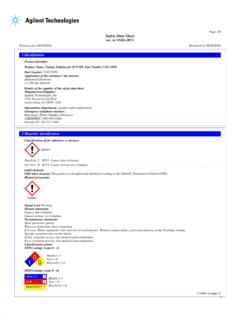
1 Section 1. IdentificationHPLC Flushing Solvent, Part Number G1969-85026 CHEMTREC : 1-800-424-9300 SAFETY data SHEETP roduct nameIn case of emergency::Supplier/Manufacturer: Agilent Technologies, Stevens Creek BlvdSanta Clara, CA 95051, USA800-227-9770 HPLC Flushing Solvent, Part Number G1969-85026 Conforms to US OSHA Hazard Communication :Part uses:Reagents and Standards for Analytical Chemistry Laboratory Use500 mlValidation date:5/22 Relevant identified uses of the substance or mixture and uses advised Product Details of the supplier of the SAFETY data Emergency telephone numberSection 2. Hazards identificationClassification of the substance or mixtureSignal word:DangerHazard GHS label elementsOSHA/HCS status:This material is considered hazardous by the OSHA Hazard Communication Standard (29 CFR ).
2 H225 FLAMMABLE LIQUIDS - Category 2H302 ACUTE TOXICITY (oral) - Category 4H315 SKIN IRRITATION - Category 2H319 EYE IRRITATION - Category 2AH351 CARCINOGENICITY - Category 2H335 SPECIFIC TARGET ORGAN TOXICITY (SINGLE EXPOSURE) (Respiratory tract irritation) - Category 3H336 SPECIFIC TARGET ORGAN TOXICITY (SINGLE EXPOSURE) (Narcotic effects) -Category 3H373 SPECIFIC TARGET ORGAN TOXICITY (REPEATED EXPOSURE) (blood system,central nervous system (CNS), kidneys, liver) - Category 2H304 ASPIRATION HAZARD - Category 1H400 AQUATIC HAZARD (ACUTE) - Category 1H411 AQUATIC HAZARD (LONG-TERM) - Category Classification of the substance or mixture1/17 Date of issue :05/22/2018 HPLC Flushing Solvent, Part Number G1969-85026 Section 2.
3 Hazards identificationHazard statements:H225 - Highly flammable liquid and - Harmful if - Causes serious eye - Causes skin - Suspected of causing - May be fatal if swallowed and enters - May cause respiratory - May cause drowsiness or - May cause damage to organs through prolonged or repeated exposure. (blood system, central nervous system (CNS), kidneys, liver)H400 - Very toxic to aquatic - Toxic to aquatic life with long lasting statementsPrevention:P201 - Obtain special instructions before - Do not handle until all SAFETY precautions have been read and - Wear protective gloves.
4 Wear eye or face protection. Wear protective - Keep away from heat, hot surfaces, sparks, open flames and other ignition sources. No - Use explosion-proof electrical, ventilating, lighting and all material-handling - Use only non-sparking - Take precautionary measures against static - Keep container tightly - Use only outdoors or in a well-ventilated - Avoid release to the - Do not breathe - Do not eat, drink or smoke when using this - Wash hands thoroughly after :P391 - Collect - Get medical attention if you feel + P313 - IF exposed or concerned: Get medical + P340 + P312 - IF INHALED: Remove person to fresh air and keep comfortable for breathing.
5 Call a POISON CENTER or physician if you feel + P310 + P330 + P331 - IF SWALLOWED: Immediately call a POISON CENTER or physician. Rinse mouth. Do NOT induce + P361 + P353 - IF ON SKIN (or hair): Take off immediately all contaminated clothing. Rinse skin with water or + P352 + P362+P364 - IF ON SKIN: Wash with plenty of soap and water. Take off contaminated clothing and wash it before + P313 - If skin irritation occurs: Get medical + P351 + P338 - IF IN EYES: Rinse cautiously with water for several contact lenses, if present and easy to do. Continue + P313 - If eye irritation persists: Get medical :P405 - Store locked - Store in a well-ventilated - Keep :P501 - Dispose of contents and container in accordance with all local, regional, national and international not otherwise classified:None Other hazards2/17 Date of issue :05/22/2018 HPLC Flushing Solvent, Part Number G1969-85026 Section 3.
6 Composition/information on ingredientsPropan-2-ol 25 - 5067-63-0 Acetonitrile 10 - 2575-05-8 Dichloromethane 10 - 2575-09-2 Cyclohexane 10 - <25110-82-7 Ingredient nameCAS number%Substance/mixture:Occupational exposure limits, if available, are listed in Section concentration shown as a range is to protect confidentiality or is due to batch are no additional ingredients present which, within the current knowledge of the supplier and in the concentrations applicable, are classified as hazardous to health or the environment and hence require reporting in this medical attention immediately. Call a poison center or physician.
7 Wash out mouth with water. Remove dentures if any. Remove victim to fresh air and keep at rest in a position comfortable for breathing. If material has been swallowed and the exposed person is conscious, give small quantities of water to drink. Stop if the exposed person feels sick as vomiting may be dangerous. Aspiration hazard if swallowed. Can enter lungs and cause damage. Do not induce vomiting. If vomiting occurs, the head should be kept low so that vomit does not enter the lungs. Never give anything by mouth to an unconscious person. If unconscious, place in recovery position and get medical attention immediately.
8 Maintain an open airway. Loosen tight clothing such as a collar,tie, belt or flush eyes with plenty of water, occasionally lifting the upper and lower eyelids. Check for and remove any contact lenses. Continue to rinse for at least 10 minutes. Get medical contaminated skin with plenty of water. Remove contaminated clothing and shoes. Continue to rinse for at least 10 minutes. Get medical attention. Wash clothing before reuse. Clean shoes thoroughly before victim to fresh air and keep at rest in a position comfortable for breathing. If it is suspected that fumes are still present, the rescuer should wear an appropriate mask or self-contained breathing apparatus.
9 If not breathing, if breathing is irregular or if respiratory arrest occurs, provide artificial respiration or oxygen by trained personnel. It may be dangerous to the person providing aid to give mouth-to-mouth medical attention. If necessary, call a poison center or physician. If unconscious,place in recovery position and get medical attention immediately. Maintain an open airway. Loosen tight clothing such as a collar, tie, belt or waistband. In case of inhalation of decomposition products in a fire, symptoms may be delayed. The exposed person may need to be kept under medical surveillance for 48 4.
10 First aid measuresEye contactSkin Description of necessary first aid Most important symptoms/effects, acute and delayedInhalation:Can cause central nervous system (CNS) depression. May cause drowsiness or dizziness. May cause respiratory if swallowed. Can cause central nervous system (CNS) depression. May be fatal if swallowed and enters airways.:IngestionSkin contact:Causes skin serious eye irritation.:Eye contactOver-exposure signs/symptomsPotential acute health effects3/17 Date of issue :05/22/2018 HPLC Flushing Solvent, Part Number G1969-85026 Section 4. First aid measuresProtection of first-aiders:No action shall be taken involving any personal risk or without suitable training.