Transcription of SANIBRITE LIQUID - General Sanitation
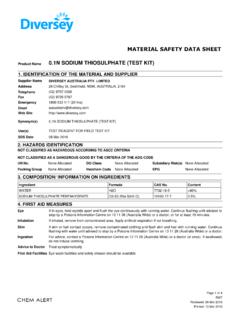
1 Product Name SANIBRITE LIQUID . 1. IDENTIFICATION OF THE MATERIAL AND SUPPLIER. Supplier Name DIVERSEY AUSTRALIA PTY. LIMITED. Address 29 Chifley St, Smithfield, NSW, AUSTRALIA, 2164. Telephone (02) 9757 0300. Fax (02) 9725 5767. Emergency 1800 033 111 (24 hrs). Email Web Site Synonym(s) HH15417 SANIBRITE LIQUID 4X5L. Use(s) CLEANING AGENT. SDS Date 08 Mar 2010. 2. HAZARDS IDENTIFICATION. CLASSIFIED AS HAZARDOUS ACCORDING TO ASCC CRITERIA. RISK PHRASES. R36/38 Irritating to eyes and skin. SAFETY PHRASES. S24/25 Avoid contact with skin and eyes. NOT CLASSIFIED AS A DANGEROUS GOOD BY THE CRITERIA OF THE ADG CODE. UN No. None Allocated DG Class None Allocated Subsidiary Risk(s) None Allocated Packing Group None Allocated Hazchem Code None Allocated EPG None Allocated 3.
2 COMPOSITION/ INFORMATION ON INGREDIENTS. Ingredient Formula CAS No. Content SODIUM HYPOCHLORITE (AS % CL ACTIVE) Not Available <5%. SODIUM HYDROXIDE Na-OH 1310-73-2 <1%. NON HAZARDOUS INGREDIENTS Not Available Not Available >50%. 4. FIRST AID MEASURES. Eye If in eyes, hold eyelids apart and flush the eye continuously with running water. Continue flushing until advised to stop by a Poisons Information Centre on 13 11 26 (Australia Wide) or a doctor, or for at least 15 minutes. Inhalation If inhaled, remove from contaminated area. Apply artificial respiration if not breathing. Skin If skin or hair contact occurs, remove contaminated clothing and flush skin and hair with running water.
3 Continue flushing with water until advised to stop by a Poisons Information Centre on 13 11 26 (Australia Wide) or a doctor. Ingestion For advice, contact a Poisons Information Centre on 13 11 26 (Australia Wide) or a doctor (at once). If swallowed, do not induce vomiting. Advice to Doctor Treat symptomatically First Aid Facilities Eye wash facilities and safety shower should be available. Page 1 of 4. RMT. Reviewed: 08 Mar 2010. Printed: 10 Mar 2010. Product Name SANIBRITE LIQUID . 5. FIRE FIGHTING MEASURES. Flammability Non flammable. May evolve toxic gases (chlorine) when heated to decomposition. Fire and Evacuate area and contact emergency services.
4 Toxic gases may be evolved in a fire situation. Remain upwind Explosion and notify those downwind of hazard. Wear full protective equipment including Self Contained Breathing Apparatus (SCBA) when combating fire. Use waterfog to cool intact containers and nearby storage areas. Extinguishing Prevent contamination of drains or waterways. Hazchem Code None Allocated 6. ACCIDENTAL RELEASE MEASURES. Spillage Contact emergency services where appropriate. Use personal protective equipment. Clear area of all unprotected personnel. Ventilate area where possible. Contain spillage, then cover / absorb spill with non-combustible absorbant material (vermiculite, sand, or similar), collect and place in suitable containers for disposal.
5 7. STORAGE AND HANDLING. Storage Store in a cool, dry, well ventilated area, removed from acids, reducing agents, organic materials, active metals, heat or ignition sources and foodstuffs. Ensure containers are adequately labelled, protected from physical damage, sealed when not in use, vented and stored upright. Check regularly for leaks or spills. Large storage areas should have appropriate ventilation systems. Handling Before use carefully read the product label. Use of safe work practices are recommended to avoid eye or skin contact and inhalation. Observe good personal hygiene, including washing hands before eating. Prohibit eating, drinking and smoking in contaminated areas.
6 8. EXPOSURE CONTROLS/ PERSONAL PROTECTION. Exposure Stds TWA STEL. Ingredient Reference ppm mg/m3 ppm mg/m3. Sodium hydroxide (peak limitation) ASCC (AUS) -- 2 -- -- SODIUM HYPOCHLORITE (AS % CL ACTIVE). ES-TWA: 1 ppm (3 mg/m3) (chlorine). Biological Limits No biological limit allocated. Engineering Avoid inhalation. Use in well ventilated areas. Where an inhalation risk exists, mechanical extraction ventilation is Controls recommended. Maintain vapour levels below the recommended exposure standard. PPE Wear splash-proof goggles, rubber or PVC gloves and coveralls. When using large quantities or where heavy contamination is likely, wear: a PVC apron and rubber boots.
7 Where an inhalation risk exists, wear: a Type B. (Inorganic gases and vapours) respirator. 9. PHYSICAL AND CHEMICAL PROPERTIES. Appearance CLEAR LIQUID Solubility (Water) SOLUBLE. Odour SLIGHT CHLORINE ODOUR Specific Gravity pH - (neat) % Volatiles NOT AVAILABLE. Vapour Pressure NOT AVAILABLE Flammability NON FLAMMABLE. Vapour Density NOT AVAILABLE Flash Point NOT RELEVANT. Boiling Point 100 C Upper Explosion Limit NOT RELEVANT. Melting Point NOT AVAILABLE Lower Explosion Limit NOT RELEVANT. Evaporation Rate NOT AVAILABLE. Page 2 of 4. RMT. Reviewed: 08 Mar 2010. Printed: 10 Mar 2010. Product Name SANIBRITE LIQUID . 10. STABILITY AND REACTIVITY.
8 Chemical Stability Stable under recommended conditions of storage. Conditions to Avoid Avoid heat, sparks, open flames and other ignition sources. Material to Avoid Incompatible with reducing agents (eg. amines), organic materials, some metals. Do not mix with any other chemicals. Decomposition May evolve toxic gases (chlorine) when heated to decomposition. Hazardous Reactions Polymerization is not expected to occur. 11. TOXICOLOGICAL INFORMATION. Health Hazard This product has the potential to cause adverse health effects. Use safe work practices to avoid eye or skin Summary contact and inhalation. Over exposure to chlorine vapour may result in lung tissue damage.
9 Do not mix with other chemicals unless advised and specific instructions provided, as toxic and irritating gases may be evolved. Use safe work practices to avoid over exposure. Upon dilution, the potential for corrosive effects may be reduced. Eye Contact may result in irritation, lacrimation, pain, redness, corneal burns and possible permanent damage. Inhalation Over exposure may result in irritation of the nose and throat, coughing, nausea and headache. Due to the low vapour pressure, an inhalation hazard is not anticipated with normal use. Skin Contact may result in irritation, redness, pain, rash, dermatitis and possible burns. Ingestion Ingestion may result in ulceration and burns to the mouth and throat, nausea, vomiting, abdominal pain and diarrhoea.
10 Toxicity Data SODIUM HYPOCHLORITE (AS % CL ACTIVE) (Not Available). LD50 (Ingestion): 5800 mg/kg (mouse). TDLo (Ingestion): 1 gm/kg (woman). TDLo (Intravenous): 45 mg/kg (man). SODIUM HYDROXIDE (1310-73-2). LD50 (Intraperitoneal): 40 mg/kg (mouse). LDLo (Ingestion): mg/kg (human). 12. ECOLOGICAL INFORMATION. Environment ATMOSPHERE: May release toxic chlorine gas. WATER: Hypochlorites are extremely toxic to fish; Exposure to % over 96 hours resulted in death of trout. SOIL: May leach to groundwater with resultant toxicity to aquatic organisms. Hypochlorites are non-persistent in the environment and there is no accumulation potential as they gradually decompose into a salt and oxygen.