Example: bankruptcy
Secular Changes in Physical Education Attendance Among …
Data Analysis ... NPAP’s ultimate purpose is to improve health, prevent disease and disability, and enhance quality of life. ... high school students reporting daily physical education attendance was observed to decrease signiicantly from 41.6% in 1991 to 25.4% in 1995 and then did not
Tags:
Information
Domain:
Source:
Link to this page:
Documents from same domain
Fast Facts
www.cdc.govAny person working outdoors is at risk of exposure to poisonous plants, such as poison ivy, poison oak, and poison sumac. When in contact with skin, the sap oil (urushiol) of
Trans Fat: The Facts
www.cdc.gov• Read the Nutrition Facts label and ingredient list to compare foods. » Choose products with 0 grams trans fat. » Check the Ingredient List to see if there is any partially hydrogenated oil in the product.
School Chemistry Laboratory Safety Guide
www.cdc.govSchool Chemistry Laboratory Safety Guide. October 2006. U.S. Consumer Safety Product Commission DEPARTMENT OF HEALTH AND HUMAN SERVICES. Centers for Disease Control and Prevention
Biosafety in Microbiological and Biomedical …
www.cdc.goviii. Foreword. Biosafety in Microbiological and Biomedical Laboratories (BMBL) quickly became the cornerstone of biosafety practice and policy in the United States upon first
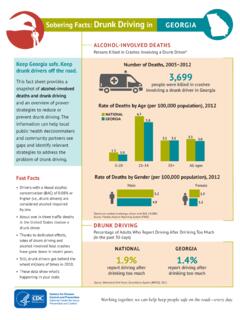
Sobering Facts: Drunk Driving in Georgia
www.cdc.govSobering Facts: Drunk Driving in GEORGIA Keep Georgia safe. Keep drunk drivers off the road. This fact sheet provides a snapshot of alcohol-involved deaths and drunk driving
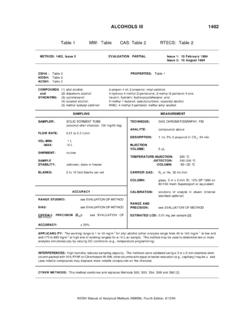
ALCOHOLS III 1402
www.cdc.govALCOHOLS III: METHOD 1402, Issue 2, dated 15 August 1994 - Page 3 of 4 a. Remove and discard back sorbent section of a media blank sampler. b. Inject a known amount of analyte or DE stock solution directly onto front sorbent section

ANTIBIOTIC RESISTANCE THREATS
www.cdc.govApr 23, 2013 · 6. ANTIBIOTIC RESISTANCE THREATS IN THE UNITED STATES, 2013. Executive Summary. Antibiotic Resistance Threats in the United States, 2013. is a snapshot of the complex problem
Chlorine Residual Testing
www.cdc.govChlorine Residual Testing Fact Sheet, CDC SWS Project 4 Methods to Test Free Chlorine in the Field in Developing Countries There are three main methods to test free chlorine residual in drinking water in the field
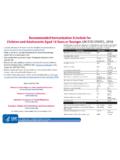
2018 Combined Recommended Immunization …
www.cdc.govRecommended Immunization Schedule for Children and Adolescents Aged 18 Years or Younger, UNITED STATES, 2018 Approved by the Advisory Committee on …
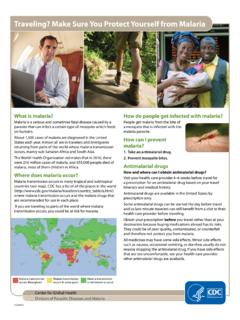
Traveling? Make Sure You Protect Yourself from …
www.cdc.govCS26201 Malaria transmission occurs throughout Malaria transmission occurs in some parts Malaria transmission is not known to occur Center for Global Health
Related documents

CIVIL RIGHTS DATA COLLECTION - ed
www2.ed.govMar 21, 2014 · of-school suspension. NOTE: Data reflects 99% of CRDC schools and a total of 290,000 American . Students with disabilities suspended out-of-school . Students with disabilities served by IDEA are more than twice as likely to receive one or more out-of-school suspension as students without disabilities. Indian/Alaska Native females, 300,000 American

Examining School Discipline Policies and Connections to ...
www.usccr.govData the U.S. Department of Education reports show a consistent pattern of schools suspending or expelling black students with disabilities at higher rates than their proportion of the population of students with disabilities. Data show the large majority of out-of-school suspensions are for non-violent behavior.

Parental Engagement: Engaging with Families of Children ...
www.education.act.gov.auEach school has a Disability Education Co-ordinator (DECO). The DECO offers support for families and staff in relation ... a targeted educational program to achieve appropriate learning outcomes for identified students with specific needs. An ILP conversation is a good way to engage with the family of a child with disability, acknowledging that ...
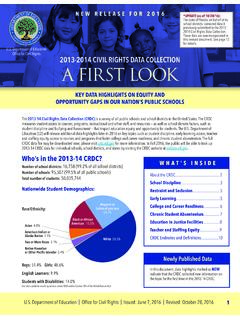
2013-14 Civil Rights Data Collection: A First Look
www2.ed.govOct 28, 2016 · 2013-14 CRDC data for individual schools, school districts, and states by visiting the CRDC website at oc. ... sex, English learner status, and disability, from public schools across the nation. The CRDC is a longstanding and important aspect of the Office for ... strengthen behavioral supports for students, and a School
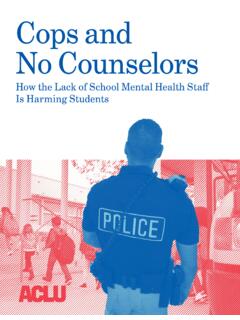
Cops and No Counselors - ACLU
www.aclu.orgbased mental health providers improve school climate17 and other positive outcomes for students.18 Data shows that school staff who provide health and mental health services to our children not only improve the health outcomes for those students,19 but also improve school safety.20 Furthermore, schools that employ

Strategies for Supporting Students Who Are Twice-Exceptional
files.eric.ed.gov2e students and those students identified as having solely a disability or gifts and talents. Students with disabilities are often recognized by their families and teachers when they are not showing the same academic, social, or developmental characteristics as same-age peers. In the educational setting, teachers often target
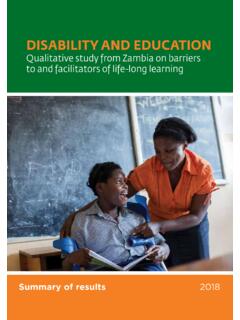
DISABILITY AND EDUCATION - UNICEF
www.unicef.orgData-collection instruments 13 The field team 14 Data analysis 14 ... Disability Survey was to carry out a qualitative, in-depth study of the barriers to and facilitators of life- ... textbooks out loud to blind students. Fourth, schools should have more assistant
School Violence Fact Sheet - Centers for Disease Control ...
www.cdc.govschool. 1. In 2013, 12% of students ages 12–18 reported that gangs were present at their school during the school year. 1. In a 2015 nationally representative sample of youth in grades 9-12: 2 • 7.8% reported being in a physical fight on school property in the 12 months before the survey. • 5.6% reported that they did not go to school on