Transcription of SELF RANGE OF MOTION PROGRAM
1 self RANGE OF MOTION PROGRAM FOR PERSONS WITH PARAPLEGIA DAILY Lie on your stomach, preferably with your feet off the bed. This will help stretch and lengthen the muscles in the front of your hips, which tend to tighten and shorten from prolonged sitting. It is helpful to remain on your stomach for periods of 30 minutes or longer each day. To add to this stretch, do push-ups with your upper body while your hips and legs remain on the bed.
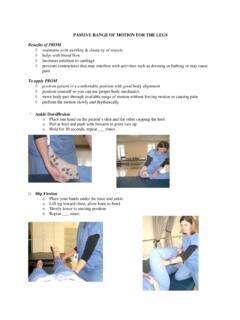
2 THREE DAYS / WEEK Do the following stretching PROGRAM at least three days per week, unless you or your therapist notice a particularly tight and limited MOTION that may benefit from daily stretching to increase its flexibility. Do two repetitions of each stretch, holding each stretch for a slow count of five. 1. Begin by sitting with your back supported against the wall, and your legs straight out in front of you. 2. Bring your left leg up and place your left foot across your right thigh, allowing your left knee to drop down to the outside, toward the bed.
3 This will stretch the inside of your thigh. Do 2 repetitions of 5 seconds each. 3. Reach down to the ball of your left foot with your right hand. Press your foot upward toward your knee. This is a calf stretch. Do 2 repetitions of 5 seconds each. 4. Sit up as tall as you can by tilting your pelvis forward. Try to stay as erect as possible during the entire stretch. Turn your trunk to the left, use your left hand for balance support on the bed, and reach down to your right foot with your right hand, keeping your right knee straight.
4 Pull your foot toward you. This is a combination stretch for your right calf and hamstring muscles. Do two repetitions of 5 seconds each. 5. Now perform all the same stretches with the opposite leg by straightening your left leg out in front of you, bending your right leg, and starting with #2 above. THINGS TO AVOID **As important as it is to stretch regularly, it is just as important to avoid over- stretching. Avoid the kissing your knee syndrome by not bringing your head toward your knees when your knees are straight.
5 **Avoid pulling your knee across your body, toward the opposite shoulder. **Avoid any leg stretches or leg positioning that you would consider abnormal. If it seems like it would hurt if you could feel it, DON T DO IT!!