Transcription of Steam Tables… - Armstrong International
1 2 Steam They to Use ThemThe heat quantities and temperature/pressure relationships referred to in thisHandbook are taken from the Propertiesof Saturated Steam of Terms UsedSaturated Steam is pure Steam at thetemperature that corresponds to theboiling temperature of water at the and Gauge PressuresAbsolute pressure is pressure in poundsper square inch (psia) above a perfectvacuum. Gauge pressure is pressure inpounds per square inch above atmo-spheric pressure which is pounds persquare inch absolute. Gauge pressure(psig) plus equals absolute , absolute pressure minus equalsgauge Relationship(Columns 1, 2 and 3).
2 For every pressureof pure Steam there is a correspondingtemperature. Example: The temperatureof 250 psig pure Steam is always 406 of Saturated Liquid (Column 4).This is the amount of heat required to raisethe temperature of a pound of water from32 F to the boiling point at the pressureand temperature shown. It is expressedin British thermal units (Btu).Latent Heat or Heat of Vaporization(Column 5). The amount of heat (ex-pressed in Btu) required to change apound of boiling water to a pound ofsteam. This same amount of heat isreleased when a pound of Steam iscondensed back into a pound of heat quantity is different for everypressure/temperature combination, asshown in the Steam the Table is UsedIn addition to determining pressure/temperature relationships, you cancompute the amount of Steam which willbe condensed by any heating unit ofknown Btu output.
3 Conversely, the tablecan be used to determine Btu output ifsteam condensing rate is known. In theapplication section of this Handbook, thereare several references to the use of thesteam Heat of Steam (Column 6). The sumof the Heat of the Liquid (Column 4) andLatent Heat (Column 5) in Btu. It is the totalheat in Steam above 32 Volume of Liquid (Column 7).The volume per unit of mass in cubic feetper Volume of Steam (Column 8).The volume per unit of mass in cubic feetper of Saturated Steam (Abstracted from Keenan and Keyes, THERMODYNAMIC PROPERTIES OFSTEAM, by permission of John Wiley & Sons, Inc.)
4 Col. 1 Gauge PressureCol. 2 Absolute Pressure (psia)Col. 3 SteamTemp. ( F)Col. 4 Heat of Sat. Liquid(Btu/lb)Col. 5 Latent Heat(Btu/lb)Col. 6 Total Heat of Steam (Btu/lb)Col. 7 Specific Volume of Sat. Liquid (cu ft/lb)Col. 8 Specific Volume of Sat. Steam (cu ft/lb)Inches of at Steam temperature andunder 100 psig pressure has a heatcontent of Btu per pound. (SeeColumn 4 in Steam Table.) If this conden-sate is discharged to atmosphericpressure (0 psig), its heat content instantlydrops to 180 Btu per pound. The surplusof Btu re-evaporates or flashes aportion of the condensate.
5 The percentagethat will flash to Steam can be computedusing the formula:% flash Steam = x 100SH = Sensible heat in the condensate atthe higher pressure = Sensible heat in the condensate atthe lower pressure to whichdischarge takes =Latent heat in the Steam at thelower pressure to which thecondensate has been flash Steam = x 100 = convenience Chart 3-1 shows theamount of secondary Steam which will beformed when discharging condensate todifferent pressures. Other useful tableswill be found on page heat absorbed by the water in raisingits temperature to boiling point is called sensible heat or heat of saturated heat required to convert water atboiling point to Steam at the sametemperature is called latent heat.
6 Theunit of heat in common use is the Btuwhich is the amount of heat required toraise the temperature of one pound ofwater 1 F at atmospheric water is heated under pressure,however, the boiling point is higher than212 F, so the sensible heat required isgreater. The higher the pressure, thehigher the boiling temperature and thehigher the heat content. If pressure isreduced, a certain amount of sensibleheat is released. This excess heat willbe absorbed in the form of latent heat,causing part of the water to flash Steam (Secondary)What is flash Steam ?
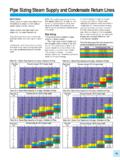
7 When hot conden-sate or boiler water, under pressure, isreleased to a lower pressure, part of it isre-evaporated, becoming what is knownas flash is it important? This flash Steam isimportant because it contains heat unitswhich can be used for economical plantoperation and which are is it formed? When water is heatedat atmospheric pressure, its temperaturerises until it reaches 212 F, the highesttemperature at which water can exist atthis pressure. Additional heat does notraise the temperature, but converts thewater to - 180 0010 0200300400 PRESSURE AT WHICH CONDENSATEIS FORMED LBS/SQ INCU FT FLASH STEAMPER CU FT OF CONDENSATEC hart of flash Steam formed when one cubic footof condensate is discharged to atmospheric pressure300510152025 20300250200150100500 PERCENTAGE OF FLASH STEAMPSI FROM WHICH CONDENSATE IS DISCHARGEDCURVEBACK INABCDEFG105010203040 BCDEFAGC hart of flash Steam formed when discharging condensateto reduced pressure SH - SL H4 Steam is an invisible gas generated byadding heat energy to
8 Water in a energy must be added to raisethe temperature of the water to theboiling point. Then additional energy without any further increase in tempera-ture changes the water to is a very efficient and easilycontrolled heat transfer medium. It ismost often used for transporting energyfrom a central location (the boiler) toany number of locations in the plantwhere it is used to heat air, water orprocess noted, additional Btu are required tomake boiling water change to Btu are not lost but stored in thesteam ready to be released to heat air,cook tomatoes, press pants or dry a rollof heat required to change boilingwater into Steam is called the heat ofvaporization or latent heat.
9 The quantityis different for every pressure/tempera-ture combination, as shown in thesteam ConceptsDefinitionsnThe Btu. A Btu British thermal unit is the amount of heat energy required toraise the temperature of one pound of cold water by 1 F. Or, a Btu is the amount ofheat energy given off by one pound of water in cooling, say, from 70 F to 69 The degree of hotness with no implication of the amount of heatenergy A measure of energy available with no implication of temperature. Toillustrate, the one Btu which raises one pound of water from 39 F to 40 F couldcome from the surrounding air at a temperature of 70 F or from a flame at atemperature of 1,000 at the Heat of Steam is UtilizedHeat flows from a higher temperaturelevel to a lower temperature level in aprocess known as heat transfer.
10 Startingin the combustion chamber of the boiler,heat flows through the boiler tubes to thewater. When the higher pressure in theboiler pushes Steam out, it heats thepipes of the distribution system. Heatflows from the Steam through the walls ofthe pipes into the cooler surrounding heat transfer changes some of thesteam back into water. That s whydistribution lines are usually insulated tominimize this wasteful and undesirableheat Steam reaches the heat exchang-ers in the system, the story is the transfer of heat from the steamis desirable.