Transcription of Steps of Ancient Covenant Making
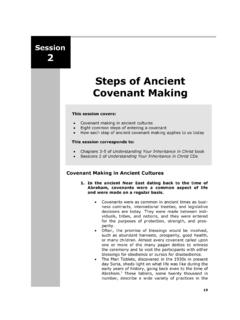
1 Session 2. Steps of Ancient Covenant Making This session covers: Covenant Making in Ancient cultures Eight common Steps of entering a Covenant How each step of Ancient Covenant Making applies to us today This session corresponds to: Chapters 3-5 of Understanding Your inheritance in Christ book Sessions 2 of Understanding Your inheritance in Christ CDs Covenant Making in Ancient Cultures 1. In the Ancient Near East dating back to the time of Abraham, covenants were a common aspect of life and were made on a regular basis. Covenants were as common in Ancient times as busi- ness contracts, international treaties, and legislative decisions are today. They were made between indi- viduals, tribes, and nations, and they were entered for the purposes of protection, strength, and pros- perity. Often, the promise of blessings would be involved, such as abundant harvests, prosperity, good health, or many children. Almost every Covenant called upon one or more of the many pagan deities to witness the ceremony and to visit the participants with either blessings for obedience or curses for disobedience.
2 The Mari Tablets, discovered in the 1930s in present day Syria, sheds light on what life was like during the early years of history, going back even to the time of Abraham. These tablets, some twenty thousand in 1. number, describe a wide variety of practices in the 19. 20 Understanding Your inheritance in Christ Ancient Near East. Among the many details described, one was the rite of Covenant Making during the days of Abraham. Delbert Hillers gives us insight into this Covenant - Making rite by docu- menting a Covenant ceremony which involved the king of Mari. Hillers tells how a representative of the king of Mari, presiding over the cove- nant ceremony, refused to enter into the treaty lightly and insisted upon having a donkey sacrificed. 2. Hillers' example shows us three important points about covenants. First, it reveals how common covenants were during the time that God cut a Covenant with Abraham. Second, it shows that animal sacrifices were an integral part of Ancient - Covenant Making .
3 And third, it rein- forces how serious Covenant agreements were considered in Ancient times. 2. Examples from history show that Covenant Making was a common practice in biblical times. H. Clay Trumbull shares an extra-biblical account of a Near Eastern Covenant that illustrates many of the common Steps involved in mak- ing an Ancient Covenant : In bringing this rite of the Covenant of blood into new promi- nence, it may be well for me to tell of it as it was described to me by an intelligent native Syrian, who saw it consummated in a village at the base of the mountains of Lebanon; and then to add evidences of its wide-spread existence in the East and elsewhere, in earlier and in later times. It was two young men, who were to enter into this cove- nant. They had known each other, and had been intimate [as friends], for years; but now they were to become brother- friends, in the Covenant of blood. Their relatives and neighbors were called together, in the open place before the village foun- tain, to witness the sealing compact.
4 The young men publicly announced their purpose, and their reasons for it. Their decla- rations were written down, in duplicate one paper for each friend and signed by themselves and by several witnesses. One of the friends took a sharp lancet, and opened a vein in the other's arm. Into the opening thus made, he inserted a quill, through which he sucked the living blood. The lancet- blade was carefully wiped on one of the duplicate Covenant - papers, and then it was taken by the other friend, who made a like incision in its first user's arm and drank his blood through the quill, wiping the blade on the duplicate Covenant -record. The two friends declared together: We are brothers in a cove- nant made before God: who deceiveth the other, him will God deceive. Each blood-marked Covenant -record was then folded carefully, to be sewed up in a small leathern case, or amulet, about an inch square; to be worn thenceforward by one of the Covenant -brothers, suspended about the neck, or bound upon the arm, in token of the indissoluble relation.
5 3. Steps of Ancient Covenant Making 21. We can also look to more modern times at the lives of the famous ex- plorers Sir Henry Stanley and David Livingstone. John Osteen in his book, Unraveling the Mystery of the Blood Covenant , shares an inter- esting story about Stanley. The following summarizes Osteen's illus- 4. tration. Livingstone, the first great missionary to Africa, was in the Afri- can jungles so long that England, his native country, began to worry about his status. As a result, the English government sent David Stanley to find him. Stanley's search party encoun- tered great difficulties in their travels. They were plagued by disease and starvation, and were even threatened by canni- bals. At one point, the group encountered a strong, hostile Afri- can tribe near the equator. When the tribe showed no signs of letting them pass through their land, Stanley's interpreter advised Stanley to cut a Covenant with the tribe to avoid severe peril.
6 Not knowing what else to do, Stanley agreed. First, negotiations were made between Stanley's party and the African tribe. The terms were agreed upon and the ceremony began. A representative was chosen from each group and the two representatives went through the blood- Covenant rite. After blood was drawn from the wrist of each representa- tive, mingled together and mixed with wine, both drank the mixture. Gunpowder was then rubbed on each person where the blood had been drawn, creating a permanent mark. The pagan priest that officiated the ceremony then pronounced blessings for following the terms of the agreement and curses for violating the pact. To seal the agreement, Stanley and the chief exchanged gifts. The chief wanted Stanley's prized possession, a goat that he had brought from England that provided milk for his weak stomach. The chief offered Stanley a spear bearing his insignia. Stanley wondered what he would do with an old spear.
7 As he traveled throughout the darkest places in Africa in search of Livingstone, he soon found out. When other tribes with evil in- tent saw the chief's spear in Stanley's hand and his Covenant mark, they knew that Stanley was in Covenant with the most feared tribe in the land. Further, they knew that if they at- tacked Stanley or refused him passage, they would not only have to fight Stanley's search party, but also the African tribe in Covenant with Stanley. Rather than opposing Stanley, the tribes bowed before him, allowing him to pass freely through their territories, and provided him with anything he needed. Stanley reportedly used the Covenant rite at least fifty times during his travels in Africa. Stanley was mightily blessed be- cause of Covenant ! 22 Understanding Your inheritance in Christ 3. God chose to use a common practice of everyday life entering into a Covenant to illustrate His commitment to His people. When God entered into Covenant with Abraham, Moses, David, and Jesus, He drew upon many of the same practices that were common in the day in which they lived.
8 Because God employed cultural practices of the day to introduce His covenants with man, it spoke volumes to the people who lived in the days when biblical covenants were formed. It revealed to them how seriously God takes His Covenant invitations, how seriously God expects His people to take Covenant , the extent of God's blessings to His people, and God's faithfulness toward His cove- nant promises. As we see the Steps of Ancient - Covenant Making applied in God's covenants with us, it underscores how serious God is about His cove- nant promises to us and it conveys the extensive blessings that God has offered us because of Covenant . Steps of Covenant Making 1. From the historical evidence, several Steps of Covenant Making emerge as common in Ancient times. Ancient covenants were always very solemn and serious agree- ments. Animal sacrifices were almost always included. Covenants were accompanied by the promise of blessings for obedience and the warning of curses for disobedience.
9 In pagan societies, the partici- pants almost always invoked their false gods as witnesses to secure the agreement. Finally, a sign of the Covenant would usually accom- pany the sealing of the agreement. From historical information, we see the following eight Steps com- monly used in Ancient Covenant ceremonies: The Pre-Ceremony Actions The Selection of the Covenant Representatives and the Cutting of the Covenant Sacrifice The Exchange of Robes, Belts, and Weapons The Walk unto Death The Pronouncement of Blessings and Curses The Seal of the Covenant Mark The Exchange of Names The Covenant Meal Not every Ancient Covenant included all of these Steps , but many were included. A brief review of these eight Steps will give us a basic understanding of God's covenants with man. Steps of Ancient Covenant Making 23. The important point to us is that God chose these same Steps to enter into Covenant with man. Thus, what each step represented to the people of Abraham's day applies to us today.
10 Eight Steps of Covenant Making 1. The Pre-Ceremony Actions Overview In a typical Ancient Covenant , before the Covenant was en- acted, the two parties would discuss the terms, conditions, the promises of blessing, and the warning of curses related to the agreement. As a part of this step , they would weigh the advantages and disadvantages of the treaty and evaluate whether it was a worthwhile opportunity. They would spend time counting the cost of entering into the Covenant . In essence, they would assess whether the personal sacrifice demanded by the pact would return equal or greater blessings. How It Applies to Us Today When God initiated a Covenant with Abraham, a period of time preceded the actual Covenant ceremony recorded in Genesis 15. This pre-ceremony interaction between God and Abraham is recorded in Genesis 12:1-8. In this passage, God proposed the terms, conditions, and promises. Abraham's role was to count the cost and to respond in faith and obedience.