Transcription of Strength theories - UW Courses Web Server
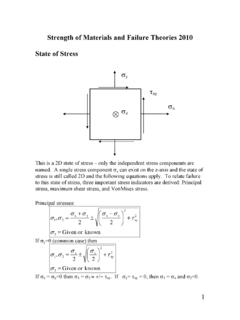
1 Strength theories The majority of material Strength data is based on uniaxial tensile test results. Usually, all that you have to work with is the yield Strength Sy and/or the ultimate tensile Strength Su. This is fine if you only have the one normal stress component present : this is true for simple tension or compression members and for parts loaded only in bending. 1 1 = x In this case, failure (defined as the onset of plastic deformation) occurs when x = 1 =Sy/n n' is the factor of safety. In many loading cases, we have more than just one normal stress component. in torsion, we have a single shear stress component: xy xy Or, combined bending and torsion in a shaft: xy x x xy These cases can all be reduced to a simple biaxial case by finding the principal stresses, 1 and 2. 2. 1 1. 2. Now when does failure occur? For ductile materials there are two commonly used Strength theories - the Maximum Shear Stress (MSS) or Tresca theory and the von Mises or Distortion Energy theory.
2 Strength theories 1. Maximum Shear Stress: This states that failure occurs when the maximum shear stress in the component being designed equals the maximum shear stress in a uniaxial tensile test at the yield stress: This gives max = Sy/2n or | 1 2 | = Sy/n or | 2 3 | = Sy/n or | 3 1 | = Sy/n whichever of the last three leads to the safest result. The latter usually involves 3. being zero, plane stress, and both 1 and 2 having the same sign. Note that the yield Strength is reduced by the factor of safety n'. 2. von Mises or Distortion Energy Theory: This states that failure occurs when the von Mises stress e in the component being designed equals the von Mises stress e in a uniaxial tensile test at the yield stress: This gives: e = 2/2 [( 1 2 )2 + ( 2 3 )2 + ( 3 1 )2 ] = Sy/n In the plane stress case we have 3 = 0 and hence: e = [ 12 1 2 + 22] = Sy/n This is the most commonly used of the Strength equations.
3 A third theory, the Maximum Normal Stress theory is similarly defined. It must NEVER be used for design with ductile materials. A modified version of this theory is sometimes used with brittle materials. All three of these theories are shown on a plot the 1 versus 2 below: Strength theories