Transcription of The Snowy Day - Scholastic
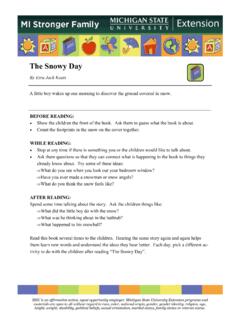
1 THE Snowy DAYBy Ezra Jack Keats (Viking)Theme: Winter Grade Level: Pre-K-1 Running Time: 6 minutes, animatedSUMMARYThis story involves a young boy s experience on a verysnowy day. The magic and wonder of a lovely snow-fall, as seen through the eyes of a child, is conveyed aswe watch young Peter explore and enjoy the snow. Asthe day progresses, we find Peter finding new ways toenjoy the snow that has piled up all over the the end of the story, we find Peter saddenedbecause the snowball he brought home in his pockethas disappeared. However, when Peter awakes the nextmorning, he discovers that the snow outdoors has nowdisappeared, and he calls to his friend across the hall tojoin him for another day of fun in the Children will explore the look and feel of a snowyday.
2 Children will investigate the many ways snow can beenjoyed. Children will develop a basic understanding of theways heat transforms VIEWING ACTIVITIESS hare the book THE Snowy DAY with with children about the kinds of things they enjoydoing outdoors on a Snowy day. (If you live in an areawhere children may not have experienced show, shareillustrations and photographs of snow-covered land-scapes, people skiing, and children playing in thesnow.)Explain to children that the film they are about to seetakes place on a very Snowy day. Encourage children tothink about the way snow must feel to Peter as hewalks and plays in it as they enjoy the a foot painting activity with children.
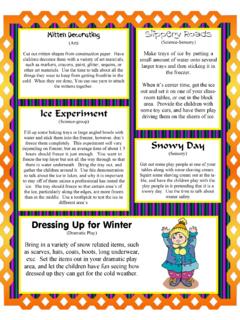
3 Spread longsheets of craft paper against the classroom floor. Havechildren remove their shoes and shocks, dip their feetinto paint, and walk across the paper. Later, let childrendip other objects, such as small sponges, eraser, bottlecaps, etc. into the paint and press them onto the paperbeside the VIEWING ACTIVITIESP rovide children with cotton balls, pieces of black con-struction paper, glue, pieces of white constructionpaper, and scissors. Have children use the materials tocreate their own Snowy day scenes. Later, providewhite chalk that children can use to add figures andother objects tot heir Snowy day pictures.
4 Encouragechildren to share their creations with their with children about what happened to the snow-ball in Peter s pocket. Ask: What do you think happened to Peter s snowball? Why did the snowball melt?Then try the following simple experiments to help chil-dren see how heat can change the form objects take: Melt a stick of butter and have children watch howthe heat transforms the butter. Leave a popsicle on the windowsill in the sunlightand have children check the popsicle frequently forchanges. Make a bowl of Jello with children. Have them watchcarefully to see what happens to the powder when it ismixed with boiling each experiment, help children identify the heatsource and talk about the changes that took children compose some wonderful winter children to describe how cold, Snowy daysfeel.
5 (Ask children who have not experienced snow todescribe how they imagine Snowy days would feel).Print children s descriptions exactly as they tell them toyou. Read children s descriptions of that Snowy feelingback to them. Later, encourage children to illustratetheir Snowy day poetry. Display children s work on aclassroom videos and films about winter available fromWeston Woods include:BRAVE IRENE by William SteigOWL MOON by Jane Yolen & illustrated by JohnSchoenherrTHE SNOWMAN by Raymond BriggsTHE TOMTEN written by Astrid Lindgren & illustrat-ed by Harald WibergZLATEH THE GOAT written by Isaac Bashevis Singer& illustrated by Maurice SendakTHE Snowy DAYCALL 1-800-243-5020 TO ORDER THESE AND OTHER WESTON WOODS VIDEOS!
6 This guide may be photocopied for free distribution without restriction