Example: stock market
Trauma-Focused Cognitive Behavioral Therapy for Children ...
youth in foster care in this study was double the rate of trauma exposure for youth in the general population (Salazar et al., 2013). A review of the literature found that the majority of children in foster care had a history of multiple forms of maltreatment (Oswald, Heil, & Goldbeck, 2010).
Tags:
Information
Domain:
Source:
Link to this page:
Documents from same domain

Implementing Trauma Focused Cognitive Behavioral Therapy ...
tfcbt.orgTrauma‐Focused Cognitive Behavioral Therapy (TF‐CBT)—for trauma‐impacted lesbian, gay, bisexual, transgender, queer/questioning and gender diverse (LGBTQ) youth. The information in this manual was developed through a National Child Traumatic Stress Network (NCTSN, www.nctsn.org) Learning

DEALING WITH TRAUMA: A TF-CBT WORKBOOK FOR TEENS
tfcbt.orgCOPING WITH DIFFICULT FEELINGS 22 CHECKING IN: COPING SKILLS 23 GROUNDING SKILLS 24 ... DEALING WITH TRAUMA: A TF-CBT WORKBOOK FOR TEENS ... Family can mean the people you are related to by blood. Family …

YOUR VERY OWN TF-CBT WORKBOOK
tfcbt.orgSit comfortably in your chair with your arms at your sides and your feet planted on the floor. Close your eyes or look down at the ground while you do this exercise. Imagine that you have a ball of clay in your right hand. Squeeze that ball of clay as hard as you can! While you are squeezing, feel how tight the muscles of your hand and arm are.

Thinking Mistakes 4 Kids - Trauma-Focused Cognitive ...
tfcbt.orgCreated by M. Kliethermes, 2009 THE “WHAT ARE YOU THINKING?” TEAM “All or Nothing” Allen (All-or-nothing thinking) “Blaming” Blake (personalization) “Over and Over” Oliver (overgeneralization) “Negative” Nate (mental filter, disqualifying the positive) “Not a Big Deal” Norman (minimization) Allen only sees things in “black and white” or “right or wrong.”

Trauma and the Brain Handout - Trauma-Focused Cognitive ...
tfcbt.org6. Find them a therapist who can provide Trauma Focused-Cognitive Behavioral Therapy (TF-CBT) if they have persistent posttraumatic stress symptoms. a. If the child has significant ongoing distress, TF-CBT is a proven treatment. These are all strategies to prevent any brain changes from becoming permanent and to restore the child to normal ...
DEALING WITH TRAUMA: A TF-CBT WORKBOOK FOR TEENS
tfcbt.orgsome pages maybe be used for specific components. Keep in mind that some traumatized adolescents may require other types of treatment before, during, or after TF-CBT. The workbook activities correspond to the components of the TF-CBT model as follows: Orientation to Therapy and TF-CBT, Engagement Pages 5-7

Trauma-Focused Cognitive Behavioural Therapy for Children …
tfcbt.orgstages of treatment. Parenting component As noted above, parents receive parallel sessions that address each of the PRACTICE components. In addi-tion, they receive interventions to optimise parenting Trauma-Focused CBT for Children and Parents 159
Related documents
A Brief Legislative History of the Child Welfare System
www.masslegalservices.orgfoster care, inadequate efforts were made to either reunify them with their biological families or place them with adoptive families. Concerns were also raised about the lack of oversight within the foster care system. To address these concerns, Congress enacted the Adoption Assistance and Child Welfare Act of 1980.

State of the Nation’s Foster Care
thefosteringnetwork.org.ukchild tailored support. For children in long-term foster care, it should mean that the child will remain living with a specific foster family until reaching adulthood or leaving care. Long-term foster care is unique in that it provides children with permanence while remaining in the care system. It offers children who are unable to

The AFCARS Report
www.acf.hhs.govNumber served by the foster care system during the FY Number waiting to be adopted on September 30 of the FY Number adopted with public child welfare agency involvement during the FY Number waiting to be adopted for whom parental rights (for all living parents) were terminated as of the last day of the FY 63,815 57,881 117,470 631,832
The Social and Emotional Well-Being of Children in Foster Care
www.ncsl.orgChildren in Foster Care By Nina Williams-Mbengue A. Introduction Child well Just over 415,000 children and youth in the U.S. currently reside in foster care. While this number is high, it represents a significant decline in foster care placements over the past decade, with the number of children in foster care decreasing by almost a quarter

Foster Care in England: Review - GOV.UK
assets.publishing.service.gov.ukFostering and the wider care system are particularly criticised because children in public care perform very poorly in education compared to the general population, with only about 6% of care leavers aged 19 to 21 attending university compared to half the non-looked after population.
Child Welfare Practice to Address Racial ...
www.childwelfare.govand just 44 percent of the foster care population. Although Hispanic children have historically been underrepresented in foster care at the national level, they were overrepresented in 20 States in 2018, when the most recent available data were collected (Puzzanchera & Taylor, 2020).

Home Safety Checklist - Adoption Agency & Foster Care ...
families4children.comFOSTER HOME SAFETY CHECKLIST. GENERAL _____ Telephone service connected, phones working properly, easily & accessible. Emergency numbers are posted within view of phone. _____ Well water clearance must be obtained if water is from a private source. _____ House appears reasonably neat and clutter free. _____ Windows have screens in good repair.
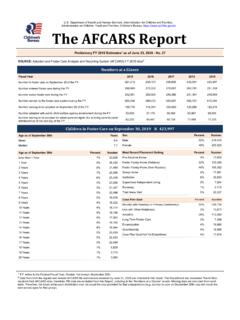
The AFCARS Report
www.acf.hhs.govChildren Exiting Foster Care during FY t r s { æ N ± t v z á x x {Age at Exit: Years Mean. 8.6 Median: 7.6. Age at Exit Percent Number Less than 1 Year 4% 10,681 1 Year 9% 20,979 2 Years 9% 21,454 3 Years 8% 18,508 4 Years 7% 16,236 5 …