Transcription of TSP Fund Information, March 2021
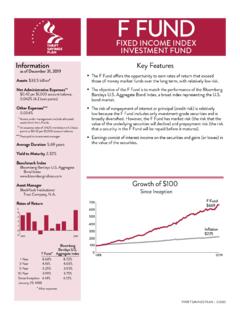
1 FUND INFORMATIONL FUNDSG FUNDF FUNDC FUNDS FUNDI FUNDM arch 2021We re glad you asked .. about your TSP investment options. The information in this booklet will help you decide how to invest your get started, first determine your approach to investing. You can man age your own account or put your money in one of the Lifecycle (L) Funds that are invested according to a professionally determined mix of the G, F, C, S, and I Funds based on various time horizons. Remember that the amount you contribute and your investment allocation are the most important factors affecting the growth of your TSP account.
2 If you choose your own investment mix from the G, F, C, S, and I Funds, think about these points: Consider both risk and return. The F Fund (bonds) and the C, S, and I Funds (stocks) have higher potential returns than the G Fund (government securities). But stocks and bonds also carry the risk of investment losses that the G Fund does not have. On the other hand, investing entirely in the G Fund may not give you the returns you need to meet your retirement savings goal. You need to be comfortable with the amount of risk you expect to take. Your investment comfort zone should allow you to use a buy and hold strategy so that you are not chasing market returns during upswings or abandoning your investment strategy during downswings.
3 You can reduce your overall risk by diversifying your account. The five individual TSP funds offer a broad range of investment options, including government securities, bonds, and domestic and foreign stocks. Generally, it s best not to put all of your eggs in one basket. The amount of risk you can sustain largely depends upon your investment time horizon. The more time you have before you need to withdraw from your account, the more risk you can take. (This is because early losses can be offset by later gains.) As your time horizon shortens, you may need to modify your investment mix.
4 Periodically review your investment choices. Check the distribution of your account among the funds to make sure that the mix you chose is still appropriate for your situation. If not, make an interfund transfer (IFT) to rebalance your account to the allocation you want. For each calendar month, your first two IFTs can redistribute money in your account among any or all of the TSP funds. After that, for the remainder of the month, your IFTs can only move money into the G Fund. If you have both a civilian and a uniformed services account, this applies to each account separately.
5 For more information about TSP investment options, visit the website You can get recent and historical rates of return, use the calculators to estimate the effect of various rates of return on your account balance, and read the Thrift Savings Planner articles about , there is no guarantee that future rates of return will match historical rates. Page 1 Lifecycle FundsL FUNDSI nformationTo see which L Fund might be right for you, refer to the Choosing an L Fund table on the next Dates(when you expect to need the money)Choose: If your target date is:L 2065 2063 or laterL 2060 2058 2062L 2055 2053 2057L 2050 2048 2052L 2045 2043 2047L 2040 2038 2042L 2035 2033 2037L 2030 2028 2032L 2025 2022 2027L Income Now withdrawing or withdrawing before 2022 Assets $ billion (as of 12/31/2020)2020 Net Administrative and investment ExpensesFund*Net Admin Expenses** investment Expenses**L * L 2025, L 2035, L 2045, L 2055, L 2060, and L 2065 did not exist for all of 2020.
6 ** An expense ratio of .049% translates to basis points or $ per $1,000 account balance. ** Fees paid to investment managerInceptionThe first L Funds were introduced August 1, Features Each of the ten L Funds is a diversified mix of the five core funds (G, F, C, S, and I). They were designed by investment professionals to let you invest your entire portfolio in a single L Fund and get the best expected return for the amount of expected risk that is appropriate for The year in the name of the L Fund is its target date, and the exact mix of core funds in each L Fund is called the target allocation .
7 The farther away the target date, the more aggressive the target allocation . So, for example, L 2065 is designed for people who plan to retire and begin withdrawing money within a few years of 2065. These younger participants can take more risk, seeking greater return, because they have time to recover from any market downturns before they ll need their money. L 2065 s target allocation includes more of the aggressive C, S, and I Funds and very little of the conservative G and F Funds. Every quarter (three months), the target allocations of all the L Funds except L Income2 are automatically adjusted, gradually shifting them from higher risk and return to lower risk and return as they get closer to their target dates.
8 When an L Fund reaches its target date, it goes out of existence and any money in it becomes part of the L Income Fund. For example, in 2025, the L 2025 Fund will be rolled into the L Income Fund. (See the bar graph below for the current target allocations.) One of the important things about the L Funds is that they stick to their target allocations for a full quarter regardless of what the markets do. Every trading day, some of the core funds in an L Fund will do better than others. At the end of the day, the core funds that did better will make up a higher percentage of the L Fund than the ones that did less well.
9 To maintain each L Fund s target allocation , we rebalance it at the end of every trading day. We do this by buying and selling the core funds that make up the L Fund so that the percentages go back to what they were at the beginning of the day. In effect we re buying low and selling high at the end of every trading day. Important: L Funds carry the same risks as the core funds they include. Investors may experience losses at any time, including as they approach retirement and after they ve retired. There is no guarantee that the L Funds will provide adequate retirement income.
10 For the L Funds historical returns, visit Fund Performance on Past performance does not guarantee future The asset allocations are based on assumptions regarding future investment returns, inflation, economic growth, and interest rates. We regularly review these assumptions to see whether changes to the allocations should be The target allocation of the L Income Fund generally does not adjust quarterly because its target date is always the present. However, following the review process described in footnote 1, we decided in 2019 to change L Income s target allocation , putting more of it into the C, S, and I Funds and less into the G and F Funds.