Example: bankruptcy
Understanding Blood Tests - osumc.edu
Understanding Blood Tests • Liver Tests There is a group of tests your doctor can do to check how well your liver is working. High levels may be a sign of liver problems caused by certain medicines or blood diseases and disorders.
Tags:
Information
Domain:
Source:
Link to this page:
Documents from same domain

Understanding Blood Cell Counts - osumc.edu
healthsystem.osumc.edupicks up oxygen in your lungs and carries it to your body’s cells. Hemoglobin also carries away carbon dioxide waste. Normal ranges are different for men and women ⊲ Normal range: 13.2 – 17.3 g/dL for men ⊲ Normal range: 11.7 – 15.5 g/dL for women Anemia is the medical term for a low red blood cell count. Anemia

Vocal Hygiene - osumc.edu
healthsystem.osumc.eduVocal Hygiene • Stay away from caffeine. Do not drink more than 2 caffeinated products each day. Caffeine can cause your vocal cords to become dry and irritated. • Stay away from alcohol. Alcohol can cause your blood vessels to dilate (open) and cause mucus to build up. This can irritate your voice.
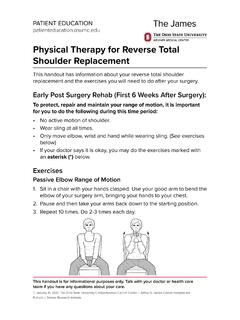
Physical Therapy for Reverse Total Shoulder Replacement
healthsystem.osumc.eduThis handout has information about your reverse total shoulder replacement and the exercises you will need to do after your surgery. Early Post Surgery Rehab (First 6 Weeks After Surgery): To protect, repair and maintain your range of motion, it is important for you to do the following during this time period: • No active motion of shoulder.
James Patient Education Handouts A-Z
healthsystem.osumc.eduJames Patient Education Handouts (A – Z) Click on the title to see the handout To narrow your search use “Ctrl + F” and enter a keyword . The Ohio State University Comprehensive Cancer Center – Arthur G. James Cancer Hospital and Richard J. Solove Research Institute
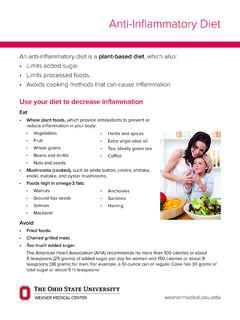
Anti-Inflammatory Diet
healthsystem.osumc.edu2 Anti-Inflammatory Diet wenermedical.osu.edu Avoid (continued) • Too much animal protein. Limit to 6 to 8 ounces by cooked weight per day and choose lean meat, such as skinless
PICC or Midline Catheter Sterile Dressing Change
healthsystem.osumc.edulocking clips. • Peel the paper backing off the anchor device. Place it on the skin to the side or just below the catheter exit site. • If the PICC catheter is long, you may need to curve the catheter up to make sure the anchor and all of the line is under the dressing. Note: If the PICC catheter is longer and the anchor device is not

Care of Your Tracheostomy Stoma After Tube Removal
healthsystem.osumc.eduCare of Your Tracheostomy Stoma After Tube Removal • If needed, use two extra pieces of tape to secure the gauze in place. The last two pieces of tape should be placed up and down, next to each other. Important Things to Remember • Change your dressing and tape every day. • The dressing and tape should be dry and clean.

Flexibility and Strengthening Exercises - osumc.edu
healthsystem.osumc.eduFlexibility and Strengthening Exercises Leg / Knee / Feet Exercises ☐ Exercise 9 • Sit in a chair with your knees bent and feet flat on the floor. • Breathe in and slowly kick out your leg, so your toes point up toward the ceiling. • Breathe out and slowly return your foot to starting position. • Repeat with your other foot.

Exercises for a Frozen Shoulder (Adhesive Capsulitis)
healthsystem.osumc.edu(Adhesive Capsulitis) Adhesive capsulitis, or “frozen shoulder,” happens when the capsule of your shoulder joint becomes tight or thickened. These changes reduce the range of motion in your shoulder. This can make it hard for you to do activities that require you to reach your arm up and/or away from your side.

Checking for Tube Placement - osumc.edu
healthsystem.osumc.eduHow to Check Tube Placement Measure your tube: 1. Use a ruler to measure the length of your feeding tube. • If you have a nasogastric tube (NG), measure from where the tube comes out of your nose to the end of the tube. • If you have a G-tube or PEG tube, measure from where the tube comes out of your abdomen to the end of the tube. 2.
Related documents

ABO Blood Group Discrepancies - iacld.ir
www.iacld.irABO Blood group typing: is the most important test in assuring a safe blood transfusion. ABO blood Group System:
Healthcare Common Procedure Coding System (HCPCS) …
www.cms.govJun 03, 2021 · [Landsteiner-Wiener blood group] • 0198U - Red blood cell antigen genotyping, Rh blood group D antigen exons 110 - and Rh blood group CcEe antigens exon 5 • 0199U - Red blood cell antigen genotyping, erythroblast membrane associated protein [Scianna blood group] exons 4, 12 • 0200U - Red blood cell antigen genotyping, X-linked Kx blood ...
PROCEDURE MANUAL FOR THE i-STAT SYSTEM
clinlab.uams.eduJan 04, 2014 · Fresh whole blood without anticoagulant collected in a plastic syringe. If from an indwelling line, flush the line with 5mL saline and discard the first 5mL of blood or six dead space volumes of the catheter. Fresh whole blood collected in a plastic tube without anticoagulant, clot activators, or serum separators.
Patient Blood Management Guidelines: Module 5
www.blood.gov.au4.2.4 Role of blood group and antibody screening before birth 67 4.2.5 Red cell selection for maternity patients requiring transfusion 67 4.3 Adapting or modifying a massive transfusion protocol 68 4.3.1 Trigger and activation of massive transfusion protocol 68
Blood Bank Management System
portal.scitech.au.eduList of Figures 1 Figure Page 10.1 Context Diagram of Blood Bank Management System 17 10.2 Level 0 of Blood Bank Management System 18 10.3 Level 1 of Blood Bank Management System 19 10.4 Level 4 of Blood Bank Management System 20 10.5 Level 9 of Blood Bank Management System 21 10.6 Level 10 of Blood Bank Management System 22 Figure 10.7: …

Blood Type Punnett Square Practice - Weebly
ellsworthbiology.weebly.comBlood Type Punnett Square Practice There are four major blood groups determined by the presence or absence of two antigens (proteins) – A and B – on the surface of red blood cells: Group A – has only the A antigen on red cells (and B antibody in the plasma) Group B – has only the B antigen on red cells (and A antibody in the plasma)

Blood Donor Selection - WHO
www.who.intthe requirements for an effective national system for blood donor selection; policy recommendations are provided on p. 5. Part 2 provides guidance on specific criteria for blood donor selection in relation to general donor assessment, donor 1 The term “blood donors” includes donors of whole blood, red cells, platelets, plasma and