Example: biology
Using SolidWorks for Finite Element Analysis – in 12 Easy ...
calculations are incorrect. Either problem needs to be resolved. 11. Refine the mesh until the results converge. a) Return to the FEM file (under the Window menu). b) In the “Simulation Navigator” expand the collectors for the mesh, and double click on the mesh. In the meshing dialog, reduce the size of the elements from Step 5 and save the
Tags:
Information
Domain:
Source:
Link to this page:
Documents from same domain

What we did on the computers last class Sec. 4.2-4
community.wvu.eduWhat we did on the computers last class Sec. 4.2-4.6. MAE 340 – Vibrations 2 ... used to simplify a MDOF analysis into a several SDOF analyses: Mapping Eigenvalue MAE 340 – Vibrations 9 problem to SDOF problem ... individual dampers in a Modal Analysis.
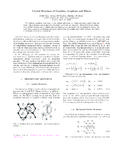
Crystal Structure of Graphite, Graphene and Silicon
community.wvu.eduCrystal Structure of Graphite, Graphene and Silicon Dodd Gray, Adam McCaughan, Bhaskar Mookerji∗ 6.730—Physics for Solid State Applications (Dated: March 13, 2009)
SWE 621: Software Design Lecture Notes on Software Design
community.wvu.eduSWE 621: Software Design Lecture Notes on Software Design Spring Semester 2002 Hassan Gomaa Dept of Information & Software Engineering George Mason University ... Software Construction Detailed Design Internal design of individual components Design of logic and data structures Coding
Plates and Shells - West Virginia University
community.wvu.edu1 MAE456 Finite Element Analysis Plates and Shells All images are from R. Cook, et al. Concepts and Applications of Finite Element Analysis, 1996.
Chapter 8 : Sequence Diagram - West Virginia University
community.wvu.eduChapter 8 : Sequence Diagram The Sequence Diagram What is a Sequence Diagram This diagram is a model describing how groups of objects collaborate in some behavior over time. The diagram captures the behavior of a single use case. It shows objects and the messages that are passed between these objects in the use case. When to use a sequence diagram
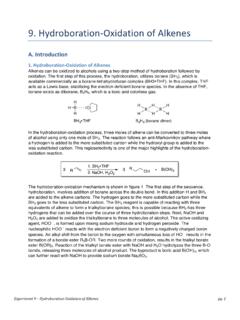
9. Hydroboration-Oxidation of Alkenes
community.wvu.eduthis washing procedure with one additional 0.5 mL portion of brine. Prepare a sodium sulfate drying column (a small pipet plugged with a wad of cotton followed by the addition of 0.5 cm of sand and 3 cm of anhydrous Na 2SO 4). Transfer your organic layer to the drying column and collect the dried solution in a pre-weighed conical vial.
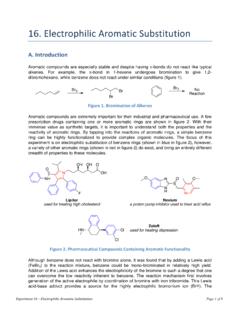
16. Electrophilic Aromatic Substitution
community.wvu.eduAromatic compounds are extremely important for their industrial and pharmaceutical use. A few prescription drugs containing one or more aromatic rings are shown in figure 2. With their immense value as synthetic targets, it is important to understand both the properties and the reactivity of aromatic rings.
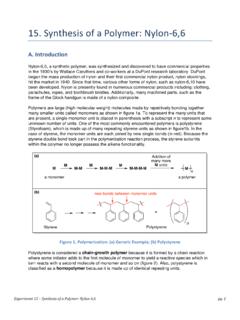
15. Synthesis of a Polymer: Nylon-6,6
community.wvu.eduNylon 6,6, which you will prepare in today’s lab experiment is an example of an alternating copolymer because it contains alternating diamine and dicarbonyl units. The 6,6 numbering refers to the number of carbon atoms in the diamine and dicarbonyl units, respectively. Another
Plates and Shells - West Virginia University
community.wvu.eduPlates and Shells All images are from R. Cook, et al. Concepts and Applications of Finite Element Analysis, 1996. MAE456 Finite Element Analysis 2 Plate Formulation • Plates may be considered similar to beams, however: – Plates can bend in two directions – Plates are flat with a thickness (can’t have an interesting cross-section)
Crystal Structure of Graphite, Graphene and Silicon
community.wvu.eduMar 13, 2009 · lar to the graphene sheet. The corresponding ABCABC layer forms a rhombohedral structure with identical lat-tice spacing parallel and orthogonal to the layer. 1.2. Reciprocal Lattice Structure Recall that the reciprocal lattice vectors bi are defined as a function of the primitive lattice vectors ai such that b1 = 2π a2 ×a3 a1 ·a3 ×a3 b2 ...
Related documents

Stick Consumable Charts - Global Industrial
www.globalindustrial.com1440-0404 Steel Welding Electrodes, 3/32" diameter x 14' long; Excellent problem solver type electrode 4 1440-0405 6013 General Purpose Electrodes, 1/16" x 10" long 4 1440-0406 6013 General Purpose Electrodes, 3/32" diameter x 14" long; Excellent for use with all …

Beany® Block - Marshalls
media.marshalls.co.ukGreat problem solver. General installation detail ensures load classification E600. A full and comprehensive range. Withstands installation damage. Beany Block is the original combined kerb and drainage system which has been on the market …