Transcription of Vertical Installation Technical Specification
1 JULY 2018 I NEW ZEALANDV ertical InstallationTechnical SpecificationWEATHERBOARDL inea ObliqueContents5 Installation General Fastener durability Fastener size and layout 76 JOINTS Vertical joint Horizontal joint Drainage joint External corner Internal corner 77 FINISHES Preparation Painting Flexible sealant 88 STORAGE AND HANDLING 89 MAINTENANCE 810 PRODUCT INFORMATION Manufacturing and classification Product mass Durability 911 SAFE WORKING PRACTICES 1012 PRODUCT AND ACCESSORIES 1213 DETAILS 14 PRODUCT WARRANTY 391 APPLICATION AND SCOPE Application Scope Details 3 Specific design 32 DESIGN Compliance Responsibility Site and foundation Surface clearances Moisture management Structure Fire rated walls Structural bracing Energy efficiency 43 FRAMING General Timber framing Special framing requirements Tolerances 54 PREPARATION Flexible underlay/HomeRAB Pre-Cladding RAB Board cavity closure/vent strip cavity battens Intermediate support Flashings Junctions and penetrations 6WE VALUE YOUR FEEDBACKTo continue with the development of our products and systems, we value your input.
2 Please send any suggestions, including your name, contact details, and relevant sketches to:Ask James Hardie Oblique Weatherboard Vertical Installation Technical Specification July 2018 New Zealand APPLICATIONL inea Oblique Weatherboard installed as per this Specification gives a Vertical rusticated profile weatherboard appearance. Linea Oblique Weatherboard can be fixed to timber-framed external walls. A wide range of colours can be used, varying from light to dark. Linea Oblique Weatherboard is available in 200mm or 300mm wide x 4200mm or 2700mm lengths and is 16mm thick. Specifiers If you are a specifier or other responsible party for a project ensure that the information in this document is appropriate for the application you are planning and that you undertake specific design and detailing for areas which fall outside the scope of these specifications.
3 InstallersIf you are an installer ensure that you follow the design, moisture management principles, associated figures and material selection provided by the designer and this James Hardie Technical Specification . All of the details provided in this document must be read in conjunction with the project Specification . Make sure your information is up to date When specifying or installing James Hardie products, ensure that you have the current manual. Additional Installation information, warranties and warnings are available at or Ask James Hardie on 0800 808 SCOPEThis Specification covers the Installation of Linea Oblique Weatherboard fixed vertically over James Hardie horizontal cavity battens on buildings that fall within the scope limitation of NZS 3604 and E2/AS1 of the New Zealand Building Code (NZBC).
4 This Specification also covers the Installation of Linea Oblique Weatherboard on projects, which are subject to specific engineering design (SED) up to a wind pressure of (ULS). DETAILSV arious typical Linea Oblique Weatherboard Vertical construction details are provided in the Details section of this document. These details are available in dwg, dxf, jpg and pdf file format and can be downloaded from our website at All dimensions shown are in millimetres unless noted otherwise. SPECIFIC DESIGNFor use of Linea Oblique Weatherboard in a specific engineering design (SED) project that is outside the scope of this literature, the designer, architect or engineer must ensure that applicable clauses of the NZBC have been considered and a specific design has been Oblique Weatherboard is suitable for use in SED project up to a wind pressure of (ULS).
5 2 Design1 Application and COMPLIANCEL inea Oblique Weatherboard has been isued a CodeMark certification number GM-CM30059 which confirms Linea Oblique Weatherboard is deemed to comply with the requirements of the NZBC. Please refer to our website for a copy of the CodeMark certificate. Linea Oblique Weatherboard has been appraised by BRANZ as an alternative solution and found to meet the required provisions of the NZBC when installed in accordance with this Linea Oblique Weatherboard Vertical Installation Technical Specification . BRANZ Appraisal number 897 (2015) at or RESPONSIBILITYThe specifier or other party responsible for the project must ensure that the information and details in this Specification are appropriate for the intended application and that additional detailing is performed for specific design or any areas that fall outside the scope of this Technical Specification .
6 For applications outside the scope of this literature and details, which are not provided herein, the architect, designer or engineer must undertake specific design and it should be ensured that the intent of their design meets the requirements of the New Zealand Standards referenced in this document are current editions and must be complied Hardie conducts stringent quality checks to ensure that any product manufactured falls within our quality spectrum. It is the responsibility of the builder to ensure that the product meets aesthetic requirements before Installation . James Hardie will not be responsible for rectifying obvious aesthetic surface variations following SITE AND FOUNDATIONThe site on which the building is situated must comply with the NZBC Acceptable Solution E1/AS1 Surface Water.
7 Foundation design must comply with the requirements of NZS 3604 Timber-framed Buildings or be as per specific engineering design. The grade of adjacent finished ground must slope away from the building to avoid any possibility of water accumulation in accordance with the NZBC SURFACE CLEARANCESThe clearance between the bottom edge of the cladding and paved/unpaved ground must comply with section of E2/AS1. The finished floor level must also comply with these requirements. These clearances must be maintained throughout the life of the building. Linea Oblique Weatherboard must overhang the bottom plate by a minimum of 50mm, as required by E2 Oblique Weatherboard must maintain a minimum clearance of 100mm from paved ground, and 175mm from unpaved ground. On roofs and decks, the minimum clearance must be not install external cladding such that it may remain in contact with water or ground, refer to Figure Linea Oblique Weatherboard Vertical Installation Technical Specification July MOISTURE MANAGEMENTIt is the responsibility of the specifier to identify moisture related risks associated with any particular building design.
8 Wall construction design must effectively manage moisture, considering both interior and exterior environments of the building, particularly in buildings that have a higher risk of wind driven rain penetration. The building should also be ventilated sufficiently to control moisture accumulation due to condensation, especially in artificially cooled/heated buildings. Walls must include those provisions as required by the NZBC Acceptable Solution Clause E2/AS1. In addition, all wall openings, penetrations, junctions, connections, window sills, heads and jambs must incorporate appropriate flashings for waterproofing. The other materials, components and Installation methods used to manage moisture in external walls, must comply with the requirements of relevant standards and the NZBC. For further guidance on designing for weathertightness, refer to BRANZ Ltd.
9 And the Ministry of Business Innovation and Employment (MBIE) updates on the following websites respectively, and addition, the following issues must also be considered: Sealant must be installed where detailed in this literature Where the walls are higher than two storeys, it is necessary to provide a horizontal flashing at the second floor level to drain the cavity The Installation of smoke chimneys, pipe penetrations and other fixtures etc. must not track moisture into the wall or restrict the drainage of moisture to the Timber FramingTimber-framed buildings must either be in accordance with NZS 3604 (Timber-framed Buildings) or designed as per specific engineering design. For a building requiring a specific engineering design, the framing stiffness must be equivalent to, or more than, the stiffness requirements of NZS 3604.
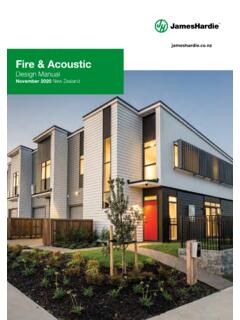
10 For specific design projects, the timber framing must be designed in accordance with the requirements of NZS 3603 and AS/NZS 1170. For timber frame walls longer than 12m, it is best practice to allow for construction joints to accommodate movements generated due to timber shrinkage or deflections generated by loadings Wind PressuresLinea Oblique Weatherboard is suitable for use in wind zones up to and including EH as defined in NZS 3604. Linea Oblique Weatherboard is also suitable for use in specific design projects up to wind pressures of (ULS). FIRE RATED WALLSL inea Oblique Weatherboard when fixed over timber cavity battens to external walls can achieve fire ratings up to 60/60/60 to comply with Clause C/AS1 of the NZBC, when the walls are constructed in accordance with the current James Hardie Fire and Acoustic Design Oblique Weatherboard is classified as a 'non-combustible' material suitable for use on walls close to a STRUCTURAL BRACINGL inea Oblique Weatherboard installed as per this Specification cannot be used to achieve structural bracing.