Example: quiz answers
VSEPR Theory (Molecular Shapes)
2. All bonds are represented in this table as a line whether the bond is single, double, or triple. 3. Any atom bonded to the center atom counts as one domain, even if it is bonded by a double or triple bond. Count atoms and lone pairs to determine the number of domains, do not count bonds. 4.
Tags:
Information
Domain:
Source:
Link to this page:
Documents from same domain

CHM 130LL: Electrolytes - Welcome to web.gccaz.edu
web.gccaz.edumainly in body fluids outside the cells. Human body fluids have almost the ... CHM 130LL: Electrolytes Lab . GCC CHM 130LL Spring 2016 page 2 of 7 Understanding ... This makes it possible to identify which substance is in which well (ex: A3 or C2). In your data table (on the next page), ...

Chapter 14. CHEMICAL EQUILIBRIUM
web.gccaz.eduChapter 14. CHEMICAL EQUILIBRIUM 14.1 THE CONCEPT OF EQUILIBRIUM AND THE EQUILIBRIUM CONSTANT Many chemical reactions do not go to completion but instead attain a ...
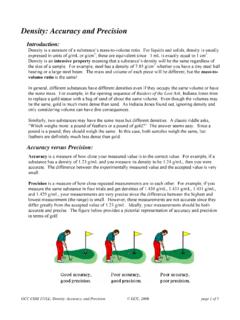
Density: Accuracy and Precision
web.gccaz.eduGCC CHM 151LL: Density: Accuracy, and Precision © GCC, 2008 page 4 of 5 glassware. ... 1. Obtain a set of 4 brass slugs and 1 aluminum slug. 2.
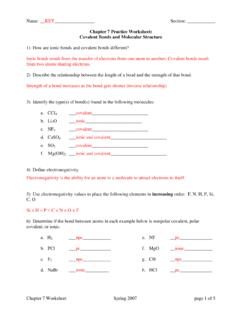
Chapter 7 Practice Worksheet: Covalent Bonds and Molecular ...
web.gccaz.eduChapter 7 Worksheet Spring 2007 page 1 of 5 Chapter 7 Practice Worksheet: Covalent Bonds and Molecular Structure 1) How are ionic bonds and covalent bonds different? ... f. Mg(OH) 2 ___ ionic and covalent _____ 4) Define electronegativity. Electronegativity is the ability for an atom in a molecule to attract electrons to itself. ...

Balancing Equations Worksheet KEY
web.gccaz.eduBalancing Equations Worksheet KEY 1. Zn (s) + 2 AgNO 3 (aq) ⇒ Zn(NO 3) 2 (aq) + 2 Ag (s) 2. N 2 (g) + 3 H 2 (g) ⇒ 2 NH 3 (g) 3. NaCl (aq) + AgC 2H 3O 2 (aq) ⇒ NaC 2H 3O 2 (aq) + AgCl (s) 4. 3 Mg(OH) 2 (aq) + 2 H 3PO 4 (aq) ⇒ 6 H 2O (l) + Mg 3(PO 4 ) 2 (aq) 5. 2 HNO 3 (aq) + Ni (s) ⇒ Ni(NO 3) 2 (aq) + H 2 (g) 6. Ba(HCO 3) 2 (s) ⇒ BaCO 3 (s) + H 2O (g) + CO
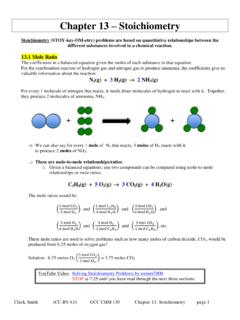
Chapter 13 Stoichiometry - Glendale Community College
web.gccaz.eduChapter 13 – Stoichiometry Stoichiometry (STOY-key-OM-etry) problems are based on quantitative relationships between the different substances involved in a chemical reaction.

Intermolecular and Ionic Forces - web.gccaz.edu
web.gccaz.eduIntermolecular and Ionic Forces ... general, intermolecular forces are much weaker than the ionic and covalent bonds that hold together the atoms and ions in a compound. ... compared in this lab. The alkane used in this activity is pentane, CH 3 CH 2 CH 2 CH 2 CH 3. Alcohols are

Marine Biology: Study Guide - web.gccaz.edu
web.gccaz.eduBIO145: Marine Biology 3 Study Guide Chapter 10 An Introduction to Ecology Ecology is the scientific study of the interactions between organisms and their environment that determine the distribution and abundance of organisms.
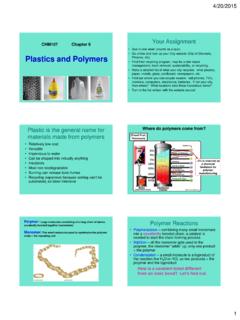
Polymers and Plastics - web.gccaz.edu
web.gccaz.edua chemical feedstock for polymer manufacturing Polymer: ... • Now back to polymers and plastics Given these monomers predict the structure of the polymer Ethylene Vinyl chloride ... recycle numbers are these plastics? • Plastic comes from oil – so less recycling means

CHM 130 Predicting Products Worksheet
web.gccaz.eduCHM 130 Predicting Products Worksheet Circle the appropriate reaction type for each, complete the reaction with products (remember to check charges for ionic compounds), include states, and finally balance each reaction.
Related documents

Configuring Basic Settings - Cisco
www.cisco.comThe default domain name is default.domain.invalid. For multiple context mode, you can set the domain name for each context, as well as within the system execution space. ... the routing table. Because the system does not include any interfaces in multiple context mode, specify an interface name defined in the admin
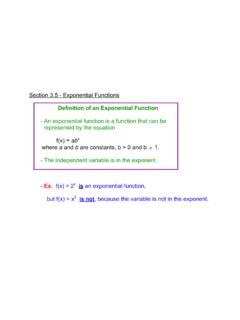
Identifying Exponential Functions from a Table
cf.linnbenton.eduEx.2 continued Make a table of values for each exponential function. Plot the points and sketch the graph. State the domain and the range. b.) g(x) = ( …

K-12 Louisiana Student Standards for Mathematics: Table of ...
www.cpsb.orgthe Conceptual Category and the Domain, the letter of the Cluster Header, and then the standard number. High school Conceptual Categories and their abbreviations are located in the table of the next section (Progressions). The code for standard 5 in the list above is GM: G-SRT.B.5 with the meaning of each part noted in the graphic below.
Name Date Ms - White Plains Public Schools
www.whiteplainspublicschools.orgTable of Contents Chapter 4-1: Graphing Relationships SWBAT: (1) Identify the domain and range of relations and functions (2) Match simple graphs with situations Pgs. #1 - 7 Hw pgs. #7 - 8 Chapter 4-2: FUNCTIONS SWBAT: Determine if a relation is a function, by examining ordered pairs and inspecting graphs of relations Pgs. #9 - 13 Hw pg. 14
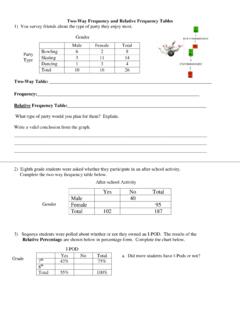
Yes No Total Male 40 Female 95 Total 102 187
www.anderson5.netComplete the two-way frequency table. Creating a Relative Frequency table based on TOTAL people. 5) Below is a table of people in the park and the activities that they do. Complete the frequency table below, based on the total participants. To create a relative-frequency two-way table for all 50 people , divide each number in each cell by 50

ORGANELLE LOCATION DESCRIPTION FUNCTION
www.greeleyschools.orgMicrosoft Word - ORGANELLE table.doc Author: Richy Created Date: 1/11/2015 11:34:29 AM ...

Tangent, Cotangent, Secant, and Cosecant
math.dartmouth.eduThe range of cscx is the same as that of secx, for the same reasons (except that now we are dealing with the multiplicative inverse of sine of x, not cosine of x).Therefore the range of cscx is cscx ‚ 1 or cscx • ¡1: The period of cscx is the same as that of sinx, which is 2….Since sinx is an odd function, cscx is also an odd function. Finally, at all of the points where cscx is ...
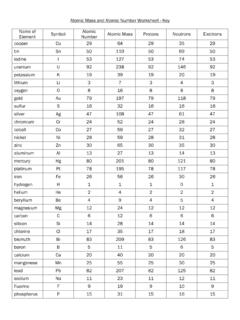
Atomic Mass and Atomic Number Worksheet Key
www.readington.k12.nj.usAtomic Mass and Atomic Number Worksheet - Key Name of Element Symbol Atomic Number Atomic Mass Protons Neutrons Electrons copper Cu 29 64 29 35 29