Transcription of What To Do if You Have an Electronic Interference Problem
1 What To Do if You have an Electronic Interference Problem This is a self-help guide for the consumer published jointly by the American radio Relay League (ARRL), an organization representing Amateur radio operators, and the Consumer Electronics Association (CEA). Introduction As our lives become filled with more technology, the likelihood of unwanted Electronic Interference increases. Every lamp dimmer, hair dryer, garage-door opener, radio transmitter, microprocessor-controlled appliance or remote-controlled new technical "toy" contributes to the electrical noise around us. Many of these devices also "listen" to that growing noise and may react unpredictably to their Electronic neighbors.
2 Interference : What Is It? Complex Electronic circuitry is found in many devices used in the home. This creates a vast Interference potential that didn't exist in earlier, simpler decades. Your own consumer electronics equipment can be a source of Interference , or can be susceptible to Interference from a nearby noise source. Interference can also result from the operation of nearby amateur, citizens band, police, broadcast or television transmitters. The term " Interference " should be defined without emotion. To some people, it implies action and intent. The statement, "You are interfering with my television" sounds like an outright accusation.
3 It is better to define Interference as any unwanted interaction between Electronic systems -period! No fault. No blame. It's just a condition. Personalities You can't overestimate the importance of personal diplomacy when you're trying to solve a Problem that involves two or more people! The way you react and behave when you first discuss the Problem with other individuals, such as a neighbor, utility or cable company, or manufacturer, can set the tone for everything that follows. Everyone who is involved in an Interference Problem should remember that the best solutions are built on cooperation and trust.
4 This is a view shared by Electronic equipment manufacturers, the Federal Communications Commission (FCC) and the American radio Relay League (ARRL). Responsibilities No amount of wishful thinking (or demands for the "other guy" to solve the Problem ) will result in a cure for Interference . Each individual has a unique perspective on the situation -- and a different degree of understanding of the technical and personal issues involved. On the other hand, each person may have certain responsibilities toward the other and should be prepared to address those responsibilities fairly. Page 1 of 7.
5 Any individual who operates a radio transmitter, either commercial or private, is responsible for the proper operation of the radio station. All radio transmitters or sources are regulated by the FCC. The station should be properly designed and installed. It should have a good ground and use a low-pass filter, if needed. If consumer electronics equipment at the station is not suffering the effects of Interference , you can be almost certain that the Problem does not involve the radio station or its operation. However, if the Interference is caused by a Problem at the station, the operator must eliminate the Problem there.
6 Manufacturers of consumer electronics equipment are competing in a difficult marketplace. To stay competitive, most of them place a high priority on service and customer satisfaction. For example, many manufacturers have service information that can be sent to a qualified service dealer. Most manufacturers are willing to assist you in resolving Interference problems that involve their products. Over recent years, manufacturers have built up a good track record designing equipment that functions well in most electrically noisy environments. The FCC will do what it can to help consumers and radio operators resolve their Interference problems.
7 They expect everyone involved to cooperate fully. Experience has taught them that solutions imposed from the outside are not usually the best solutions to local problems. Instead, they provide regulatory supervision of radio operators and manufacturers. To help consumers, basic information concerning Interference solutions is now available on the Internet through the FCC Consumer & Governmental Affairs Bureau Home Page. This basic information includes the CIB Interference Handbook and the FCC Consumer Facts Interference Bulletin. Specific information includesthe CGB Telephone Interference Bulletin,What Can I Do About Interference to My radio page and the What Can I Do About Interference to My Television page.
8 The CIB Interference Handbook includes a list of equipment manufacturers who provide specific assistance with Interference problems. The list also is available through the Commission's Fax on Demand at (202) 418-2830. Callers should request document number 6904. Finally, the consumer has responsibilities, too. You must cooperate with the manufacturer, the radio operator, and, if necessary, the FCC as they try to determine the cause of the Problem . They need your help to find a solution. What Causes Interference ? Interference occurs when undesired radio signals or electromagnetic "noise" sources are picked up by consumer electronics products -most often telephones, audio equipment, VCRs or TVs.
9 It usually results in noise, unwanted voices or distorted TV pictures. In most cases, the source is nearby. Page 2 of 7. There are three common types of Interference : (1.) Noise: Interference can be caused by an electromagnetic noise source. Defective neon signs, bug zappers, thermostats, electrical appliances, switches or computer systems are just a few of the possible sources of this type of Interference . Both you and your neighbors may be suffering from its effects. In some cases, the noise may be the result of a dangerous arc in electrical wiring or equipment and may provide warning of an unsafe condition that should be immediately located and corrected.
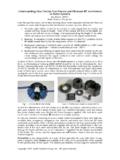
10 (2.) Overload: Even if a nearby radio signal is being transmitted on its assigned frequency, if it is strong your equipment may be unable to reject it. Your telephone, radio , stereo or TV. should be able to separate the desired signal or sound from a large number of radio signals and electrical noises. This is shown in Figure 1. Figure 1. Consumer electronics equipment manufacturers have worked in cooperation with government regulators to set and meet voluntary standards of Interference immunity. Modern equipment usually includes enough filtering and shielding to ensure proper performance under average conditions.