Transcription of World Robotics 2018
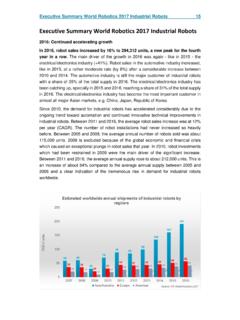
1 Executive Summary World Robotics 2018 Industrial Robots 13. Executive Summary World Robotics 2018 Industrial Robots Robot Sales 2017: Impressive growth In 2017, robot sales increased by 30% to 381,335 units, a new peak for the fifth year in a row. The main drivers of this exceptional growth in 2017 were the metal industry (+55%) and electrical/electronics industry (+33%). Robot sales in the automotive industry increased by 22% and remained still the major customer of industrial robots with a share of 33% of the total supply in 2017. The electrical/electronics industry has been catching up, especially since 2015. In 2017, it reached almost the same share of total supply (32%). The electrical/electronics industry became the most important customer in almost all major Asian markets, China, Japan, Republic of Korea, already in 2016. Since 2010, the demand for industrial robots has accelerated considerably due to the ongoing trend toward automation and continued innovative technical improvements in industrial robots.
2 Between 2012 and 2017, the average robot sales increase was at 19%. per year (CAGR). The number of robot installations had never increased so strongly before. Between 2005 and 2008, the average annual number of robots sold was about 115,000 units. 2009 however, was not an ordinary year because of the global economic and financial crisis which caused an exceptional plunge in robot sales that year. In 2010, investments which had been restrained in 2009 were the main driver of the significant increase in robot sales. Between 2011 and 2017, the average annual supply doubled to about 236,000 units compared to the average annual supply between 2005 and 2008. In the past three years (2015-2017) the average annual increase was about 310,000 units. This is a clear indication of the tremendous, accelerating rise in demand for industrial robots worldwide. 14 Executive Summary World Robotics 2018 Industrial Robots Continued considerable increase in all regions Asia1 is still the World 's strongest growth market.
3 With a total of about 261,800 units sold in 2017, a rise of 37% more than the global sales volume of 2015 (253,300) was reached in this region. This was the highest sales level ever recorded for the fifth year in a row. Between 2012 and 2017, robot installations rose by an average annual rate of 25%. Industrial robot sales in the second largest market, Europe, increased by 18% to almost 66,300 units (a new peak, for the fith year in a row) and an annual average increase rate of 10% between 2012 and 2017, like in the Americas. About 46,100 industrial robots were shipped to the Americas, 12% more than in 2016, establishing a new peak for the sixth year in a row. 73% of the global robot sales in five countries There are five major markets representing 73% of the total global sales volume in 2017: China, Japan, the Republic of Korea, the United States and Germany. Since 2013. China has been the biggest robot market in the World with a continued dynamic growth. China has significantly expanded its leading position as the biggest market with a share of 36% of the total supply in 2017 (30% in 2016).
4 About 137,900 industrial robots were sold to China in 2017, 59% more than in 2016. This was considerably more than the total sales volume of Europe and the Americas together (112,400 units). About 34,700 units of robots were sold by Chinese robot manufacturers in China according to the information from the China Robot Industry Alliance (CRIA). Their sales volume was about 29%. higher than in 2016 (27,000 units). Foreign robot suppliers increased their sales by 72%. to 103,200 units, including robots produced locally by the international robot suppliers in China. This is the first time that the foreign robot suppliers have a higher growth rate than the local ones. The market share of the Chinese robot suppliers decreased from 31% in 2016 to 25% in 2017. (For more details see chapter ). In 2017, robot sales in Japan increased by 18% to 45,566 units, representing the second highest value ever observed for this country. Only in the year 2000 a higher value (46,986. units) was recorded.
5 Main driver of the growth in 2017 was the electrical/electronics industry, while the automotive industry remained at previous year's level. Between 2012. and 2017, robot sales increased by 10% on average per year (CAGR). (For more details see chapter ). Robot supplies in the Republic of Korea decreased by 4% to 39,732 units in 2017. The year before, industrial robot installations peaked at 41,373 units. The main driver of this development is the electrical/electronics industry that reduced robot installations by 18%. in 2017. Between 2012 and 2017, robot sales increased by 15% on average per year (CAGR) in the Republic of Korea. (For more details see chapter ). Robot installations in the United States continued to increase to a new peak in 2017 . for the seventh year in row - (33,192 units), 6% higher than in 2016. Since 2010, the driver of the growth in all manufacturing industries in the has been the ongoing trend 1. Australia and New Zealand included in the category Executive Summary World Robotics 2018 Industrial Robots 15.
6 To automate production in order to strengthen the US-industries in both domestic and global markets. (For more details see chapter ). Germany is the fifth largest robot market in the World . In 2017, the number of robots sold increased by 7% to 21,404 units - a new peak - compared to 2016 (20,074 units). Between 2014 and 2016, annual sales of industrial robots stagnated at around 20,000. units. (For more details see chapter ). Other important Asian markets Since 2013, Taiwan has ranked sixth among the most important robot markets in the World regarding the annual supply. Robot installations increased considerably between 2012 and 2017, by 26% on average per year (CAGR). In 2017, robot sales surged by even 44% to about 10,900 units, a new peak. In 2017, Vietnam became the seventh largest robot market in the World . Robot sales jumped from about 1,600 units in 2016 to almost 8,300 units in 2017. The driver of the growth was the electrical/electronic industry. The electronics industry is also responsible for the significant increase of robot sales in Singapore in 2017, +72% to about 4,500 units.
7 After decreasing in recent years, robot sales in Thailand were up by 28% to 3,400 units in 2017. Robot installations increased by 30% to a new peak of about 3,400 units in India, the same level as in Thailand. (For more details see chapter ). Other important European markets Robot investments increased by 19% to a new record of 7,700 units in Italy. The French robot market was up by 16% to a new peak level of about 4,900 units. In Spain, sales of industrial robots further increased to a new peak of 4,200 units. Sales of Robot installations in all other Western European countries rose, except in Austria and Portugal. Nordic countries saw a decrease. Sales in most Central and Eastern European markets increased considerably, except in the Romania and Slovakia. Sales in Turkey continued to increase in 2017. (For more details see chapter ). Other important markets in the Americas Mexico has become an important emerging market for industrial robots. Robot sales again reached a new peak, with 6,334 units in 2017, 7% more than in 2016.
8 In Canada, robot sales surged by 72% to 4,003 units in 2017, the highest level ever reached. Robot sales in Brazil decreased in 2017. (For more details see chapter ). 16 Executive Summary World Robotics 2018 Industrial Robots Main driver of the growth: electrical/electronics industry Since 2010, the automotive industry the most important customer of industrial robots . considerably increased investments in industrial robots worldwide. After two years of single-digit growth rates, robot sales increased in 2017 by 22% to a new peak of almost 125,700 units. This is 33% of the total supply. Between 2012 and 2017, robot sales to the automotive industry increased by 14% on average per year (CAGR). After the economic crisis in 2008/2009, car manufacturers started to restructure their businesses. Since 2010, investments in new production capacities in the emerging markets as well as investments in production modernization in major car producing countries have led to a rising number of robot installations.
9 Using new materials, developing energy efficient drive systems, as well as high competition in all major car markets pushed for investments despite the existing overcapacities. The automotive parts suppliers were heavily affected by the restructuring of the car industry after the economic crisis in 2009. The restructuring of the automotive parts suppliers began after the motor vehicle suppliers started to carry out their investment plans. Therefore, the supply of robots to the automotive parts suppliers gained momentum only in 2011. Robot sales to the electrical/electronics industry (including computers and equipment, radio, TV and communication devices, medical equipment, precision and optical instruments) have been significantly up since 2013 and are almost at the same level as the automotive industry. In 2017, sales increased by 33% to a new peak of 121,300 units, accounting for a share of 32% of the total supply in 2017. Between 2012 and 2017, the average annual growth rate was 30%.
10 The rising demand for electronic products and new products, the need to automate production and the increasing need for batteries, chips and displays, were driving factors behind the boost in sales. The production facilities belonging to this industry are mainly located in Asian countries. The rubber and plastics industry has continuously increased the number of robot installations since 2009 from about 5,800 units to the peak value of 17,300 units in 2015. After a setback in 2016 (16,000 units), sales crossed the 17,000-unit mark again in 2017. The industry's share of the total supply in 2017 was below 5%. Between 2012 and 2017, sales were up by 8% on average per year. Robot sales to the pharmaceutical and cosmetics industry substantially increased to a new peak of 4,184 units, 24% more than in 2016. This was mainly the result of considerable sales increase in China. Despite the high degree of automation in this industry, the number of industrial robot installations has remained relatively low for many years.