Transcription of XXX - Kitchen Ventilation
1 XXXXXX1 FACTORY-WELDEDGREASE DUCTSYSTEMSXXX3 The purpose of the NFPA 96 Standard is to reduce the potential fire hazard of cooking operations, independent of the type of cooking equipment used and whether used in public or private facilities. Please refer to Chapter 7 of the NFPA 96 Standard, Exhaust duct Systems, for detailed description of duct requirements and design . All dimensions are shown in American Standard (feet and inches).Grease duct is an ETL listed, single wall construction made from 430 stainless steel. duct diameters range from 8 to 24 , with multiple lengths and accessories available. Grease duct is ideal for use in Kitchen Ventilation applica-tions and is available as a stand-alone system or part of a fully integrated package. Grease duct is pre-engineered for optimum performance for exhaust fans and hoods. Grease duct is ETL listed to Standard UL-1978; duct does not have to be welded in the InformationProduct OverviewGeneral Notification5 Table of Contents 4 General Information-Product Overview-General NotificationTable of ContentsStandards and Key Words-ReferencesSpecifications-Table 1- 3M Fire Barrier 2000 Plus UsageClearances-Table 2- Clearance- Grease duct -Zero Clearances to Combustibles- duct Wrap FeaturesDesigning duct -Types of Pressure Losses or Resistance to Flow Component and Dynamic Frictional Pressure-Table 3- Required Air and duct Values & Formulas-Nomenclature-Table 4- Part Type-Table 5- Example Part NamesDesign Considerations-Table 6- Minimum Overlap-Alignment & Bracing of Grease duct -Table 7- Horizontal Support Spacing-Table 8- Vertical Support Spacing- duct Diameter SizingGrease duct Components-Factory Installed Riser-Field Installed Riser-Straight duct -Adjustable Straight duct -Table 9- Dynamic Loss
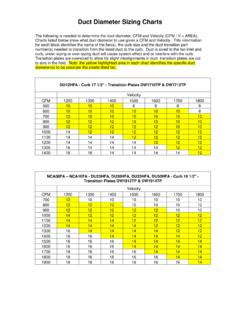
2 Coefficient Table-Adjustable Collar-Adaptor-Elbow- 90 -Elbow- 45 -Access Door Assembly- duct Tee-Y Tee-V Clamp Assembly-Support Bracket-Support Bracket Assembly-Vertical Support Assembly-Offset Collar-Drain-Transition Plate-NotesAppendix A- duct Diameter Sizing Charts- duct Diameter: Transition PlatesGrease duct Field Sheets0102030405060708091011121314151617 1819202122232425262728293040 Table of Contents& ReferencesStandards & Key Words*UL- 1978 Test Standard for Safety Grease 96 Standard for Ventilation Control and Fire Protection of Commercial Cooking Edison Testing Laboratory, The ETL listed Mark is the legal equivalent of the UL Listed and CSA Listed Marks throughout the United States and Canada. ETL is a Nationally Recognized Testing Laboratory (NRTL) designated by the Occupational Safety and Health Administration (OSHA).Access panel - A closure device used to cover an opening into a duct , an enclosure, equipment, or an Having Jurisdiction (AHJ)
3 - An organization, office, or individual responsible for enforcing the requirements of a code or standard, or for approving equipment, materials, an installation, or a Material - A material capable of undergoing Grease duct Enclosures - A listed factory-built grease duct system evaluated as an enclosure system for reduced clearances to combustibles and as an alternative to a duct with its fire-rated duct - A containment system for the transportation of air and grease vapors that is designed and installed to reduce the possibility of the accumulation of combustible condensation and the occurrence of damage if a fire occurs within the tight - Constructed and performing in such a manner as not to permit the passage of any grease under normal cooking wall - A wall separating buildings or subdividing a building to prevent the spread of the fire, and having a fire resistance rating and structural material - A material not capable of supporting expansion - The tendency of matter to increase in volume or pressure when heated.
4 REFERENCES- 1 NFPA 96, Standard for Ventilation Control and Fire Protection of Commercial Cooking Operations, 2004 6 Table 1- 3M Fire Barrier 2000 Plus UsageDuct DiameterDuct Perimeter Feet Per TubeNumber of Joints Per Tube8 30 710 30 612 30 514 30 416 30 30 320 30 324 30 single-wall, factory built, grease duct for use with Type 1 Kitchen hoods, which conforms to the requirements of NFPA-96. Products shall be ETL listed to UL-1978 for venting air and grease vapors from commercial cooking operations as described in NFPA-96. The duct wall shall be constructed of 430 stainless steel and be available in diameters 8 through 24 . All supports, fan adapters, hood connections, fittings and expansion joints required to install grease duct shall be included. Roof penetrations shall comply with listed clearance to combustibles. (See Clearance to Combustibles guide for details.)
5 The grease duct will terminate at the fan adapter plate, will be fully welded to the fan adapter plate and the fan adapter plate will be fastened to the curb using a suitably sized fastener provided by others. (See Operation, Installation, and Maintenance manual [OIM] for details.) Grease duct joints shall be held together by means of formed vee clamps and sealed with 3M Fire Barrier 2000+. Screws used to secure the vee clamps shall be of the hex-head type with flanged stops and tapered lead in threads for easy starting. Nuts shall be retained by means of a free-floating cage to allow easy alignment. Single-Wall Grease duct shall be installed in accordance with the manufacturer s Operation, Installation, and Maintenance Manual, ETL listing and state and local codes. Grease duct installed outside of the building shall be protected against accidental damage or vandalism. Support vertically installed grease duct from the building structure using rigid structural supports.
6 Anchor supports to the structure by welding or bolting steel expansion anchors or concrete inserts. Support horizontally installed grease duct from the building structure using above method or use duct Mate, Wire Rope & Clutchers, part numbers WR20 & CL20. 1/2 threaded rod and saddles may also be used for the support of horizontal grease duct . Fans shall be supported independently from the grease duct sections. The joint sealant used to seal all joint assemblies is a 3M product. 3M Fire Barrier 2000+ Silicone Sealant is a ready-to-use, gun-grade, one-component silicone elastomer that cures upon exposure to atmospheric humidity to form a flexible seal. When installed properly, the sealant will control the spread of fire before, during and after exposure to open flames. No sealant substitutes may be used. (Reference OIM for Grease duct to obtain additional information.)This grease duct is primarily intended for use in non-combustible surroundings, when installed in a room where enclosure is not required.
7 Where the duct does not require an enclosure, it must have a minimum clearance to adjacent combustible walls as shown below in Table 2. If the enclosure fire rating is not rated as above, or if the clearance listed in Table 2 cannot be maintained, then the duct system must be insulated using ZERO CLEARANCE TO COMBUSTIBLE CONSTRUCTION listed insulation per the manufacturer's installation instructions. Table 2- Clearance- Grease DuctDiameterClearance to CombustiblesClearance to Limited CombustiblesClearance to Non-combustibles8"18"3"0"10"18"3"0"12"18 "3"0"14"18"3"0"16"18"3"0"18"18"3"0"20"18 "3"0"24"18"3"0"01 Zero clearance to Two layers of wrap for grease ducts rated as an enclosure High strength and flexibility for installation Foil encapsulated with unique center overlap Safe fiber Mold resistant. We recommend using the Thermal Ceramics duct Wrap, FastWrap XL - a non-combustible, alkaline-earth silicate wool with low biopersistence, flexible fireproofing wrap.
8 Applied in 2 layers to grease ducts exhausting Type 1 hoods. Passes ASTM E2336 grease duct enclosure test standard required by 2006 IMC and NFPA 96 for reduced clearance to provide 1 or 2 hour fire rating. ClearancesDuct Wrap Features9 Designing duct 8 Pressure loss is the loss of total pressure in a duct or fitting. There are three important observations that describe the benefits of using total pressure for duct calculation and testing, rather than using only static Only total pressure in duct work always drops in the direction of flow. Static or dynamic pressures alone do not follow this rule. 02 The measurement of the energy level in an air stream is uniquely represented by total pressure only. The pressure losses in a duct are represented by the combined potential and kinetic energy transformation, the loss of total pressure. 03 The fan energy increases both static and dynamic pressure.
9 Fan ratings based only on static pressure are partial, but commonly used. Pressure loss in duct work has three components, frictional losses along duct walls, dynamic losses in fittings and component losses in duct -mounted equipment:Component Pressure - Due to physical items with known pressure drops, such as hoods, filters, louvers, or Pressure - Dynamic losses are the result of changes in direction and velocity of air flow. Dynamic losses occur whenever an air stream makes turns, diverges, converges, narrows, widens, enters, exits, or passes dampers, gates, orifices, coils, filters, or sound attenuators. Velocity profiles are reorganized at these places by the development of vortexes that cause the transforma-tion of mechanical energy into heat. The disturbance of the velocity profile starts at some distance before the air reaches a fitting. The straightening of a flow stream ends some distance after the air passes the fitting.
10 This distance is usually assumed to be no shorter then six duct diameters for a straight duct . Dynamic losses are proportional to dynamic pressure and can be calculated using the equation:--> Dynamic Loss Static Pressure = (Loss coefficient) * (Velocity pressure)Where the local loss coefficient, known as a C-coefficient, represents flow disturbances for particular fittings or for duct -mounted equipment as a function of their type and ratio of dimensions. Coefficients can be found in this document or the ASHRAE Fittings diagrams local loss coefficient can be related to different velocities; it is important to know which part of the velocity profile is relevant. The relevant part of the velocity profile is usually the highest velocity in a narrow part of a fitting cross section or a straight/branch section in a DuctTypes of Pressure Losses or Resistance to FlowFrictional PressureFrictional losses in duct sections are result from air viscosity and momentum exchange among particles moving with different velocities.