
Appendix A Eigenvalue Buckling Analysis - Rice University
Eigenvalue or linear buckling analysis predicts the theoretical buckling strength of an ideal linear elastic structure. This method corresponds to the textbook approach of linear elastic buckling analysis. •The eigenvalue buckling solution of a Euler column will …
Download Appendix A Eigenvalue Buckling Analysis - Rice University

Information
Domain:
Source:
Link to this page:
Documents from same domain
1 Finite Element Analysis Methods - Rice University
www.clear.rice.edu1 Finite Element Analysis Methods ... it is often referred to as finite element analysis (FEA). FEA is the most common tool for stress and structural ...

Lecture 1 Introduction to ANSYS Workbench - Rice …
www.clear.rice.eduThis training course covers the basics of using ANSYS Mechanical in performing structural and thermal analyses. It is intended for all new or occasional ANSYS Mechanical users, regardless

Types of Control: Open loop, feedback, feedforward
www.clear.rice.eduFeedback Control “Understand Your Technical World” ... • or better, why do you need a control system at all? • consider ovens, A/C units, airplanes, manufacturing, pumping stations, etc ... Design of dynamics through feedback Allows the dynamics (behavior) of the system to be modified ...

Lecture 9 Thermal Analysis - Rice University
www.clear.rice.eduthermal resistance. q TCC T target T contact The amount of heat flow across a contact interface is defined by the contact heat flux expression ^q” shown here: • T contact is the temperature of the contact surface and • T target is the temperature of the target surface. … Thermal ontact
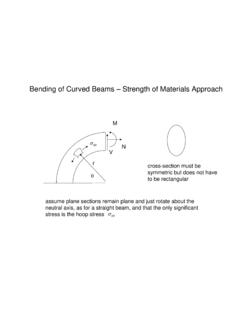
curved beam strength - Rice University
www.clear.rice.edukr σθθ=− − + = r r ... iar r m ari y r i r iar m yri ari ayri ar r m yrai r

Introduction to ANSYS Mechanical
www.clear.rice.edu– The “2D” switch must be set on the Project page prior to importing geometry. •Each node in a 2D element has two translational degrees of freedom (UX and UY) for structural or one temperature DOF for thermal. •2D solids are used to represent three types of 3D geometry, “Axisymmetric”, “Plane stress” and “Plane strain”.

8 Flat Plate Analysis - Rice University
www.clear.rice.eduThen, the plots are pretty, but wrong. If the edges of the plate are simply sitting on top of to walls, then the wall could not pull down on the corner. ... reaction forces appear, then move the split line away from the corner and repeat the process. It may be a slow procedure, but it can lead you to the correct lift off regions. ...

Lecture 7 Static Structural Analysis
www.clear.rice.edu•Thermal expansion coefficient is required if a temperature load is applied. ... Example: a Frictionless Support applied to the face of the block shown would indicate that the Z degree of freedom is no longer free (all other DOF are free). ... –Adjustment (length)

12 Buckling Analysis - Rice University
www.clear.rice.eduthose terms even though finite element analysis lets you conduct buckling studies in 1D, 2D, and 3D. For a material, stiffness refers to either its elastic modulus, E, or to its shear modulus, G = E / (2 + 2 v) where v is Poisson’s ratio.
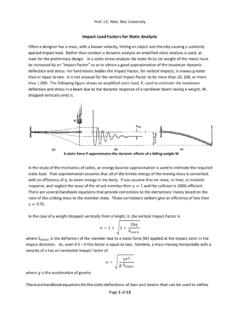
Impact Load Factors - Rice University
www.clear.rice.eduMaximum horizontal stress (143 MPa) is at the center plane top and bottom Of course, since the static model is linear there is no need to re-run the model (unless you want pretty plots). The static maximum fiber stress (SX) of 26.0 MPa could be multiplied by the 5.48 vertical Impact Factor to find the dynamic maximum SX stress of 143 MPa.
Related documents

Module 9 Stability and Buckling
web.mit.edu210 MODULE 9. STABILITY AND BUCKLING P L bcbcbcbc O (a) = 0 P L sin( ) bcbcbcbc O K (b) 6= 0 Figure 9.1: Equilibrium positions of a rigid bar on a torsional spring for a trivial solution ( = 0) and a non-trivial solution ( 6= 0). 2.Rewrite the equations in the case of small angles Solution: For small angles, sin( ) ' , hence: (PL K ) = 0
6 INTRODUCTION TO COLUMN BUCKLING - steel-insdag.org
www.steel-insdag.orgFig. 6(a) Strength curve for an axially loaded initially straight pin-ended column Elastic buckling Plastic yield λ = (fy/σcr) 1/2 σf /fy 1.0 1.0 Fig. 6(b) Strength curve in a non-dimensional form This is indicated by B-B1 in Fig. 6(a), which combines the two types of behaviour just described. The two curves intersect at C. Obviously the ...
Lateral torsional buckling and slenderness
newsteelconstruction.coma strut to fail in elastic flexural buckling compared with the elastic critical moment that defines the moment that will result in failure due to elastic lateral torsional buckling of a beam. The Elastic critical buckling (M cr) and Euler buckling (P E) curves are shown in Figure 4. The buckling moment of a section is affected by plasticity ...
12 Buckling Analysis - Rice University
www.clear.rice.edu6. Right click on the Part nameÆRun. 12.5.4 Buckling mode A buckling, or stability, analysis is an eigen‐problem. The magnitude of the scalar eigen‐ value is called the “buckling load factor”, BLF. The computed displacement eigen‐vector is referred to …
CHAPTER 3. COMPRESSION MEMBER DESIGN 3.1 …
www.egr.msu.eduBuckling is identified as a failure limit-state for columns. Figure 1. Buckling of axially loaded compression members • The critical buckling load Pcr for columns is theoretically given by Equation (3.1) Pcr = ()2 2 K L π E I (3.1) where, I = moment of inertia about axis of buckling K = effective length factor based on end boundary conditions