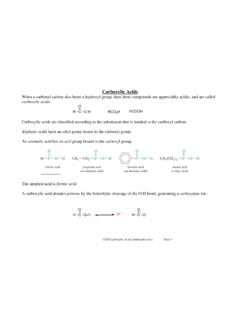
Carboxylic Acids
Carboxylic acid derivatives differ in the nature of the group bound to the acyl group. -OH is an acid-Cl is the acid chloride-OCOR' is the anhydride-OR' is the ester-NR 2 is the amide Nucleophilic acyl substitution can interconvert all of these different acid derivatives.
Download Carboxylic Acids

Information
Domain:
Source:
Link to this page:
Documents from same domain
Reactions of Aromatic Compounds - Rutgers …
crab.rutgers.eduCh17 Reactions of Aromatic Compounds (landscape).docx Page3 Bromination of Benzene Bromination follows the same general mechanism for the electrophilic aromatic substitution (EAS).
Infrared Spectroscopy and Mass Spectrometry
crab.rutgers.eduInfrared Spectroscopy and Mass Spectrometry Introduction It is fundamental for an organic chemist to be able to identify, or characterize, the …

Introduction to International Business - Rutgers …
crab.rutgers.edu1 International Business Definitions 1) IB field is concerned with the issues facing international companies and governments in dealing with all types of cross-
Organic Chemistry I - Rutgers University
crab.rutgers.eduCh01 Introduction (landscape).doc Page 1 Organic chemistry is the chemistry of Carbon and its compounds. Organic molecules constitute the essence of life (fats, sugars, proteins, DNA), and also permeate our everyday lives
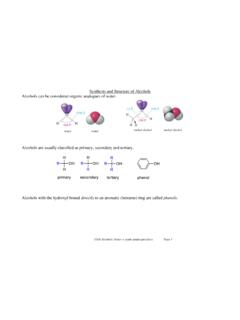
Synthesis and Structure of Alcohols
crab.rutgers.eduCh10 Alcohols; Struct + synth (landscape).docx Page 18 Other Selected Organometallic Reactions Corey-House Reaction This is a good synthetic way to join two alkyl groups together. A lithium dialkylcuprate reacts with an alkyl halide. The lithium dialkylcuprate is formed using the alkylithium reagent and copper (I) iodide.
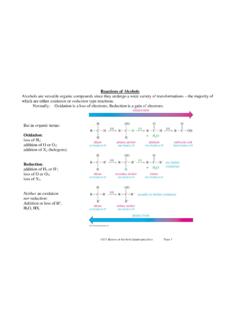
Reactions of Alcohols - Rutgers University
crab.rutgers.eduDehydration Reactions of Alcohols Dehydration of alcohols requires an acidic catalyst to convert the hydroxyl into a good leaving group – this is an equilibrium reaction. It is possible to force the equilibrium to the right (alkene) by removing one or both of the products.
Ketones and Aldehydes - Rutgers University
crab.rutgers.eduAlkenes can be cleaved by ozone (followed by a mild reduction) to generate aldehydes and/or ketones. ... Summary The base catalyzed addition reactions to carbonyl compounds result from initial attack of a strong nucleophile, whereas the acid catalyzed reactions begin with the protonation of the oxygen, followed by attack of the weaker nucleophile.
Organic Chemistry I - Rutgers University
crab.rutgers.eduBronsted-Lowry Lewis Arrhenius Definition (pre-1900) An acid is a substance that dissociates in water to give H 3 O+ ions. (Stronger acids like H 2 SO 4 were assumed to dissociate more than weaker acids like CH 3 CO 2 H). A base is a substance that dissociates in water to give …
Ketones and Aldehydes - Rutgers University
crab.rutgers.edualdehydes (two alkyl substituents vs. one alkyl substituent). (Aldehydes more reactive than ketones). Steric Reason The electrophilic carbon is the site that the nucleophile must approach for reaction to occur. In ketones the two alkyl substituents create more steric hindrance than the single substituent that aldehydes have.
Alkyl Halides - Rutgers University
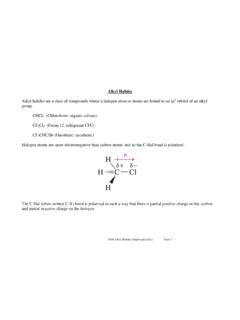
crab.rutgers.eduAlkyl halides are a class of compounds where a halogen atom or atoms are bound to an sp3 orbital of an alkyl group. CHCl 3 (Chloroform: organic solvent) CF 2 Cl 2 (Freon-12: refrigerant CFC) CF 3 CHClBr (Halothane: anesthetic) Halogen atoms are more electronegative than carbon atoms, and so the C-Hal bond is polarized.
Related documents

Organometallic Chemistry - uni-regensburg.de
www-oc.chemie.uni-regensburg.dereaction amounts to an alkylation of a carboxylic acid. • In the presence of a catalytic amount of CuI, Grignard ... Hydrolysis of the silyl enol ether regenerates the carbonyl group. ... allowing the preparation of functionalized derivatives.
12.112.112.1 Nomenclature and Structure of Carbonyl Group
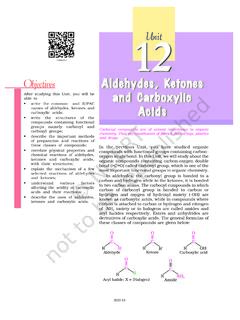
ncert.nic.inderived from the common names of the corresponding carboxylic acids [Section 12.6.1] by replacing the ending – ic of acid with aldehyde. At the same time, the names reflect the Latin or Greek term for the original source of the acid or aldehyde. The location of the substituent in the carbon chain is indicated by Greek letters α, β, γ, δ ...

Chapter 19: Lipids - latech.edu
www.chem.latech.eduglycerides: esterification, hydrolysis, saponification, and hydrogenation. 4. Understand the functions of prostaglandins in physiological processes. ... derivatives functions as chemical messengers in the body. ... because of carboxylic acid …
Synthesis of Carboxylic Acids
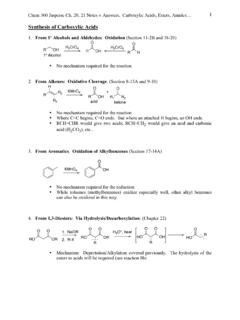
web.mnstate.eduChem 360 Jasperse Ch. 20, 21 Notes + Answers. Carboxylic Acids, Esters, Amides… 3 8. From Acid Chlorides, Anhydrides, Esters, or Amides: Hydrolysis (Section 20-8C) a) “Downhill” hydrolysis: From acids or anhydrides with NEUTRAL WATER alone

Thermo Scientific Crosslinking Technical Handbook
tools.thermofisher.comCarboxylic acid-reactive chemical groups Carboxylic acids (–COOH) exist at the C-terminus of each polypeptide chain and in the side chains of aspartic acid (Asp, D) and glutamic acid (Glu, E). Like primary amines, carboxyls are usually on the surface of protein structure. Carboxylic acids are reactive towards carboiimides.

AMIDES AND RELATED FUNCTIONAL GROUPS
webhome.auburn.eduderivatives of carboxylic acids in which the -OH of the acid has been replaced by -NR2 where R= H, alkyl, aryl, etc.): Like amines, amides can be classified as "primary", "secondary" or "tertiary" depending on the degree of carbon substitution on nitrogen: Amides may also be sub-classified as aliphatic, aromatic (i.e. anilides or benzamides) or ...

Caboxylic acid Derivatives - Rutgers University
crab.rutgers.eduCh21 Carboxylic acid Derivatives(landscape).docx Page 1 Carboxylic acid Derivatives Carboxylic acid derivatives are described as compounds that can be converted to carboxylic acids via simple acidic or basic hydrolysis. The most important acid derivatives are esters, amides and nitriles, although acid halides and anhydrides are also derivatives (really …
Fatty Acid Biosynthesis - California State University ...
www.csun.edua complex called as fatty acid synthase (FAS). • The product of FAS action is palmitic acid. (16:0). • Modifications of this primary FA leads to other longer (and shorter) FA and unsaturated FA. • The fatty acid molecule is synthesized 2 carbons at a time • FA synthesis begins from the methyl end and proceeds toward the carboxylic acid end.